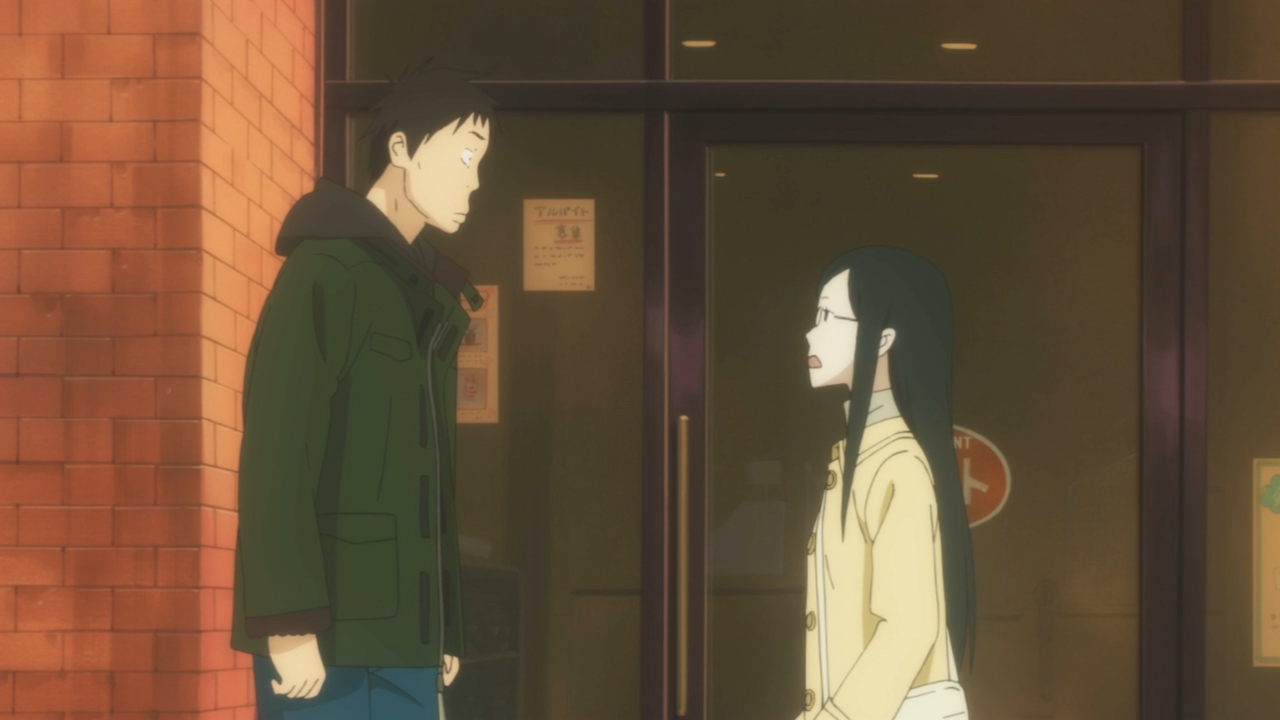
We finally get to meet Rin’s mother this week, but she’s not such an ogreish character as we might have expected.
“Am I raising Rin or is she raising me?”

That’s so mind-blowingly deep!
This reminds me of when I studied “The Taming of the Shrew” in high school English. The teacher just kept repeating the same question over and over ad nauseum: “Did he tame her or did she tame him?” Now, follow this up with some very unsubtle series of winks and nods, and you can understand why I felt so exasperated that day. Oh Mrs. Carpenter, we get it — stories have a deeper subtext if we would just try to think critically. It, however, takes a bit of the magic away when you have to spell things out. That’s why you never spoil the mystery, no matter how much people might kick and scream for the “solution.”
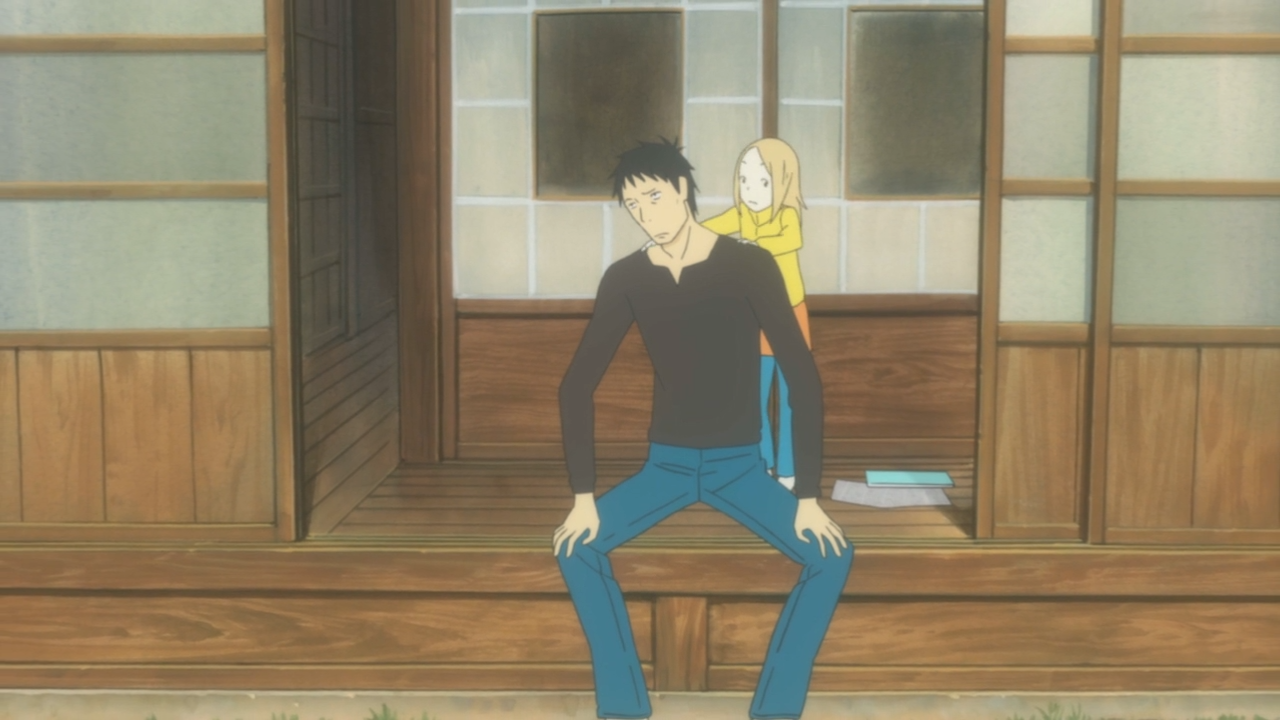
This entire episode is all about growth or the lack thereof in the anime’s characters. So there was, naturally, no reason for the anime to pose such a heavy-handed question at the end of the episode.
“Don’t talk so glibly about such an important thing!”
How many times do you think Daikichi’s mother has said the same thing to her son as she’s raised him over the past three decades? Isn’t that what we all did as young people? — constantly make big decisions with glib talk. Of course Daikichi isn’t young anymore; Daikichi isn’t actually talking glibly either. He understand the responsibilities he has to assume to properly raise Rin. But will his parents ever look at him as anything but their son?
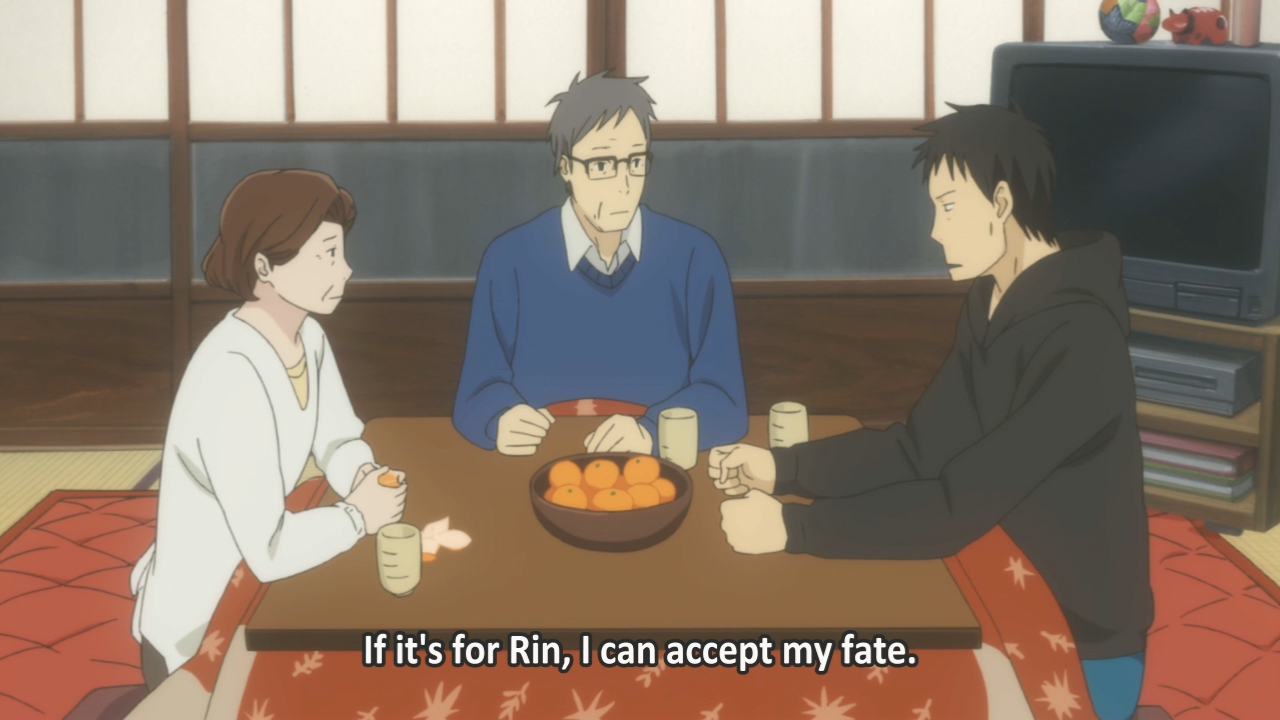
A lot of people think “Usagi Drop” is boring because the plot is rather slow and relatively little occurs on the surface. I’ll grant that, but what draws me into the anime is the little things left unsaid (most of the time). With Rin’s help, Daikichi is definitely growing up, but how does his parents come to realize this? Certainly not by Daikichi putting his foot down and whining, “Mom, I’m an adult now~!” By simply assuming full responsibility of Rin, Daikichi and his parents have a watershed moment around the kotatsu. In a way, nothing’s happening in this scene, but in another way, everything’s happening all at the same time.
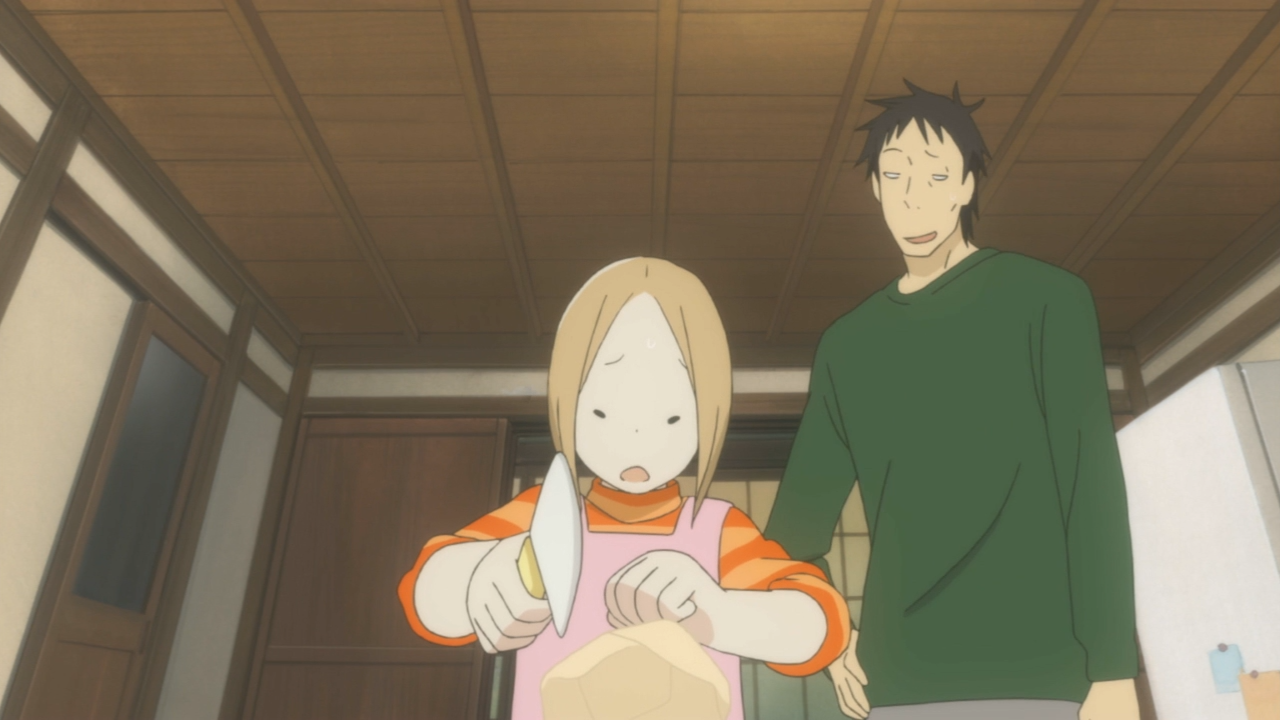
“You know what, I want my own knife.”
Throughout this episode, the anime repeatedly juxtaposes Rin’s growth against her mother’s. Rin wants to practice using a knife, she no longer wants to sleep next to Daikichi even after a nightmare, and hell, she’s even hesitant to sit in his lap despite the fact that she’s only six years old.

On the other hand, Masako, Rin’s mother, gets nothing but a child-like portrayal: a freckled face stuffing itself full with sweets — parfaits and pudding — and a refusal to take responsibility for Rin.
“And making the decision for her is what would be cruel.”
The anime also compares the mother to Daikichi. Daikichi accepts his fate, or so he says, and takes full responsibility of Rin. As a result, he is forced to grow up regardless of whether he ever wanted to or not. Masako wasn’t ready to grow up so she left her child behind. Oh, she claims that she couldn’t both take care of Rin and handle a job on her own, but isn’t that what Daikichi is trying to do?

Unlike Daikichi, Masako only seems to make unilateral decisions. After all, she assumed that leaving Rin was the best course of action regardless of the child’s feelings. She also requests from Daikichi that Rin adopts his surname without considering whether or not the girl even wants to be called anything other than ‘Kaga.’ The line “Don’t talk so glibly about such an important thing!” should’ve been directed to Masako instead.
“Either way, I’m good for nothing.”
Still, I can’t get too judgmental about Masako. She looks like she’s still just a child, after all. So many mothers and fathers leave their children behind — this doesn’t excuse Masako’s actions, but hell, it’s obviously not easy for anyone to grow up overnight. Who are we to cast stones at a poor girl like Masako? Sure, Masako had nine months plus to realize that she was having a child and prepare herself for this coming-of-age event, but nine months in a person’s life is but a drop in a bucket. Masako’s immature, but it’s not as if the world is equipped to embrace young, single mothers like her.
Changing a woman’s name
Uh oh, not another gender issue topic! Y’know how I just can’t help myself!
“I’m a woman, so I don’t have any great affection or attachment to my family name. … Rin’s a woman too, so she probably feels the same way.”
“Well, she’s a girl, so her family name will change anyway….”
The quotes above are from two different women in the same episode. Of course, I don’t care whether or not my girlfriend takes my surname when she marries me — hell, I don’t even care if my kids take my surname or not, but things are probably different in Japan. I dunno, I’m not an expert on such matters. I just think the two quotes above are really weak reasons to justify changing Rin’s last name from ‘Kaga’ to ‘Kawachi.’
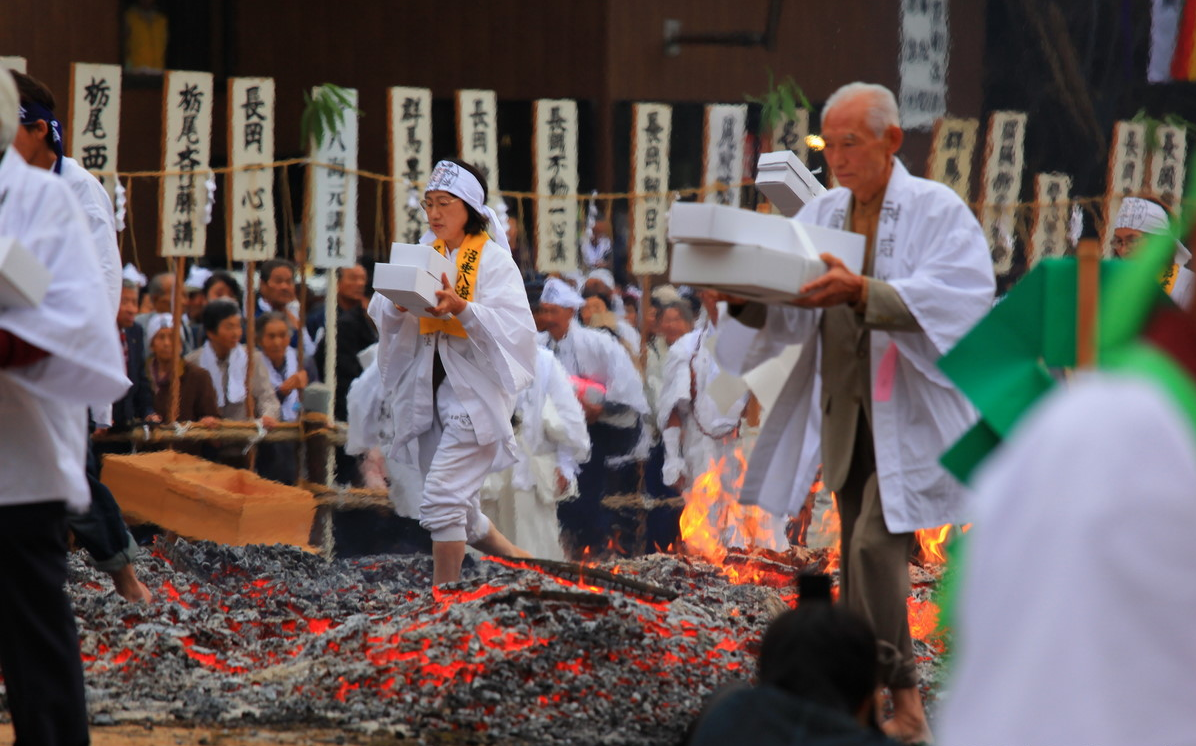
Hey, I understand the women’s underlying sentiment: kids can be so cruel and they might pick on Rin if they think she’s adopted. At the same time, however, I find it a little too overprotective of Rin. It’s like walking over hot coals — it sounds and looks painful so I can understand why someone would warn me against it. But if we were always so overprotective of ourselves, we would never realize just how cool it is to firewalk. What we simply need is the right foreknowledge or preparation and firewalking becomes a piece of cake. It’s the same in Rin’s case.

If Rin keeps her surname, sure, the kids at school might taunt her and that would probably hurt. At the same time, however, with the right foreknowledge or preparation, she can understand where those comments are coming from and that they ultimately do not matter. There might be a little pain at first, but the payoff is that Rin gets to keep her surname, i.e. a part of her identity. Essentially, I just think it’s unnecessary to change the poor girl’s name.

I loved, loved, loved this episode. It’s the little things: from the background chatter where Daikichi met Rin’s mother, to the way this woman absent-mindedly played with her hair. Also, that whole non-verbal scene where they go through the graduation. There are just so many subtleties that really made me feel like I’m peeking into another person’s reality. They’re really showing more and more of Rin’s character, too.
Some things made me ponder, though: the way Masako spoke of Daikichi’s grandfather sounded like his concern for Rin was similar to Daikichi’s own. Maybe she wasn’t his daughter, after all? I couldn’t picture those two together, anyway. There’s also the way Daikichi takes Rin’s opinion into account, even though she is only a child. I praise his respect for her, but this –along with Rin keeping his relation to her at arm’s length– could be foreshadowing the rumored ending…
I guess it slipped my mind, but I was going to talk about what the man was saying to Masako before Daikichi realized who and where she was. He was like “Give the characters two or three problems each.” Masako responded with “That wouldn’t be overdoing it?” That makes me wonder if it’s some meta-commentary on the structure of these types of stories. What would Daikichi’s second and third problems be anyway (the first is fairly obvious)?
From the anime’s own portrayal, dude sat in a chair all day. I’m not sure how virile he could have been. Plus, Masako doesn’t seem like someone who would really go for geriatric men, but who knows.
Of course, I really am struck by the fact that Daikichi never once stopping to ask whether or not Rin is even his grandfather’s daughter. Who would the question really have offended anyway?
Yeah, it doesn’t look keen, but I heard the actual anime adaptation is short so I’m hoping we never even get to that point. Hopefully the season will just end on her finishing kindergarten.
I think they made it fairly obvious that Daikichi’s grandfather wasn’t Rin’s father. Firstly, their hair colours don’t match. Rin is blonde but both the grandfather and Masako had black hair. Secondly, at the end of the episode they show a young man living with Masako who happens to have blonde-ish hair.
This adds a very progressive tone to the story. Daikichi’s grandfather took a young, unwed mother into his house and raised her child as his own. Even in Western society this would be viewed as being extremely unconventional. It also adds another dimension to the whole “should Daikichi adopt Rin” issue. If Rin went to live with Masako, she would have the chance to grow up with her real father and mother. It forces you to consider the question of whether nontraditional families are equal to traditional ones.
Also, I’ve heard that in Japan, women are legally required to assume their husband’s name. Only in very particular cases are they allowed to keep their name. In that context, Rin’s loyalty to her name and Daikichi’s acceptance of her decision is also quite progressve.
I doubt that. There are plenty of Western stories of people taking in children who aren’t blood related to them. This might be progressive for Japan, but it doesn’t seem all that rare to me in the West. Besides, this isn’t a competition anyway.
Hey, E Minor, I know this is completely unrelated to this article but, can you add back where the lines come from in the Say What? section? I like knowing where the stupid stuff comes from.
I don’t know where each and every screenshot comes from, however.
At least the idea behind Rin raising Daikichi and helping him grow is profound.
Not really.
On Rin changing her last name.: Here’s a case where I understand and support you raising the gender issues inherent to the situation, as even the character dialogue (which you quoted) emphasizes the gender aspect of the discussion (i.e. if Rin was a boy, the arguments made would indeed be entirely different, or possibly even non-existent).
Rin’s current last name is clearly important to her, and hence for that reason, I think it was for the best that she kept her name as is.
Also, whether or not a person’s last name will be changed due to marriage, or (virtual) adoption, is a legitimate question, and it shouldn’t be simply assumed that a person’s last name will be changed in such an event.
However, and here is where I differ with you a bit, I think that a family name is called a family name for a reason. That reason is because it is that family name which signifies the bond between family members. I’m not saying a person would love his or her daughter/son any less due to a difference of last names, but just that sharing the same last name can help to show (both to other family members, but also to people outside of your family) the fact that you are in fact family. In other words, I think it can have some psychological benefit in keeping the family feeling tight, and having a shared sense of family identity (think about families on the show “Family Feud”, and how they all identify as a family via their most commonly shared last name).
As such, I do think that it’s probably ideal for children to have the same last name as their parents. Should a married couple have children, I think it’s also ideal for the couple to have the same last name (whether that involves one spouse adopting the other’s last name, or both going with a hyphenated last name that fuses both last names together).
Now, it’s certainly no big deal, but I think that there can be some benefit to every member of a nuclear family having the same last name, and that would have been a much more convincing argument to me than the, admittedly, slightly gender regressive arguments made in this episode.
I don’t value the family name as much as you do. The bond between family members should be signified by the actual love and care between family members. Hell, the family name didn’t always carry such a positive connotation. For most of human history, a family name was a way to designate property, i.e. which of these kids should be working on your side of the field (you can cynically interpret your Family Feud example in a similar fashion, as well). It is only recent history that it has become mostly a bloodlines sort of thing, but even then, a mostly patriarchal concept.
But the thing is, you can love and care for a friend that you bear no family bond with. So loving and caring alone can’t truly signify family, in my view.
I think that you’re a bit too quick to dismiss the positive aspects of all members of a family sharing the same family name due to how you associate family name with “patriarchy”. But the fact is that family members can all share the same family name without either parent giving up his/her last name, due to the hyphenated option.
Family doesn’t always supersede friendship, however. I don’t subscribe to the view that blood is thicker than water. I have friends I cherish far more than most of my relatives. As a result, how much water does this ‘family’ concept hold? If we dilute the concept even further so that we can include friends we cherish, so much for that family name then….
No, you misunderstand me. I’m stating that your notion of familial bond through the sharing of a common name is a fairly modern concept. It is similar to how people defend the sanctity of marriage as a union only between man and woman — that, too, is a fairly modern concept. I agree — people can derive something positive from sharing a family name, but this is merely practice and a recent one at that*; it isn’t necessary and there’s no reason to think it’s ideal either.
*In the past, the people who often bragged about family names were usually those of the upper class. They asserted their superiority over others through lineage, with the family name being the most apparent marker.
I will agree with Ryan R about the gender issue in naming: here, since we talk about modern times, criticism has meaning. We live in the 21rst century, Japan is becoming more Western and such things said aren’t excused (in contrast to Ikoku case, where I think you decontextualize things and your accuses and mockery are a bit anachronistic. As a woman I sure find annoying and sad examples of female submission, yet each (past) era and society has its good and bad customs, that I can’t change. I can only act upon the present.)
On the other hand I’m absolutely with you about the family name as sth meaningless. We don’t choose family and that can be associated with very unpleasant people and situations. Friends is the family we choose says a saying. We choose to cherish names that are important to us. For Rin her father was precious and that’s why she wanted to hang onto it. As a way to show her deep love and respect. Daikichi is precious, sure, but her surname is the only thing that she has from her deceased father. It’s her choice that matters. It’s what you put value on. The bad thing with the other women talking so matter-of-factly about their surnames is that they don’t value their feelings towards what is part of themselves and what is important for them. Acceptance needs struggles. Life isn’t easy for whomever wants to live as being the ‘real thing’. Choosing the easy way out is cheap. Don’t decide for others ‘for their own good’.
One last thing: Masako did have sex with the gramps. I used to think the same: it can’t be, it can’t possibly be that this baby desired an old man with a wrinkled penis and had a kid with him, but that’s the ugly truth (there’s no other discussion stating otherwise in the manga. Plus *spoiler* that lad at her place is her new boyfriend. If he was the father of the baby, we would get at least a comment from him about the whole issue)… Sure work – what’s more the manga industry- is tough to handle, but shouldn’t she have thought this before bearing a child that she was so willing to abandon? Cough cough there’s a wonderful thing called condom and another super awesome thing called pill. Brains little miss? Where were you when it was raining brains? That’s the only thing I can’t forgive her.
Look, guys, the anime is made in the present. We didn’t dig up an anime from the 1800s (which would have been impossible anyway). It’s not like I’m criticizing “Madame Bovary” for having Rouault hand Emma off in a marriage. We’re talking about a studio in 2011 making a conscious decision to produce an anime about a young Japanese girl being sold to a Parisian to work as a maid and cook. The anime could have focused on a wide variety of topics; after all, the differences between Japan and France are huge. The studio, however, chose to have a cute girl cook.
I’m not accusing anyone of explicit sexism. I’m just saying that there are troubling implications in the anime, implications that the studio could have easily avoided had they been a little more self-aware about the world they exist in. There’s nothing wrong with historical accuracy, but it’s not like late 1800s women were doormats either. It wouldn’t have hurt “Ikoku Meiro no Croisée” to offer a balanced viewpoint.
I’m treating the anime adaptation as separate from the manga and until the anime adamantly asserts that Masako has slept with Daikichi’s grandfather, I see no reason to believe this.
People screw up, accidents happen even when you wear a condom, sex education might not be up to par, etc. There are too many variables unaccounted for.
We’re talking about a studio in 2011 making a conscious decision to produce an anime about a young Japanese girl being sold to a Parisian to work as a maid and cook.
What more realistic senario could they choose? If they transfered it to nowadays that these differences have decreased it would be sth very typical. Indeed they went for moe. I can’t deny it. Yet the other options seem unreal to me (weren’t they doormats? if I remember well it’s only early 20th century that women could open their own shop in France) and they would produce less impressive results imho. Plus the girl came as poster girl. Not a cook. It just ended up otherwise. Anyway, that’s an Usagi post.
People screw up, accidents happen even when you wear a condom, sex education might not be up to par, etc. There are too many variables unaccounted for.
Irresponsible is still irresponsible. Especially when you become an adult. And there’s the next day pill. Oh and the abortion option as well. Depending on the love of a family is too risky. Daikichi is an exception. Rin would have ended in a nasty orphanage 99,9% .
You keep talking about the anime as if it’s very realistic in the first place, yet all you do is make conjectures. You assume that an old man would be too prideful or nationalistic to come to France. You assume that an older Japanese woman could never leave her family behind. And yet somehow, you think a tiny, little girl would produce the most “impressive results?” Come on. It’s merely a cute show. It’s not remotely thought-provoking. This is what you’re defending.
You’re not seeing the bigger picture that I’m trying to get at. It’s not just that she’s a cook. It’s that Yune has no dimension to her character beyond cooking. Cooking by itself isn’t bad. Lots of women cook and there’s nothing wrong with that. But all Yune does is cook and clean and otherwise stand by Claude’s side while she awaits her latest orders.
The anime doesn’t say how old she is. She could have been a teenager when she had the baby. How do you know she had any control over Rin being conceived? What if the condom broke like I previously suggested? What if she was coerced into sex? Even if you think she should’ve gotten rid of the baby, the grandfather convinced her otherwise. It wouldn’t surprise me if she listened to an adult who she thought knew best, an elder especially.
Just started this series, and I’m loving it already.
Masako cares for Rin alright, but to what extent, I really wonder. Not that picking yourself to extend your career over your child is an easy decision, but she’s trying to pass it off. Of course, she’s not that mature yet, so there’s many conflicting issues raising up in my head. Hard to judge…mixed opinions, to say the least.
I think that keeping her name was a good decision, so she could remember her family and keep her identity. Changing her name in the future is, well, a long future to go, anyways.
“Maybe she wasn’t his daughter, after all?”
I am resisting every urge to spoil myself and search up the novel right now.
“Am I raising Rin or is she raising me?”
To see both characters “taking care” or changing each other touches my heart. People change and make sacrifices for the sake of others. I’m sure my parents had their share of troubles. Seeing Daikichi changing his habits (cutting down on the drinking/smoking/behaviour) and Rin becoming a bit more open was a great experience. Of course, my analysis skills aren’t that great yet and I probably need a watching over. For example,
“Daikichi should just stay Daikichi.”
I wasn’t quite sure what to pull out of this. Sure, he should stay who he is. But as who? Not a father, not a brother, but as Rin’s guardian, or her special person?
Nyoron said to me, “Masako doesn’t care for Rin.” I disagreed however: “She loves Rin. She just loves herself more.” I think this makes sense. Young people like Masako are just a little more self-absorbed than someone like Daikichi and I’m not trying to be judgmental. I’m the same way; I don’t want children at the moment because I know a kid would interfere with the life I currently want to live. Masako’s pretty young and a child’s a huge burden — she can’t go out at night, she can’t earn a living for both of them as a freelance mangaka, etc.
It’s really hard to answer your question without spoiling the manga. Plus, I want to see where this adaptation goes. To a certain extent, an adaptation should separate itself from the original material, so the same statement from Rin in the anime might not carry the same meaning as it might’ve in the manga. Judging by the events of the manga, I hope not anyway.
“Young people like Masako are just a little more self-absorbed than someone like Daikichi and I’m not trying to be judgmental.”
Good point. Guess having a kid coming into my life would be one of the last things I want currently, just when I started university life.
“It’s really hard to answer your question without spoiling the manga.”
Urgh, I see. The urges grow…hopefully, the manga and the anime would both end up having their own awesome take on it.
2 quick things rather unrelated to the content of this post:
1. You mentioned in an earlier post how Daikichi’s father doesn’t seem to have a role in this anime but I wondered if he was not actually there to show what kind of home life Daikichi might have grown up with. I just laughed at how impotent he seemed when he tried to calm his wife with an orange and she just stared at it for a moment and then continued on. Perhaps it’s supposed to show that Daikichi was raised in a more strongly matriarchal household. Which perhaps impacts how he views raising Rin.
2. Yukari’s slacken-faced, apathetic son of hers was awesome during the Nursery school graduation. That kid could not have cared less.
1. Well, Japanese households aren’t as patriarchal as one might think. Since most fathers worked all day long, they never really see the family nor involve themselves with the major domestic decisions. They provide the buying power but do a relatively small percent of the actual buying.
2. I thought he looked annoyed.
Even if they aren’t involved in the major domestic decisions isn’t the father traditionally still viewed as the head of the household? My implication was that might not be true for Daikichi’s household.
There’s a difference between authorized/symbolized power and what actually occurs in practice. The husband is the authorized or symbolic head of the household, but when it comes to domestic affairs, it should come as no surprise that Daikichi’s father plays a rather insignificant role:
“Women’s control over the household. Urban Japanese housewives have inherited the shufu’s traditional rights and power over the household. Women enjoy relative autonomy under the conditions of sexual segregation of social spheres. As far as family issues are concerned, husbands rarely interfere with the decision making of their wives, which sometimes extends to the realm of kinship relations, investments in children’s education, and even the buying of houses. The scope of women’s power in the household extends to any issue of concern to family members, for it is they who are responsible for the household. In the Western tradition, economics is more the concern of men, but not so in Japan.” — Chizuko Ueno, “The Position of Japanese Women Reconsidered”
I’m well aware of a difference between authorized and symbolized power but it doesn’t mean that symbolized power isn’t without it’s equal share of the weight. If the male of the family is traditionally seen as the breadwinner and traditionally the idea that their child should have a positive image of that figure is enforced by the mother, the father still has almost absentee power of over the child. Not to mention the more traditionally chauvinistic attitudes Japanese men have held toward women up until the 80’s.
I personally wouldn’t find it strange that Daikichi’s father is aloof. However he’s more than aloof. He’s completely impotent. Whether it’s the result of his retirement or whether he has always been a bit of wet blanket is the question that comes to mind.
Which is why i felt the scene where he tries to placate his wife was amusing. Sure it’s a comic relief moment but you don’t think it’s possibly characterizing Daikichi’s father as well? Is the rather blase feel to Daikichi’s father supposed to be a representation of an everyman Japanese father?
I don’t think it’s as significant as you think it is.
Yes, I think it was characterizing the father. I’m just saying that I don’t think it’s any different than how fathers often appear in Japanese media. They are either absent or, as you claim, impotent. I instantly think of “Tokyo Sonata” where the father even tries to yell and physically abuse his son for disobeying his orders, but it’s all for naught; he has no power.
I never wanted to come to contention on the significance of the gender roles in Japanese families. I’m more interested in relating Daikichi’s father to the rest of the Usagi Drop story because I think his behavior is potentially meant to characterize Daikichi or characterize the type of family Daikichi comes from.
I’ve not seen Tokyo Sonata so I can’t say whether I believe it’s different from how father’s appear in Japanese media. However I don’t think an impotence that produces abusive rage would be a good characterization for Daikichi’s father. What I mean to imply is he’s just a bit of a wet-blanket personality. Perhaps, in context of what we were talking about before, Daikichi’s father may not even be the symbolic figure of the family.
Clearly, our lines of communications are crossed somewhere. I’m not saying that Daikichi’s father comes anywhere close to rage. i’m just saying that impotence in the portrayal of Japanese fathers seems common to me so I listed one other example. I’ve seen little media — films, live dramas, anime, etc. — where the father is actually an active participant in the domestic affairs of the family. I don’t think Daikichi’s father’s portrayal is as uncommon as you paint it to be. I do believe most fathers hold mostly symbolic power in the household and very little practical power. At this point, I’m going to leave it at this and just agree to disagree.
Pingback: Usagi Drop: Walking alongside parenthood | ganbatte.