
The Code Geass comparisons are inevitable, but I think Guilty Crown‘s problems go deeper than this. Before we get into the meat n’ potatoes of what exactly problematizes Production I.G.’s latest offering — and a noitaminA one at that — allow me to make it clear from the very start that a lukewarm reaction isn’t necessarily a negative reaction. Is the first episode of Guilty Crown interesting and enjoyable to watch? Well, it certainly kept my attention from start to finish, and there’s just so much, much worse out there. Still, Guilty Crown is, in my opinion, a microcosm of the bigger problem facing the fall season of anime: it just doesn’t excite.
A Production I.G. anime almost always look good. Even when the animation isn’t technically impressive, the art direction is seemingly always pleasant on the eyes. Guilty Crown isn’t, however, one of Production I.G.’s warm and fuzzy shoujo offerings. Guilty Crown is a return to the sleek and sexy quasi-futuristic setting that we saw in Ghost in the Shell: Stand Alone Complex and, to a lesser extent, Eden of the East. But the anime isn’t just pretty to gawk at. Even the opening song sounds lovely, and I don’t often praise anime soundtracks. So often in J-pop, singers painfully finger our ears with a shrill, prepubescent voice that everyone calls kawaii. Don’t get me wrong — the opening song isn’t fucking Adele by any means, but in comparison to most J-pop, the ballad sounds downright sultry.
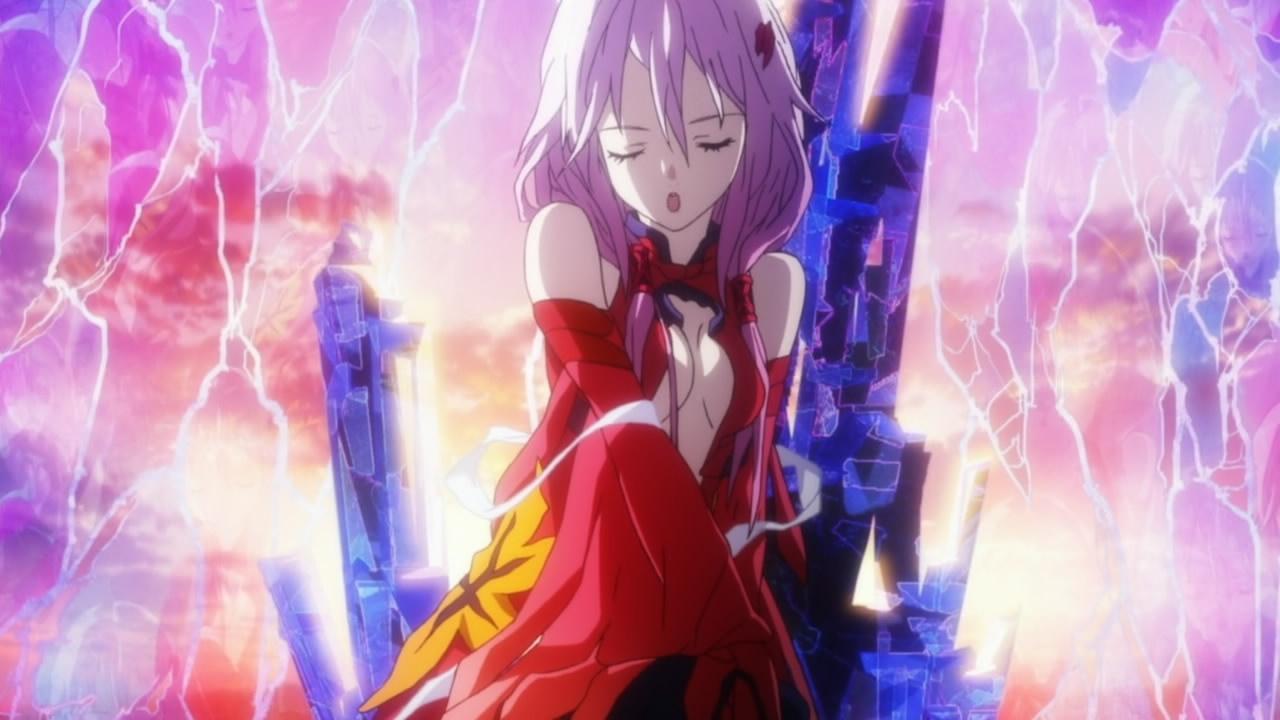
For Production I.G. to churn out technically superior visuals and audio isn’t, however, anything new or alien to most anime fans. The problem with Guilty Crown is that once you get beyond the shiny outer coating, the yolk just isn’t as rich as it could be. Guilty Crown is penned by Yoshino Hiroyuki, a writer who has worked before on Code Geass. The latter’s influence on the former is seemingly blatant from the start, but like I’ve said at the beginning of the post, the problems go deeper. Of course, it doesn’t help to say that both shows feature flawed protagonists as almost every protagonist in any story starts off weak. The point is that he or she will learn, grow and change. As a result, I don’t mind Shu’s initial social awkwardness and loser-ish sensibilities. For him to be a compelling hero, he needs an arc. In other words, if he’s awesome right off the bat, what would really be the point of watching his story?
You might then point to the fact that Inori bestows power upon Shu (complete with enigmatic visions but nothing analogous to a naked Suzaku just quite yet) in the middle of a heated confrontation much like how C.C. made Lelouch her knight. You might then bring up the fact that both anime seem to be obsessed with the threat of Japan being occupied by foreign sovereignty. In Guilty Crown, an “Apocalypse virus pandemic” forced Japan to rely on the help of other nations. Although foreign aid was readily supplied, it hasn’t been quite so eager to leave. There’s a sense here that there are lingering worries in Japan about the loss of its cultural and political identity due to the encroaching threat of globalization, but of course, I won’t draw any deeper conclusions from just one episode. In any case, you might thus see this as a clear similarity between Guilty Crown and Code Geass.
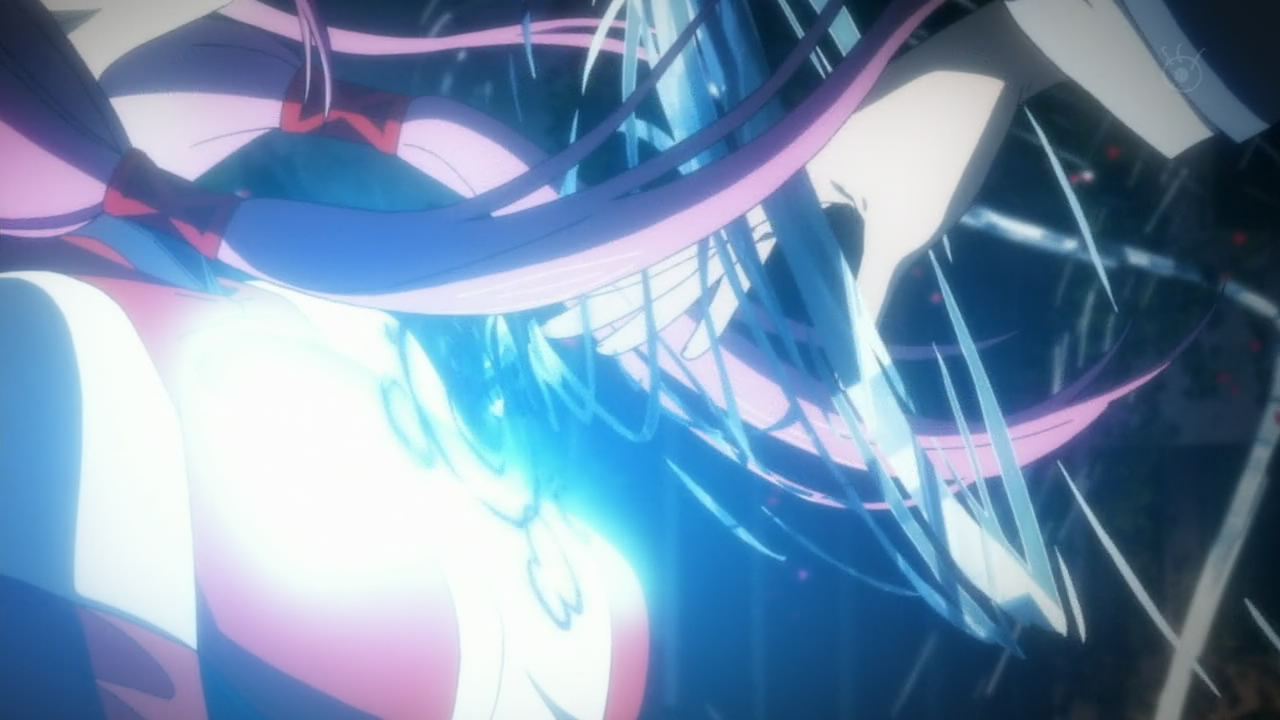
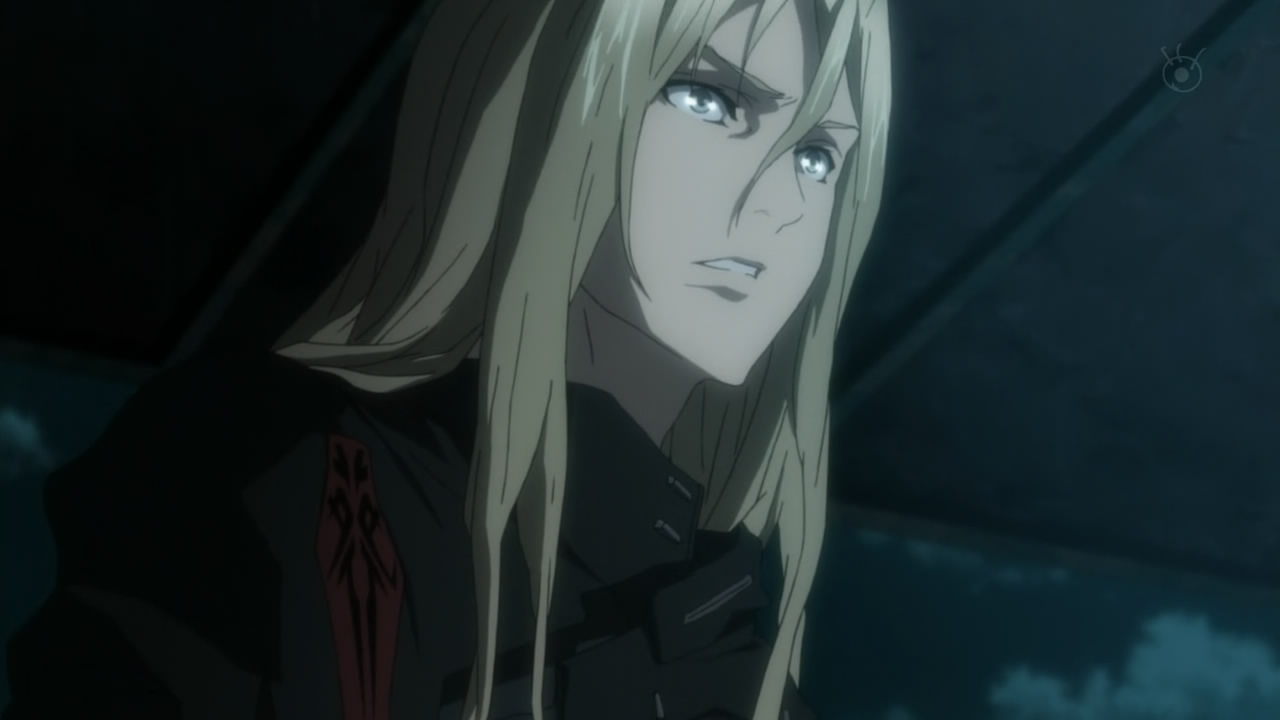
Still, for women to act as a conduit for male dominance is nothing new in anime or any other medium for that matter. Rebellion stories like the ones we might find in Guilty Crown or Code Geass are also nothing new and revolutionary. It has all been done before and this is Guilty Crown‘s biggest problem; it all just feels like déjà vu. The most striking moment of realization for me is the shot of Gai at the end of the episode. Gai is first introduced into the story accompanied by heart-pumping, high-adrenaline music. He quickly disposes of petty thugs without even breaking a sweat. Gai is thus cool and suave — a leader and a foil to the wimpish Shu. When Shu — with Inori’s assistance — draws the proverbial sword from the stone at the end of the episode, he starts to kick major ass of his own. The anime then cuts to a shot of Gai looking rather worried from a distance.
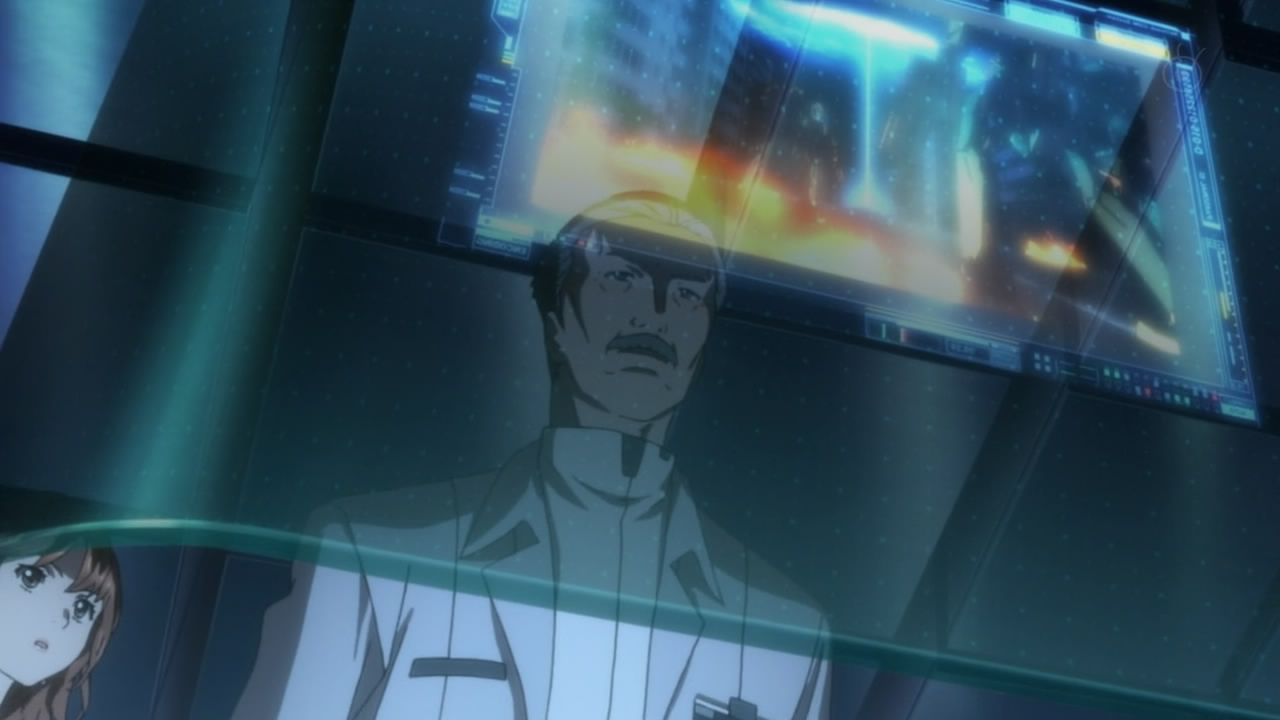
Why is this shot of Gai significant? Well, we should contrast it with the other reaction shot that the anime provides us. Here, we see almost apathy in the bald guy’s face. Clearly, the man isn’t exactly phased by what he sees, and why should he be? It’s just the first episode, after all. But Gai looks troubled as if it’s just the first damn episode and yet his authority — his superiority — has already been superseded by an upstart’s sudden ascendency. Unfortunately, we’ve seen this sort of power struggle — a quasi-love triangle — before in countless of previous anime; Berserk, Escaflowne, and Eureka Seven are the three that immediately came to my mind.

Of course, it is just the first episode. Maybe Gai won’t pull a Holland and be all mad that Inori (Eureka) chose Shu (Renton) over him. Maybe he’ll be a Kamina to Guilty Crown‘s Simon instead and they become fast buddies from start to finish. I just, however, can’t shake that shot of Gai at the end of the episode from my mind. I don’t see a leader who is pleased by the results before him; I see a man haunted by the jealousy of his previous incarnations. And like Gai, Guilty Crown‘s first episode doesn’t suggest a revolution of the genre. Hell, it doesn’t even suggest an evolution either. Rather, Guilty Crown begins as though the writer has trapped the ghosts of previous anime in a shell and asked Production I.G. to give it a nice, shiny coating.

I haven’t watched Code Geass (other than random episodes from when I’ve been in the US), so I guess this won’t affect me.
Well, I did say it goes beyond Code Geass. Guilty Crown so far is pretty much a copy of countless anime.
I wonder if Guilty Crown has a vision other than putting together all these cool shows together and giving it more budget. I see you pointed out how there seems to be this fear of globalization and being dependent on foreign aid, but it’s hard to tell if this is just so it can slightly differentiate itself from Code Geass’ setting. Oh well.
One thing I’ve always remarked about Production I.G. is that they make some slick, sexy anime, but their stuff often lacks ingenuity. So I wouldn’t bet on Guilty Crown flipping the genre on its head. Still, that doesn’t mean it can’t be a fun show to watch. It’ll just be like going out to eat a boring old beef wellington. This restaurant will execute the beef wellington really goddamn well, but we all know what a beef wellington is. Oh, here’s the obligatory sides of starch (usually potato) and sauteed greens (usually spinach).
On the question of media depicting a country under threat of sovereignty or assimilation, would you say the same reflection of cultural fears in art applies to games like Homefront, where a (more) militarized Korea occupies the United States?
Hell, that’s not even the most common example… apparently somebody forgot to tell video game writers that the Cold War ended decades ago, because we’re still fighting invading hordes of evil Russians in the overwhelming majority of military-based shooters. Of course, if I’m going to complain about that then there’s the even more pertinent issue of always playing as a US soldier. Where’s my WW1 Canadian stormtrooper FPS? :/
Well, you specifically mentioned video games. I will presume that you think the threat of military assimilation in “American” (America’s way too big and diversified to really group under one broad, umbrella term) culture is confined mostly to video games and maybe some extreme right wing literature. Of course, we’re always bitching about illegal Mexicans, but corporate interests will ensure that these folks continue to stick around. It’s nothing but a vacuous talking point for politicians come election season. But back to video games, I don’t want to open up the whole “Are video games art?” can of worms, but I will say that video game narratives make up a very small sliver of the overall “American” culture. It can’t really be said that these stories contribute anything at all to the overall “American” ideology.
Plus, there’s also the fact that people play these games to frag and m-m-multi-kill other players. Unlike, say, an anime, the majority of us don’t sit down to the latest Call of Duty to ponder and pontificate over its story’s themes and values. On the other hand, there are plenty of stories, films, and anime in Japan depicting an alt-ish universe where a foreign force occupies Japan. It’s almost always a Western threat too.
Yeesh, all these words. Bottom line is that I think marketing fuels the WW2 FPS clones more than anything else and the “stories” in these games are nothing more perfunctory. When it comes down to it, video games turbonerds are more obsessed with realism and grittiness than anything else. And how do we best attain these two aforementioned qualities? By borrowing directly from history, its settings, its guns, etc. You could do a futuristic FPS but then you’d have laser guns and armor and whatever. For a long time though, we did churn out those clones such as Quake, Unreal, etc. Halo’s just the mainstream iteration. With physics doodads and 128-man battlefields, the latest craze is pushing realism so we now have WW2 clones. Maybe the trends are cyclical and we’ll be back to copying futuristic games in no time.
Meanwhile, the fact that Japan continues to have no standing army will, in my opinion, always give us premises like Guilty Crown.
I won’t touch the art debate what with my inherent bias, but as the dude who has to make the endless numbers of guns for these games, you can see why I’m weary of the same old recycled premises :P.
Anyway, with Deus Ex: Human Revolution, Hard Reset, Tribes Ascend, Mass Effect 3, and Syndicate all coming out in such quick succession this quarter, I’d almost say the marketing machine is trundling back towards science fiction (or at least cyberpunk) already. The trends seem quite cyclical indeed.
The art debate depends entirely on the developers. If they keep churning out threadbare narratives and gameplay that caters to only what sells the most units, video games won’t ever cross that desired threshold. Books aren’t defined solely by fun. Some movies seem expressly made to convey a depressing story. The same holds true for music. I thus don’t understand why video games are almost always about fun and happy endings.
I honestly could tell from the synopsis of this series that it wasn’t going to be anything new (and the director/writer behind the show did not give me much confidence). I think a lot of people were so mesmerized by how pretty the trailer looked. I’ll give the series that it does look pretty.
Unless there are some major twists along the way I would say this series might be entertaining if you don’t expect too much.
There’s bound to an interesting twist or two. I’m not impressed by the first episode, but I wouldn’t write it off yet. Which is why my original title was just “Derivative” but I changed it in the end.
I haven’t seen this ep yet. So now I’m really intrigued by the themes this series will bring up and explore. I rather like this blog very much. I’ve been perusing the anime blogosphere for a bit trying to find someone who takes an analytical approach to anime. Often times a show, while from an average viewer standpoint, will be very good and exciting to watch but will also present problems within the story in regards to gender portrayals, racism, sexism, homophobia, etc and I hate when bloggers gloss over this fact and dismiss them in favor of how pretty everything looks. I mean, it’s possible to like a show but still recognize the glaring issues it presents as reflective of society as a whole. You have a new reader. ^_^
Ah, cool. Thanks for reading.
Yeah, it feels like Gai is going down the Holland route. I wonder who’s the Talho?
Maybe the techy girl with the cat ears.
On a related note, I keep thinking female lead (whose name I forgot) looks like Anemone. It’s getting annoying.
But… more Anemone. That could only ever annoy me by reinforcing how utterly unlike her Inori actually is.
Pingback: guilty corwn, very integral « 755.45
Well thre r some similarities to code geass the anime is overall good. I watched the whole thing and it had good changes in the plot and character development and change in Shu