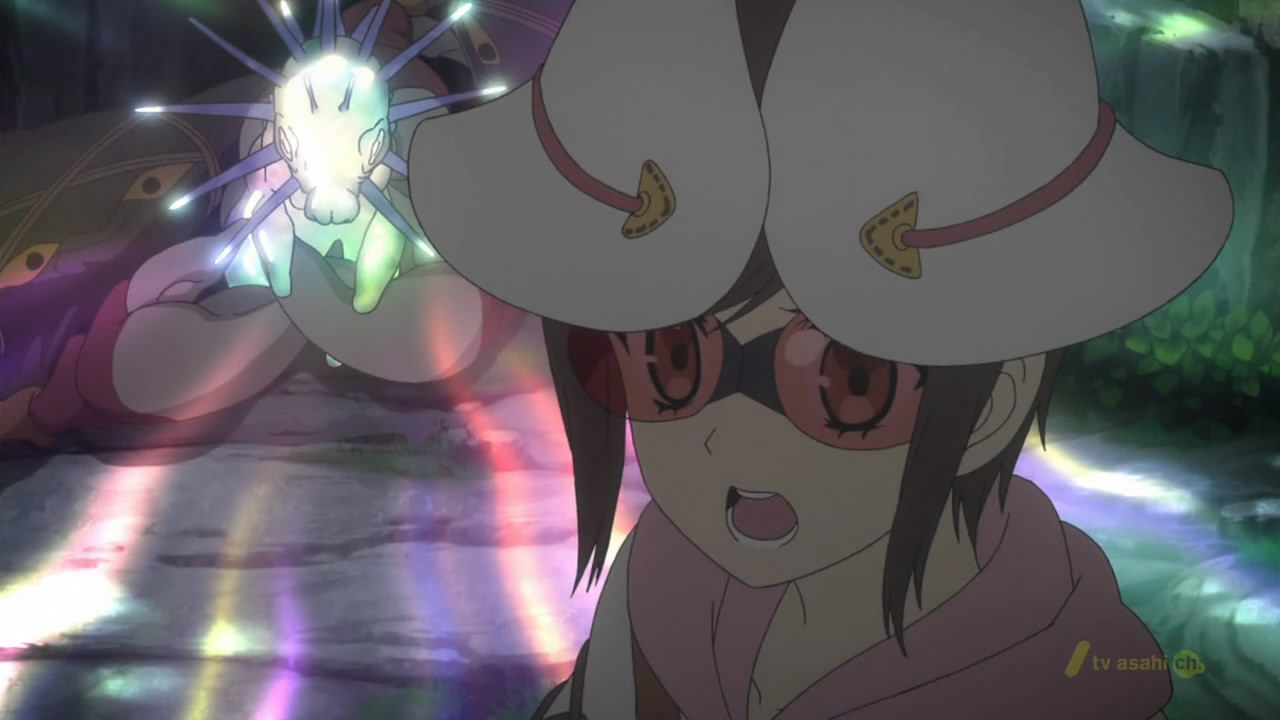
I’d like to think that somewhere in that rainbow lizard’s 890 petabytes of storage is 50 Shades of Grey just waiting to captivate future readers. This was mostly a world-building episode. As such, I don’t really have one major topic to expound upon. So y’know, let’s just jump to the stray observations.
Notes:
• Not that I hate the show we currently have or anything, but does anyone else think the flashback scenes could make for an interesting series? Hell, take what we see this week alone. Do twelve episodes based around the planning and eventual assassination of an evil emperor. Oh hey, it’d be like an anime version of Operation Valkyrie.
• What exactly did the kids do to the poor thatcher egg?

And why is that thing a “Hand of the Devil?”
• I’m not going to focus on the budding romance between two little kids.
• I wish the minoshiro had been something a little more captivating. Instead, we get a goofy, green unicorn-lizard thing… oh yeah, I’ve asked a couple people what ‘minoshiro’ means. Apparently, the characters translate to ‘ransom.’ Wonder if this will actually mean anything later in the series.
• The narration only shows up once to give us some background info about the minoshiro and related creatures. What’s up with that? Why did the second episode need so much narration in comparison?
• “In recent years, a new theory has gained acceptance. It holds that many creatures, including the minoshiro, had their evolution accelerated by the collective unconscious of humanity.”
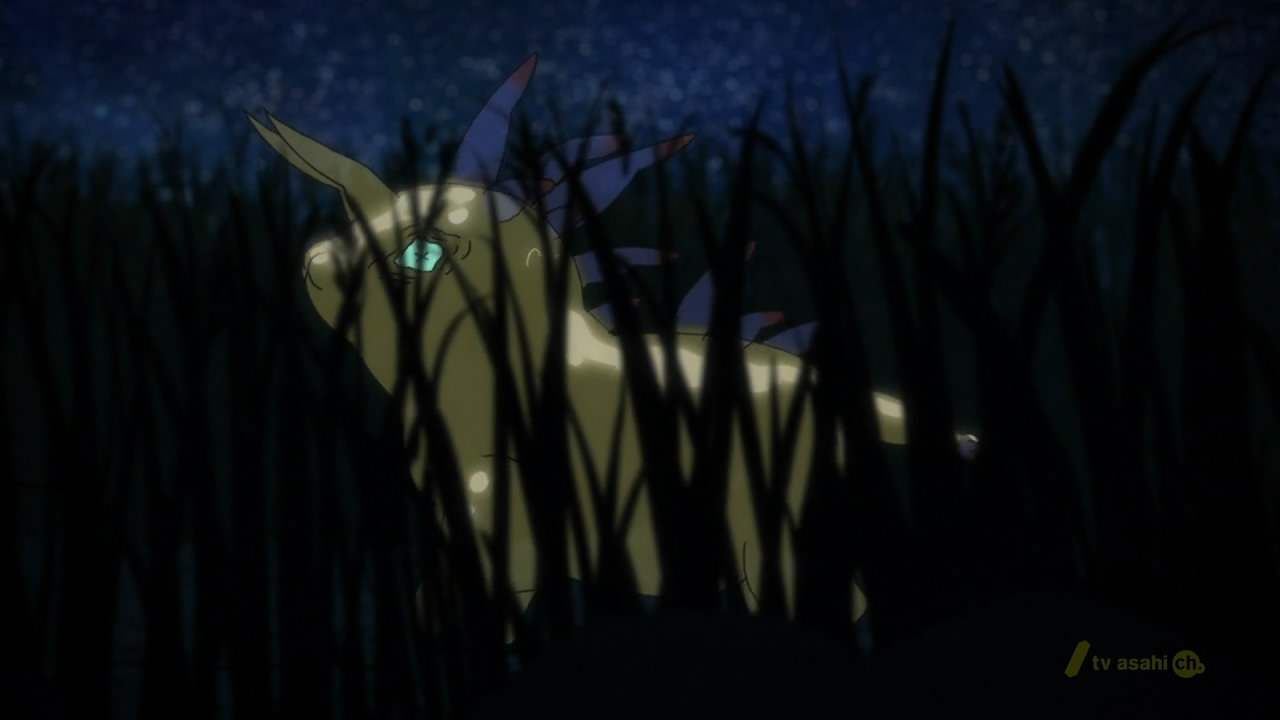
The way that the anime uses the word ‘theory’ in the lines above, it makes me think of a ‘scientific theory,’ i.e. “a well-substantiated explanation of some aspect of the natural world, based on a body of facts that have been repeatedly confirmed through observation and experiment.” So how does one substantiate a theory involving the collective unconscious? That should be an interesting explanation, but I have a feeling the anime won’t really get into too much detail about this. Too bad…
• Humanity’s collective unconsciousness seems to be anime’s go-to concept whenever something strange is afoot. Y’know, when Carl Jung coined the term, I don’t think he meant that our minds had some latent ability to connect to each other like some sort of mental internet. Rather, I think he meant that there’s a part of our unconsciousness that we inherit. More importantly, it is similar across the human race. Using this interpretation of Jung’s “collective unconsciousness,” it’s hard to imagine how such a thing could effect any sort of evolutionary change on a physical organism.
But the meanings of words will change over time, and so has the term ‘collective unconscious.’ Nowadays, we do seem to think that it refers to some sort of psychic hive mind that the human race can eventually tap into. It’s certainly a sexier idea.

• Have the kids been given permission to use their powers during the camping trip? Or did they just assume that nobody’s watching so they can do whatever?
• It’s a rather strange set-up, isn’t it? The adults have all these rules in place for the children to follow, and we know that if the children break any of the rules, there’s a good chance they will mysteriously disappear. At the same time, however, the children receive nearly no adult supervision whatsoever. Oh, I wouldn’t be surprised if someone is still keeping an eye on our five protagonists, but you know what I mean: the adults are not actually there to guide the children along their education. It’s almost as though the adults want the children to screw up. Just for the hell of it, let’s just say that this is all according to ‘keikaku,’ i.e. the authorities are trying to weed out the bad eggs now. If so, why? Why not wait until the students have become young adults to set them free to their own devices? By then, you’ll have had nearly two decades of indoctrination.
• So wait… the ritual at the start of the first episode is actually temporally prior to everything we’ve been watching thus far? What’s with all the lessons about never straying beyond the boundary rope then if the purifying ritual itself took place beyond said boundary rope?
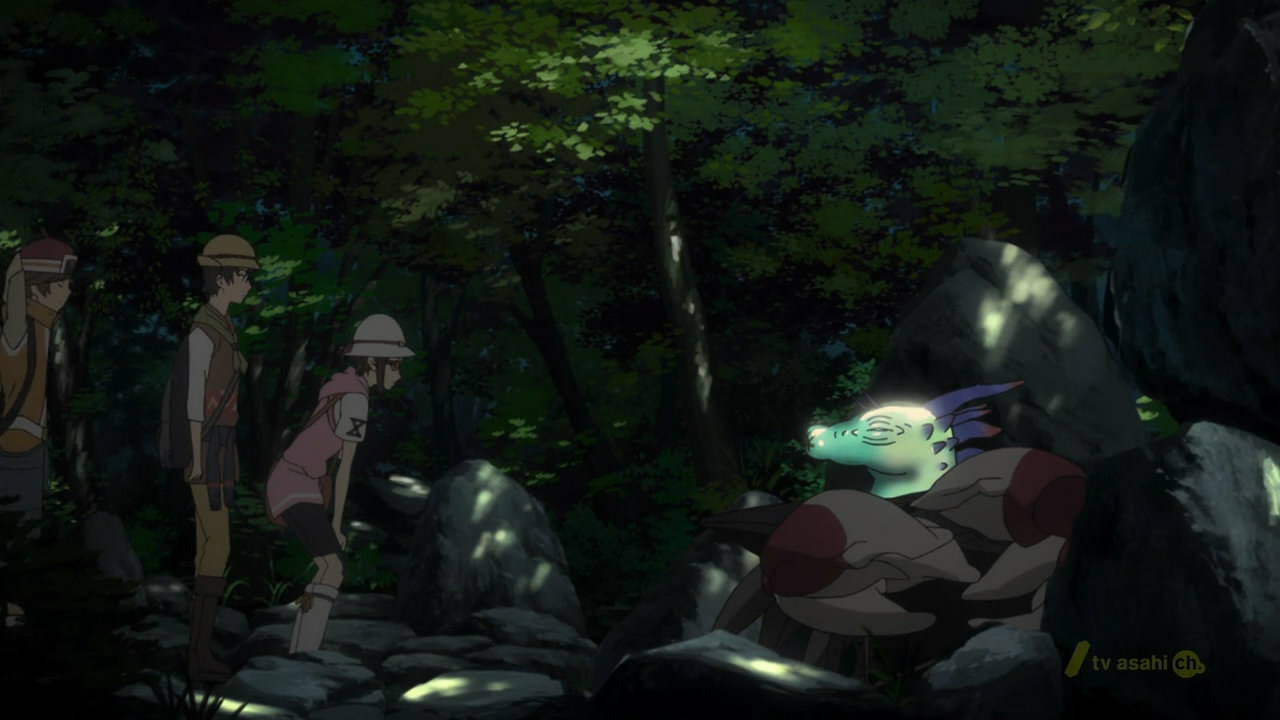
• So the children eventually capture the faux-minoshiro, a.k.a. the devil’s minoshiro. It’s really just some sort of Library storage device. I wonder why someone decided to disguise a storage device as a minoshiro. More importantly though, it doesn’t look all that dangerous. According to the rumors, people die shortly after encountering a faux-minoshiro, which is why people have taken to calling them the devil’s minoshiro instead. I wonder, however, if this is yet another thing that the villagers will punish you for. It looks like those faux-minoshiro contain a wealth of information. I can thus imagine why the village leaders might not want people to go snooping around such a thing. As a result, people mysteriously die.
• Hell, the children have broken so many rules by now, I can’t help but expect a lot of bad stuff to happen to them in the next few episodes.

I really want to like this but at least so far it feels like the plot and execution are both creaking and groaning under the strain of fitting the story into episode-sized chunks that end with cliffhanger-ish events each week.
It feels a bit like a lack of confidence, honestly: yes, cutting off right before they start accessing the library is probably the strongest cliffhanger spot they could go with at this part of the story (just guessing), but I’m not sure it was worth drawing out the first part of this episode so much just to end there; I’d bet that there will be plenty of places in next week’s exposition session that would’ve worked just as well as stopping points that’d leave you hanging for the next update.
In terms of world-building and general logic questions, I actually found the narrative about “recent theories” somewhat immersion-breaking. The issue for me is that on the one hand they’ve been painting this picture of some not-so-nice, “don’t ask questions, citizen”-style future dystopia weeding out the rebels and nonconformists, and yet there’s still some kind of academic community that does things like theorizing and advance new theories; on the other hand, the kids just found this awesome library with petabytes of data, and given the way the narration is seemingly coming from future-Saki the topics she’s speculating on seem like things future Saki would know the definitive answers to…”.
Who knows, really, it might be the adaption choosing a poor way to cut down some long narrator’s monologue, and it may just be a sloppy way to say “this is what happened” with some wiggle room, but that one line brings with it a bunch of implicit context that doesn’t seem to fit either with what we’ve seen of Saki’s present or her future…not sure what gives.
Also on the logic issues, did they ever say what the point of this camping trip is? It seems a bit inspired by the kinds of wilderness survival things you see at the end of outdoorsmanship training and juvenile rehab programs and whatnot, but here all I remember was a “go in the woods for a week and do what you want. This is critically important to your education!” and thus the whole excursion seems a bit under-specified.
I guess it could be just a convenient way to get the groups away from each other while culling the weak from the herd (and maybe they cull them young because their powers are still weak at that age?). In any case, although this seems to be the best thing going this season to my tastes, there’s just something off about the pacing and something not-quite-right about the overall feeling.
You’re really retiring @ the end of the month I take it?
No, it’s not good. I wanted to blast the episode for the whole camping fun time, but I thought the minoshiro was decently interesting enough to try to ignore it. In the end, I thought the episode was slightly better than last week’s, but my initial point about the emperor assassination was pretty much a hint at the idea that the story should’ve been about something else entirely.
I think this is meant to imply that an older Saki probably no longer lives in an environment in which there is a dystopia that discourages learning.
I don’t know about that. Don’t you think it’d be unlikely that the scholarly research would have any definite answers for the minoshiro? Judging from the cold openings in the last two episodes, the world has gone through tumultuous changes — political and otherwise. Science probably took a backseat along with every other sort of human advancement. Plus, it does appear to be an entirely new creature that has sprung up only within the last thousand years, which, according to the narration, goes against their (and quite frankly, ours) understanding of evolution. I can then imagine her looking over whatever remnants of old documents she can find, and piecing together an incomplete picture at best. She’s not a scientist by any means, and assuming that she even did escape the dystopia, it’s unlikely that she could’ve found proper training to be one. The best she can come to is that the minoshiro is some product of accelerated evolution, but I laughed when they called it a theory. I mean, c’mon, it’s not a theory. It’s a guess. Theories undergo rigorous scrutiny.
I’m unclear on the exact line you’re referring to. Which line brings with it implicit context?
No, the show is very vague about it. From the second episode:
“This is a very important event in Sage Academy. You will all board canoes and row up the Tone river. You will spend seven days living in tents. You are free to decide your plans for that time. We teachers’ll make sure that your schedules won’t clash. This is an exceedingly important experience for you. We’re expecting great topics from you.”
So on the surface, this is all about expecting some “great topics” from the students. But like the boring psychic soccer tournament from last week, the camping trip has such ill-defined rules that there’s got to be some ulterior motive to it. I think the adults want to see who will break the rules. You leave five kids alone in the middle of a forest, what do you expect to happen? So yeah, I do think the camping trip is meant to, as you say, cull the bad eggs. It still seems highly impractical to me, but crazy villagers be crazy.
Other than Zetsuen no Tempest, nothing else interests you?
It’s just boring. I think it says something when I find the cold openings far more fascinating than the actual story itself. I’m crossing my fingers that something will finally happen to the kids and kick the plot into gear though. I just have a feeling something major is about to happen. But yeah, if the fourth episode continues to world-build, I’d throw in the towel.
Nah, it was a joke that didn’t pan out.
The line with the context is just the line you pulled out but I think I’m making too many unwarranted assumptions (such as the minoshiro’s library having solid information on how it was made and what happened over the past millennia). That said, I do think talking about recent theories, etc., does bring with it a context wherein people create theories and debate them, which at least so far hasn’t been on display in the village.
In terms of culling, I was thinking less along the lines of setting up an opportunity to catch them breaking the rules and more along the lines of the previous competition, etc, having identified some groups of losers and then using the camping trip as cover to dispose of the runts out of sight from the others. Either way it wouldn’t change much.
Oh well. Based on what we’ve seen thus far I don’t find it that difficult to believe this is a decent novel, but the adaption is off to a pretty rocky start. That said, I’m not sure these backstories would make a superior storyline, either, in that there’s no telling how well they’d hold up as more than the brief vignettes we’ve seen.
In terms of this season, Zetsuen I’m curious to see what they do with it. This legitimately has my interest but is risking losing it. For the rest, Psycho-Pass looks like the kind of thing I’d like if it turned out well but something about the promotional material gives me that “this won’t turn out well” feeling so I’m waiting it out a bit. Just generally not feeling much for this season’s entries.
I do think there’s an underutilized contrast here. The majority of the show focuses on the children, so it wouldn’t exactly make sense for them to create and debate theories. So instead, they engage in campfire-esque stories, urban legends, and such. Then the adult Saki turns around and dryly talks about what she knows, albeit not much. I just think the narration is inelegant, and the contrast hasn’t been exploited to an extent that it really adds much to the narrative.
Well, nobody can be sure about any “What if?” scenario, but if you give me a choice between PK-using children going camping and assassins going after an evil, PK-using emperor, I know which one I’d pick.
Ah well, I’m as equally interested in train wrecks as I am into greatness.
Examples of lies that people tell themselves:
“I’m not breaking up with you because it’s your fault. I’m breaking up with you because…”
Yup, you’re breaking up with her because it’s her fault.
“He’s not my ONLY friend. I’ve got other friends!”
Yup, he’s your only friend.
“Not that I hate the show or anything…”
Yup, you hate it.
Hm, no.
I had the same type of conversation from Saki’s perspective denouncing a friend’s tale: in the episode, it was about balloon dogs, for us, it was about an obscure movie. I was just as mesmerized by the attraction of mosquitoes to the Tatcher egg as I was mesmerized by the detail distinguishing a real Moshirio and fake (e.g. the pair of horns). The music was engrossing and the interactions, so jovial. I can talk about how much I enjoyed the atmosphere of this episode, but because of its subjectiveness, I’m more interested in this concept of world-building that came off under appreciated in your post and comments.
A similar stigma was attached to E7 AO: too much world-building and not enough plot/character progressions. Even though Shinsekai Yori will be much shorter than E7 AO, I think the world-building in these past episodes, especially this episode, play a significant role in not only character development, but also in exploring the premises that envelope this world.
Last episode, the narration hinted at Mari’s treachery and I tried to pick that up in this episode. What I instead picked up was an uneasiness in Satoru. Satoru is meant to be our jovial and curious character, open to all possibilities. Instead, we see him initially scared at the mention of night canoeing, rowing the next day despite a stomach problem, and ominously whispering to himself right after the five loose sight of the fake Moshirio. In all three cases, he immediately reverts back to his “usual” self. Shun also raises questions throughout these past episodes. He seems to be able to balance himself on the edge of what the rules permit and get away with it. We see this during the competition and afterwards when giving advice to Saki concerning the saving of the Queerat’s life. In this episode, he actually thinks exploring these animals would be a good topic and even abets Satoru’s expeditions. What’s up with these two characters?
A more important thing these world-building episodes explore is the extent of the psychic powers. We notice this force seems to visually based and probably affected by distance as well during the first two episodes. When Satoru lies on the canoe, closes his eyes and starts using the force to move the canoe, I realized this force might have more to do with visualization than seeing. This hypothesis gains traction when Shun creates a romantic setting for the two by reflecting the light from the stars on the river. One thing that caught me offguard was Shin’s mumuring right before he highlighted the water’s surface. Maybe my hypothesis needs a further revision?
I am overly descriptive to show that world-building can be very interesting. The series is obviously starting off very slowly to emphasis the change that will come in the future episodes. Beyond that, I also see these episodes orienting the viewers, foreshadowing subtly of future events, explaining the setting and most importantly making the viewer invest in these characters. Granted, some characters have been one-dimensional (cough, Saki, cough), but as explained Shun and Satoru seem to be much more. I guess I don’t see this series the same as you do, but I wonder if it’s because of subjectiveness or something else.
I don’t recall it standing out to me.
How are these details important? In asking this, I’m not trying to be flippant here. You say that the world-building engrosses you, but why? Why should one pay attention to these details that you have pointed out? As for the stuff you’ve mentioned about Shun, Satoru, and the extent of their psychic abilities, it’s not that they’re unimportant in my eyes. It’s just that it’s way too early to say how these observations all fit into the narrative. Okay, the psychic power might be visually based… but what does this really say beyond that very fact? To say that Satoru seems off, this is merely an observation. What’s the interpretation? The problem that I have with the show is that it’s mostly observation and no interpretation. Not that it’s incapable of interpretation, but it’s moving too slow.
I’ve never understood why this is necessary. Will the contrast really enhance the narrative? I’ve never found myself say, “If only the earlier parts of a movie were slower, I’d really appreciate the ending more.” It just doesn’t make much sense to me.
What are you getting at? I’m sure you have something in mind for that “something else,” but I don’t understand why you don’t just come out and say it.
We are watching a story, and I agree that it helps if things move. I also appreciate if a story can distinguish itself from other stories. Shinsekai Yori’s attention to detail is more of an aesthetic component to the story, rather than a plot progression (though it might also be, which we’ll have to see). But solely viewing these details as oraments to the story is also incorrect, since things are subtly changing over time as I have pointed out.
Also an emotion of uneasiness is clearly coming through this episode. As Guardian Enzo of LIA puts it, “the children are people and in many ways, their behavior is quite normal–yet we can never escape the perception that their world is very wrong, a product of strange and terrible era following the collapse of our world that can only have led to a strange and terrible world hidden beneath the veneer of utopia we see.” It’s like Mai-Hime in which the first twelve or so episodes were all fairytale like, but with something hidden underneath everything. The plot twist hits and the series never stops. There is plot twist coming in this series as well, but we can’t have plot twist without something to twist against.
I think you are worried that the world-building is taking too long, but I would much rather have the experience of discovering this world than have it explained to me in one episode followed by a plot twist. In that sense, last episode was actually a little annoying with the frequent narration explaining the events. This episode did a much better job of showing as opposed to telling. For a series that takes place in a different world than ours, differences and impossible similarilites provide an additional layer of depth. I’m not sure if you are even trying to acknowledge these components of the series or simply ignoring them because you find them uninteresting. I assume it’s the latter, if so, I hope to provide an alternative perspective.
I’m not disputing that things are changing. I’m saying that the dots aren’t being connected in a way that I find interesting or meaningful.
But how is it a plot twist when you can see it coming from a mile away? We all know something bad’s going to happen. It’s just a matter of when, and some people — including myself — think it’s taking too long to reach that point. By taking things this slowly, the show is needlessly delaying something that everyone is expecting. This is why I bristle at any suggestion that we need to emphasize the upcoming change. We know it’s coming. It’s not going to be a surprise. What are we dragging our feet for? Why try to be any more clever than we need to be? Just tell the story.
I’m sorry, but I don’t find this quotation meaningful. It’s not interpretation. It’s merely an observation and a very obvious one at that. I’m surprised it even needs elaborating upon. What you’ve given me is the basic premise of the show that was established right from the very first episode. The problem is that the second and third episode followed the same exact format: kids doing normal kid things, but something is off. I personally find it tiring. The reason why I focused mostly on the minoshiro is because it felt like the plot was finally going places.
Only if it conveys something. Just being different is not depth. This is why I puzzled over the thatcher egg. Details are just details without context. Just showing me the kids marveling over a thatcher egg says nothing, and in my opinion, a big waste of time for a show with a limited amount of episodes. And I’m not just harping on the single scene with the thatcher egg. I believe the first half of the episode could’ve been judiciously edited. Obviously, you don’t feel the same way.
Ah, see, this is what I was afraid of. To avoid making our exchange antagonistic, let’s just say I look at anime very differently from you. We can just agree to disagree.
I’m sorry if I made the comment antogonisitc, because that wasn’t my intention. My second comment strayed from a style of writing I wanted to develop. Anyways, what I’m interested in is figuring out why two people share different opinions about the same episode. Thus, agreeing to disagree doesn’t really get me anywhere.
Premise 1: I’m saying that we merely have observations that are skin deep at best.
Premise 2: Just being different is not depth…Details are just details without context.
Result of 1st and 2nd Premises: By taking things this slowly, the show is needlessly delaying something that everyone is expecting… The problem that I have with the show is that it’s mostly observation and no interpretation. Not that it’s incapable of interpretation, but it’s moving too slow.
I don’t understand how you jumped to your conclusion from premises both of us would more or less accept. I would just add to the first premise that we have a lot of observations. To the second, I would change “details without context” to “details with a developing context.”
Suppose, we take out the opening historical scenes out the anime and solely concentrate on the main story and have our plot twist during the second episode. We would end up with a conflict (Saki’s fears and Keiko’s disappearance) and the plot twist. This would be an anime trying it critique its current society without even trying to portray in its actuality (straw man that anime loves). It’s like saying that we have this big bad society and these children do something about it. What do we have instead?
Without the opening scenes, the ‘details without context’ would actually lure me into a false sense of security. If I hadn’t know psychic powers could be so dangerous, I would view them as a boon to these kids. This is a society I would be interested in joining. These rules the folktales teach, they aren’t bad in themselves. It’s like teaching children lying is bad (in this case, using psychic powers blantantly is bad). But by adding those extra scenes at the beginning, it adds a sense of evolution and uneasiness to the current situation. Shinsekai Yori doesn’t just say, here’s our premise and this is what we’ll do with it. It develops its premise into something we are familiar with and only then goes about playing with its premise.
Therefore, I would say that everything from the Queerats, the pyschic soccer game to the Tatcher eggs plays a role in developing the premise, a seemingly stable equilibrium that the opening scenes hinted as being impossible. Now the anime will ask the question: why isn’t this equilibrium so great?
Well, you yourself called them opinions. We are not the same people. We value things differently, which is pretty evident from the past few comments.
The argument does not consist of merely these two premises.
This is what people mean by needlessly drawn out. I don’t understand why you think you need all of these world-building aspects in order to establish “a seemingly stable equilibrium.” Plus, you’re mischaracterizing my position. I didn’t say “skip right to the ‘plot twist.'” I merely said that a false utopia has been established from the first episode. As a result, the next two episodes need not continue following the same format. Having said that, I did not suggest that we cut everything from the second and third episode out. I also haven’t said that the anime should remove either the psychic soccer game or the camping trip completely. I just felt that these sequences are, again, needlessly drawn out, sometimes feeding us information that is not all that pertinent to our understanding of the narrative. What do I mean? The construction of the play pieces in the soccer game. It’s inconsequential in the long run. What else? The thatcher eggs. Again, inconsequential in the long run. It’s not as though you can just continue piling on details and nothing will suffer. What suffers is the pacing of the narrative. My suggestion is that the anime could’ve tighten things up and quicken the pacing. This is not the same as asking for a plot twist to immediately follow the first episode.
Neither of us have a problem with having three episodes of world-building: the first episode’s contents (which my memory can’t stretch far back enough), the pyschic soccer game and the interaction with the Queerrats, the camping trip and the Minoshiro. Where we differ is in the amount of detail in each episode, which you claim affects the pacing. The contruction of the dolls for the game is unnecessary; Mysterious poping water fountains and tatcher egss are also unnecessary. The reason I had those premises is to highlight where our differences lie, not summarize your entire arguement. I’m not belittling your argument, just trying to highlight the small section, the details argument, which seems to incite different emotions in the two of us.
To summarize my points, the addition of these details I think, instead of affecting the pacing, creates an aesthetic aspect to the series as well as allowing me to explore a world that should contradict itself (which I claim is crucial for the upcoming plot twist). As a result, it seems to me that the episode actually flew by too quickly! For example, I actually do find the construction of the dolls interesting because the regression in technology we see. The tatcher egg scene highlights both the group’s reliance on Shun and what seems like a blantant disregard for the environment. Notice they have no qualms about clearing the bushes while walking and domesticating crabs (not to mention catching animals). I don’t have a need for every detail to connect to the overarching plot as long as it is in the “spirit” of the episode. One thing that we both can agree was done poorly was the repetitive narration in the second episode.
This was what I was interested in exploring through our conversation. One’s views on this series, so far at least, correlate to how much detail one thought was necessary to the story.
Since I did spend a significant part of my time trying to explain my viewpoints and how they differ from yours, I am curious if you think my argument makes any sense. It’s one thing to have something in your head and another to actually be able to explain it.
I don’t think there is anything tricky at hand here. We just value things differently. Like this:
None of that stuff are as important to me as they are to you. I simply find these same details mundane. Anyway, I don’t think either of us are going budge from our respective positions.
TL Note: ‘keikaku’ means ‘plan’
That thing is probably called “Hand of the Devil” because, well, it has a nicer ring than “Rotten Thatcher Fetus”. Also because the resulting grotesque shape it holds when it feathersplodes can be imagined to look like a devil’s hand.