
Here’s a curious idea: what if the only way to live your life in the world of PSYCHO-PASS is to act out? Akane wakes up to some sort of virtual jellyfish assistant. One of the first things the jellyfish does is to inform Akane of her psycho hue. Well, thanks jellyfish; good to know I didn’t go to bed and wake up a psychopathic murderer. The jellyfish then goes on to suggest how many calories Akane should have in her breakfast. It seems like a lot of things in her life is automated for her, including deciding how much to eat. How does one live his or her life in such a world?
In this high tech world, it seems you can simulate any sort of surroundings you might desire. Akane turns her apartment into some sort of fancy Belgian hotel (oddly specific, by the way) — in fact, the first art nouveau building ever. What I notice, however, is the lack of change in Akane’s demeanor, and this is what separates the simulacrum from the real thing. It’s obvious that she’s done this sort of thing over and over and over. It could be a fancy Japanese hotel one day, an idyllic Austrian hamlet on another day. The point is that none of this feels truly fulfilling.
The obvious implication here is that the room preferences are fake. After all, you can’t pretend as though you’re in Belgium just because your walls have changed. It may look and perhaps even feel the same, but in the back of your mind, you know something’s missing. I’m trying to dig at a deeper implication, however, and this concerns the entire world of the show as a whole. I brought up the fact that the jellyfish even suggests how many calories to eat in a breakfast at the beginning of the post, because it shows that even mundane tasks are being regulated and monitored. But it isn’t just what you eat that’s being regulated. Your entire mental disposition is being monitored at every second, every minute, and every hour of the day. Can you imagine what this really entails?

When the unexpected so much as hits you right in the face, your hue might immediately change colors. As soon as it changes colors, however, you know that some machine will zip around the corner and let you know immediately how to behave. Life can’t feel real then when it’s on rails to such an extent. Let’s say something bad happens to you. You see your hue redshifting so you calm yourself down before anything bad can happen. Can you really pat yourself on the back for this though? Did you really make that decision to be a good person when you know fully well that any other alternative would have probably landed you into deep trouble? Perhaps it’s a stretch to say that one doesn’t make any decisions in the world of PSYCHO-PASS, but it has to be like a Choose Your Own Adventure book. Life can’t feel like life when your choices are given to you instead of you coming up with them yourself.
We can sit here and debate whether or not free will is real, but even the staunchest supporter of determinism will admit that we at least have the illusion of freedom if nothing else. A law-abiding citizen–… hell, a law-enforcing citizen like Akane herself can’t feel as though she’s really living her life, however, because there isn’t even an illusion of freedom in her life.
Notes:
• How appetizing — the Chinese breakfast plops out of a machine covered in plastic.
• The jellyfish assistant even goes so far as to warn Akane of dangerous stress groups in her commute. Apparently, there are supplements you can take to prevent “mental contamination.” This reminds me of a study I recently read about how being stuck in traffic for more than an hour a day can significantly shorten a person’s life span.

• More examples of the lack of freedom in Akane’s life: she chooses which outfit to wear, but her choices come from a bunch of presets. It’s not exactly the same as standing in front of your closet with twenty blouses and twenty bottoms to match up.
• Akane’s bangs are doing her no favors.
• Our heroine tries to confide in her friends that she feels really bad about her recent job performance, but they don’t take her seriously because her disposition isn’t “that cloudy.” This brings up another one of the show’s main themes: is there an extent to what you can quantify? Akane’s friends are perhaps relying too much on the assistance of technology to help them understand her, and the irony here is that they are in no better position to understand how Akane really feels. Akane confesses, “I couldn’t sleep at all last night,” but her friends can’t possibly get that from just her disposition alone. Instead, they just bitch about how unfair it is that Akane’s mental disposition remains so clear despite her distress.
Y’know, what makes a person a true friend is that they can read you and thus understand you. With the help of technology, perhaps any person can claim to be able to read and understand you, but does that make them a friend?
• As expected, the government in PSYCHO-PASS tells its citizens what jobs they are best fit to perform. Again, this is another example of life being on rails, which just fits neatly into the cyberpunk aesthetics of the show. Furthermore, this harkens back to the days of modernism at the turn of the 20th century, i.e. 1890–1914. Data on every boy and every girl in the country were measured, every physical and every mental qualities were assessed and quantified… for the good of the empire! So perhaps PSYCHO-PASS‘s Japan has gone back to some sort of neo-modernist society inspired by the old Meiji days.
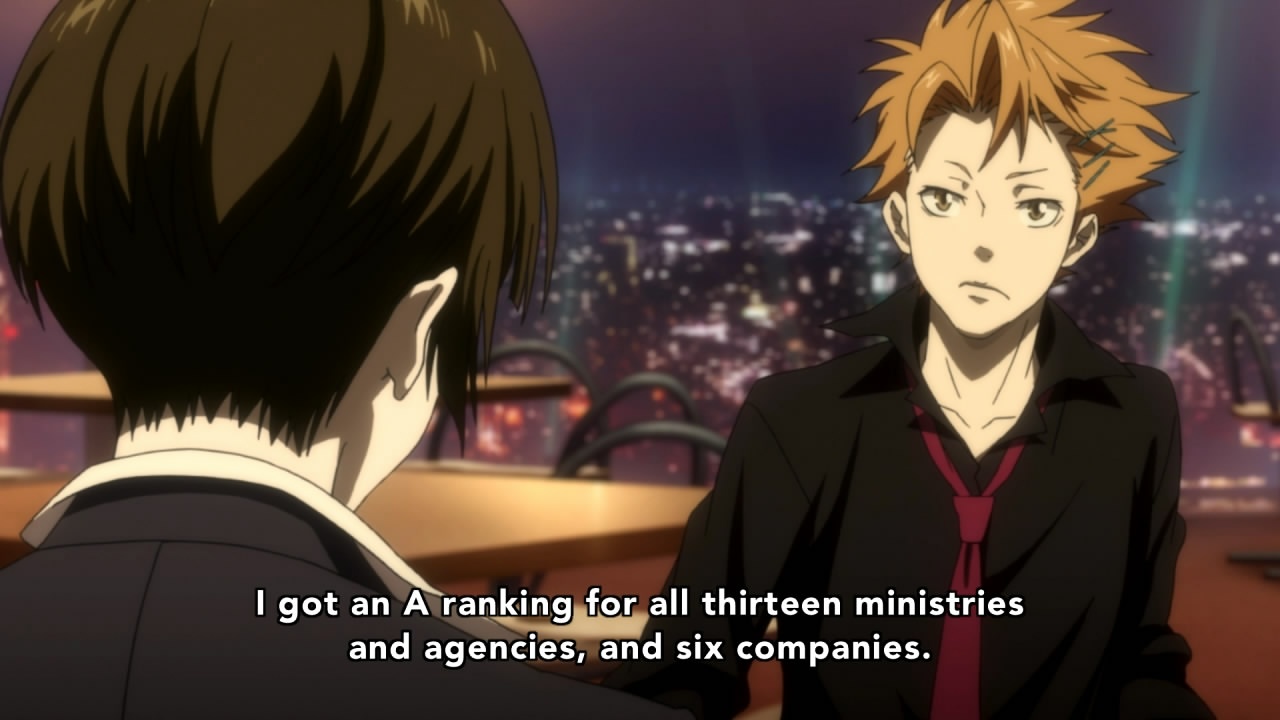
Or it could just be taking what Japan has now to its very extreme. There are already rigorous exams every step of the way until a person hopefully lands his or herself a job at a prestigious company. Anyway, we learn that Akane rejected potential jobs at both the Ministry of Economy and the Ministry of Technology to become a member of the Public Safety Bureau. Akane is the heroine, after all, and so she’s naturally the wild card that would want to buck the tradition.
• “What needs to be done is done by those capable of doing it. Such is the grace bestowed upon mankind by Sibyl.” In other words, the Sibyl knows your value; it sees your potential. You may not understand everything you are going through right now, but hold your head up high, knowing that the Sibyl is in control and it has a great plan and purpose for your life. Your dreams may not have turned out exactly as you’d hoped, but the Sibyl’s ways are better and higher than our ways.
Now where have I heard that before?
• Akane can change her outfit’s appearance in the middle of the day. She goes from a casual look for her lunch date with her friends to something more business-like for when she returns to work. I wonder what the clothes she’s wearing actually look like, however; y’know, before all the virtual stuff kicks in. One of the fun things about analyzing cyberpunk is wondering about the subject that lies beneath the veneer, i.e. searching for the very substance behind the illusion.

• Random yuri overtones out of nowhere. Analyst Shion, however, seems like another foreign-looking woman pegged as a woman with loose values in anime. Y’know how it is. If you’re a blonde, not only do you have big breasts, but you can’t stop making sexual innuendos every chance you get. This is all meant to contrast with the pure and innocent Akane.
• This guy looks like a wild Yoshino from Zetsuen no Tempest. Maybe he became a latent criminal after the incidents in that series.
• It seems that a lot of people dislike Akane because she’s so clueless about everything. I think the second episode has toned this aspect of her character down quite a bit, however. She doesn’t ask as many silly questions just for the sake of exposition, but they do come up from time to time. Even so, a lot of these hard-boiled stories always pair the newbie up with the wizened geezer. That’s Masaoka’s job. To some extent, we’re dealing with genre conventions despite the futuristic setting and premise.
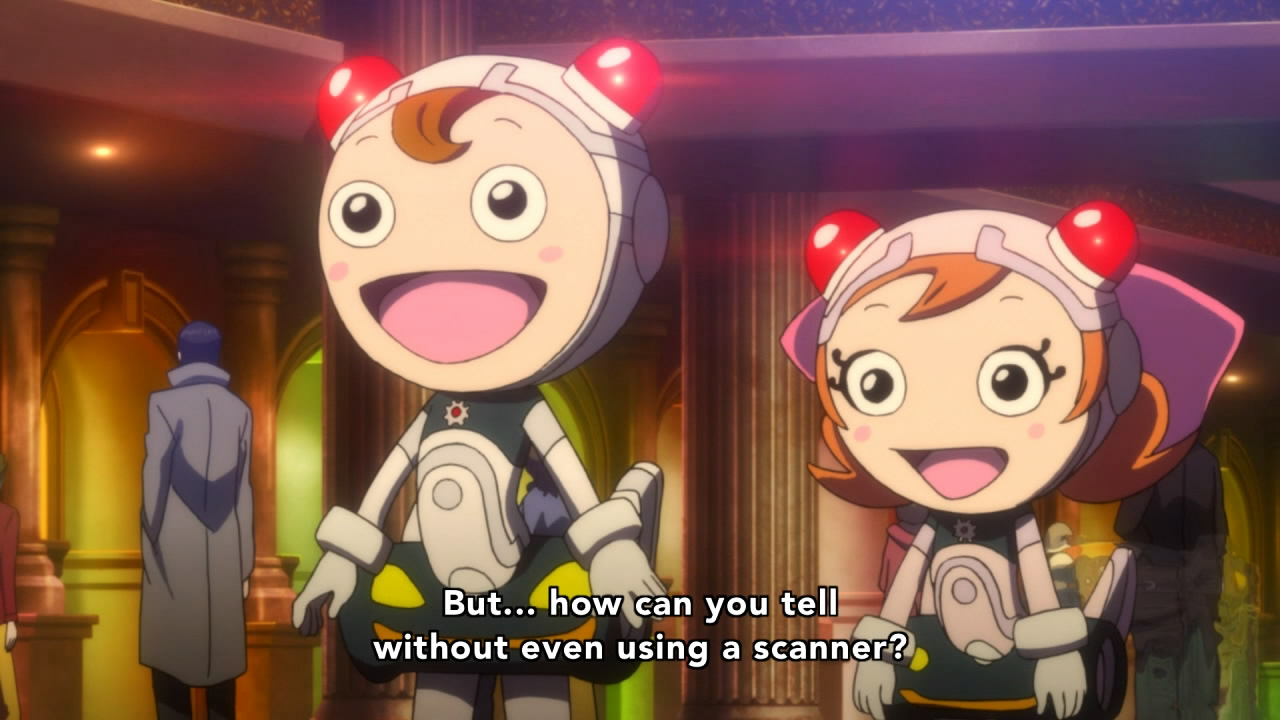
• Another example of authority cuteness: Akane and Masaoka disguise themselves as the police mascots as they investigate the mall. How would citizens feel that behind one of those cute facade lies a latent criminal who has been forced into work by the government?
• Masaoka epitomizes the wizened geezer with life experience so much that he can drop gems like, “A beast can sniff out another beast’s smell.” No, I’m not being sarcastic about this. I think he really serves as a bridge between the old detective stories and PSYCHO-PASS‘s futuristic interpretation of the genre. He injects a bit of familiarity into the anime’s alien world, i.e. the old school roots of how to catch criminals.
To go on a bit of a tangent, you can see the old school vs. the new school philosophy play out nowadays in sports. How do teams know which players to draft or sign? In the old days, you’d just send scouts out to watch prospects in action. You’d hear all these stories about guys in their sixties who just have this natural love for the game. As a result, they don’t mind flying all around the country to watch talented youngsters at some dinky high school throw some pitches. It takes a lot of trained intuition to spot talent, et cetera, et cetera.
The advent of sabermetrics, however, has allowed many people to quantify a player’s talent. Why rely solely on a scout’s eyes anymore when you can just run a bunch of statistical analysis on some numbers (take note: I’m vastly simplifying the process) and instantly determine whether or not the player has any talent? The scouts, obviously feeling threatened by the new school method, defend the old ways by espousing the belief there are just some things in a person that you just can’t quantify. Some prospects just have it, and no fancy computer can tell me that!
So anyway, Masaoka kind of uses both schools of thought to catch the criminal. Even though he can sniff out the latent criminal without scanning the guy first, Masaoka confirms his suspicions later anyway by measuring the guy’s disposition. But we also saw last week how Akane tries to spare the rape victim because she doesn’t think the scanners are 100% accurate. This suggests that there’s an “It Factor” here that the process, i.e. the Sibyl, completely ignores.

• Akane is displeased again with her job performance. This time, however, it’s her lack of any performance. She pretty much accompanies Masaoka as he does his thing. Surely, there’s more to her duties as a member of the Public Safety Bureau than just that, right? According to Masaoka, the answer is no. Her job is to make sure the Enforcers don’t act out, but usually, this isn’t much of a job. Like everything else in her life, everything just seems to be on rails, and thus wholly dissatisfying.
• Some telling words from Akane: “…I thought that there must be some work that only I could do at the MWPSB. If I went there, I thought I could find my real life… I thought I should be able to find out why I was born here and now!” For the billionth time, this just reinforces the idea that life is unfulfilling in the world of PSYCHO-PASS. For all its futuristic comforts and convenience, your life is always going to seem lacking if you can’t feel as though you’ve made your own decision and way in life. Most of us believe that our actions define our character, but if our actions are being guided by some unseen force from high above, then some existential crisis is naturally going to creep in.
• Kagari mocks Akane for whining about her problems, but he’s mistaken if he thinks the two of them are all that different. He’s in the same situation as Akane, except everything’s worse. Even if Akane’s life has been on rails ever since she was born, she at least had multiple rails to choose from. Kagari reveals how he had been flagged since he was five. As such, he’s had only one rail to follow. The fundamental problems for the two are the same: life lacks true freedom. Just because she got to make a few superficial choices in her life than him doesn’t mean she should automatically be happy with her life.
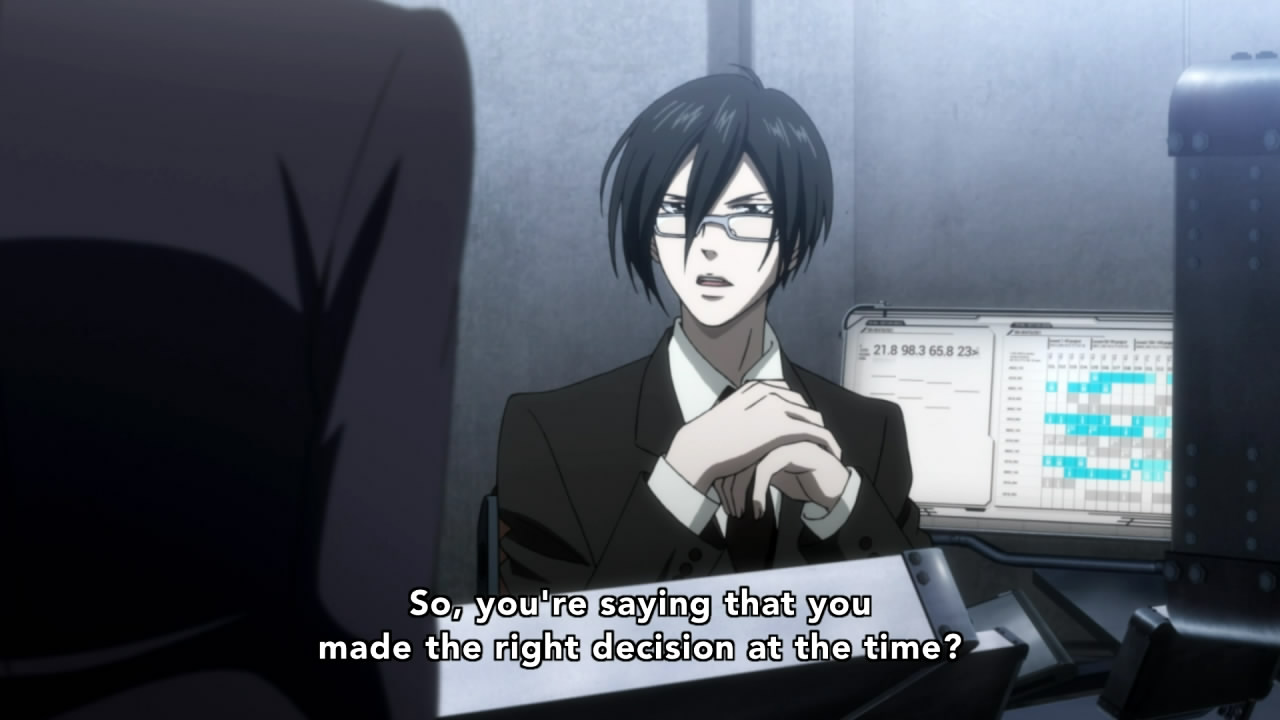
• But Akane should take solace in the fact that she’s made one non-superficial decision on the job thus far: preventing Shinya from killing the the rape victim in last week’s episode. In Shinya’s own words: “You were able to put justice before your duty.”


Great analysis of the second episode. I had many of the same thoughts while watching it, though I very much doubt I could articulate it any better than you just have. I especially liked the bit about the “old school v. new school” philosophy, as I hadn’t thought about that until you mentioned it.
I would disagree with the sabermetrics analogy though. Although I have nothing wrong with the conclusion, I would argue that the existence of some kind of mythical “It factor” — so engrained in sports rhetoric and beliefs — is dubious and is most of the time just used as a poor justification for circumventing statistics. The problem with the PSYCHO-PASS system is that it tries to quantify things that are unquantifiable. Things like someone’s mental state and their behaviour is shown in the anime to be too variable and capricious to be boiled down to a simple psycho hue. (Aside: I liked how the PSYCHO-PASS is kind of like a high-tech mood ring). A more fitting — though more esoteric — analogy would be to compare the PSYCHO-PASS to UZR in baseball. Although UZR is probably the best and most widely cited defensive stat in sabermetrics, it still has a lot of flaws and requires a very large sample size to be effective because it’s more subjective than say OPS or wOBA. Using the PSYCHO-PASS as a definitive tool is like using UZR as the only means to find the best player in baseball, it’s a rather misguided attempt that gives authoritative power to a less-than-perfect statistic. Anyway, I’m not criticizing your analysis or conclusions — because they were spot-on — I just thought the UZR made a better point of comparison.
P.S. Virtually altering your surroundings reminded me a lot of the ARI sunglasses from “Heavy Rain”.
“(Aside: I liked how the PSYCHO-PASS is kind of like a high-tech mood ring)”
Still something is off, we are told Akane’s PP is relatively low while she certainly is stressed.
I have the feeling they are trying to subtlety show us the system isn’t as superficial as we could think and take more than one thing into account.
Also this time they went to the mall because of “elevated area stress”.
Since there wasn’t a crime yet and no one was panicking, only some basic self-protection instinct of the subconscious could have been peeked at.
Maybe it thinks Akane’s too sleepy to be a real threat to anyone. ;v
That could certainly be true. There hasn’t really been enough cases to say anything definitive about the PSYCHO-PASS and it has proven useful in identifying people with a higher-than-average psycho hue/value.
That being said, I don’t think Akane’s low PP is hinting at the system’s “true” sophistication as much as it’s hinting at its biggest weakness — that there are some aspects of the human mind that it can’t quantify. I think I’m leaning towards E Minor’s interpretation of that scene, in that it was meant to show us the society’s over-reliance on Sybil and the PP. Furthermore, much of the conversation — and later conversations with Kagari — tried to portray Akane as something of an outlier due to her intelligence and superior genetic make up. Given this context, it wouldn’t be odd that the reason for Akane’s suspiciously low PP is because she somehow transcends the system itself.
Regarding your second point, the elevated “Area Stress Level” warning was triggered when someone with a PP above the regulation level was detected. This does speak to the omniscience of PP, but this was more or less the same way the guy in the first episode was identified, so I don’t really think its a hint that PP is more sophisticated than we initially thought it was.
I could be wrong though, seeing as its only the second episode of a two-cour series.
Granted, my analogy was a little simple, but I do believe there are intangibles worth considering in sports. In baseball where everything’s broken up into discrete, easily-quantifiable events? Probably not, but there’s a case to be made in sports where there are ebbs and flows to the action. But anyway, that’s my fault for using baseball as the prime example. I’m a fan of the Dodgers so I tear my hair out every year trying to understand that team’s obsession with the old school philosophy.
That’s definitely a fair assessment for a sport like basketball, where advanced stats don’t really have the power or pull that they do in baseball — largely because it is more kinetic and, as you said, involves more of an ebb and flow in action.
I didn’t mean it as an attack or anything, it’s just that any talk of the “intangibles” in baseball immediately reminds me of the Blue Jays colour analysts, who have been known to value “hustle” and “scrappiness” over things like “talent”. I might not know much about the Dodgers, but I do know that Vin Scully is still alive, and as long as he’s still calling games it can’t be all bad.
No worries. I didn’t take it as an attack.
Vin Scully is awesome, but he’s too old to call away games. So instead, I get to hear the inept team of Charlie Steiner and Steve Lyons. The latter is especially dumb: “Line-drive percentage is relative to whoever decides what’s well hit and what’s not well hit.” Hell, he’s so dumb that someone created a tumblr just to collect the nonsense he spews. Unfortunately, the tumblr seems to have been as hastily abandoned as it was started. One more awesome quote for the road: “Andre Ethier’s leg is so healthy now, it almost bends backwards!”
I kind of like the design of the psychopass universe, as a concept, not as a place I would like to live, as you mentioned, everything is automatized to everyone’s taste and “benefit” even though we are well aware (as an audience) everything is fake, and as you said unfulfilling.
They did mentioned that all you have to do is follow whatever the system tells you and you’ll end up happy, a perfect utopia, but even if there is this “perfect“ universe, there will always be crime so we get the psychopass.
The protagonist feels this, she mentioned how she wanted a purpose and so on, all the exposition we received on how clever she is etc… I felt it was like a hit she was capable of defeating the “system” the very fact that it was unable to classify her to a job, for me it was telling me she already stand above it, probably she is unaware of this … I mean we were given a bunch of exposition in how everybody just obeys and is only when their PP goes nuts is when they start panicking… I was going to say something about self-awareness but maybe we’ll get a bit of that in later episodes.
Btw this series really likes its exposition. Though that’s trivial and as for a show where the director (was it the director) banned the word moe … this shows seems full of it… I bet they have secret moe sessions unknown to the director.
I wonder about that. The reasoning is a little specious. Oh, we’ll just blame the flaws of society on the fact that people aren’t willing to buy into the system, not that the system might have something to do with the dissatisfaction.
I thought the system did classify her. She was good at everything, but instead of going into the ministries, she chose to go where no one else excelled. I’m going to be annoyed though if there’s a twist and it turns out to be that the system wanted to reform itself, so it led Akane down this path.
Huh?
No moe, but Akane’s bath scene.
In regards to unfulfillment and life on rails, have you noticed how familiar the world of this anime is to one we live in?
Instead of sibyl we have all kinds of social pressures, from laws to advertisement to religion to the “education” system etc etc etc all telling you how to behave and what to think and most of it done in a way that most people don’t even notice it.
The way we are brought up ensures that we have little free time (once you get a job you have little time to anything else and the “entertainment” takes care of the rest of the time) despite the fact that we could with present technology automate most of the jobs and aren’t educated to have the necessary mental tools to question and find relevant answers.
Also, if you read the statistics, you can see that the percentage of depressed people is higher than ever.
Is it though? Or are we just getting better at spotting mental illnesses?
What about the redefinition of what it means to have a mental illness? It could be the case. Perhaps everyone is happier on an average base level, and therefore, deviations from the norm become more distinct. Or, of course, if I was a cynic, I would argue that our society has abolished certain mental problems, but replaced them with a new sub-set of mental issues.
Personally, I’d imagine it’s a mix of the two.
There’s something about Psychopass that smells of 1984’s Big Brother is Watching You, and Brave New World’s caste system. It’s just more subtle and more updated. I guess one could say it feels alarmingly like a genuine possibility in our world, just as 1984 might have seemed to one familiar with the tyrannies of the Nazis, or indeed, looking at Stalin’s USSR.
I find watching this before or after Kyo-ani’s Moeblob show of the season, Chuuyuboni quite an interesting emotional trip.
What mental problems have we abolished?
I’d say it depends on the country, especially one that heavily determines a person’s future based on a few standardized exams…
“Nearly ten percent of young adults in the US have suffered an episode of serious depression. Rates have risen in the past decades, doubling about every ten years in industrialized countries. Studies of 39,000 people in nine different studies from five regions of the world found that young people in each country are more likely to experience depression than their elders would have at their age. Rates are rising in societies of a higher degree of economic development (Nesse and Williams, 1999).”
Also – “Unfortunately, approximately half of the people who experience depression never get diagnosed or treated for their illness. And not getting treatment can be life threatening: More than 10% of people battling depression commit suicide.”
There is no evidence (that I’m familiar with) to support you claim that we are better at diagnosing depression in the time frame analysed on the papers (that claim depression is rising on developed countries) I have read.
There’s no evidence of it because no one can back and retroactively screen our ancestors, but I think my point is still worth considering. Like any field, psychiatry has to be making leaps and bounds over the past few decades. Perhaps the stress level or whatever in society is gradually increasing over time, but you also hear stuff like this all the time: “ADD? Back in my day, it just meant hyper-active!” And even now, people don’t really understand what depression is. People think it’s just something you can snap out of. I can imagine depression becoming more and more recognizable in the future as society’s awareness increases over time. It would thus make perfect sense for depression rates to continue rising as we understand it more.
What I meant by there is no evidence of improvement is that no new diagnostic tools to apply to this problem.
On the other hand, what you point out is also true, there is now less ignorance of the disease thus, increasing the number of diagnoses.
Still, and this information should help you better understand what I am saying, there are studies that investigate depression on today’s tribal societies and compare the percentage of people depressed on tribes vs percentage of people depressed on the richest countries of the world and the results are: tribes no reported cases vs 14% in industrialized countries.
Btw, no I don’t think technology is the problem but rather the social arrangements.
I understand what you’re saying. I remember reading The Human Zoo, and it says how our modern social arrangements, which you’ve mentioned, is unnatural and can lead to a lot of negative side effects. On a related note, an experiment on rats in a confined space but with unlimited food led to some rather drastic results. The population rapidly decreased after hitting its peak, some of the males became narcissistic, sexual deviancy emerged, etc. But y’know, a question naturally comes up: would I rather be depressed in the city or a blissful tribal man? I guess I can’t really answer this question since I don’t actually have depression, so I’ll just leave it at that.
“Vin Scully is awesome, but he’s too old to call away games. So instead, I get to hear the inept team of Charlie Steiner and Steve Lyons. The latter is especially dumb: “Line-drive percentage is relative to whoever decides what’s well hit and what’s not well hit.” Hell, he’s so dumb that someone created a tumblr just the nonsense he spews forth. One more awesome quote for the road: “Andre Ethier’s leg is so healthy now, it almost bends backwards!””
LOL, it’s a shame that the blog is inactive ’cause all of those quotes are gold. To be honest, I was kind of bummed to hear that Steve Lyons was doing the commentary on “MLB 13:The Show”. After reading through those quotes though, I am actually looking forward to it — I just hope they let him improvise, the colour commentary in that game has been lacking lately.
Anyway, I’ve derailed this anime discussion far enough. I think I’ll take my leave after this comment.
I want to add one thing, people’s housing and luxury are probably granted by the government too, basing on their talent and ability.
– Akane lives in high tech apartment room (most likely air conditioned), while the police office itself still uses old school electric fans.
– Akane can change clothes in a zap, but the lewd blonde is shown in the middle of wearing her stocking.
Yeah, such an unfair world. Good thing this is two cour show. I expect our protagonists to rip apart this f**ked up system. Can’t wait for next week!
Was this in the anime or in some promo material? Just curious if I missed something.
Errr… I said ‘probably’. It’s just my speculation. Akane’s lifestyle seems to be very modern and futuristic, while her office is shown to be still using retro electric fans and ventilators.
Well, they are also latent criminals. You wouldn’t want to allocate too much money to criminals, would you?
Rathe, because they are in the police department. :-D
We know that police department always gets the lowest budget in most country. If you want to be rich, you have to enter the monetary and tax deparment. Their salaries are at least ten folds of other deparments’ workers. <– this is the case in my country.
Rather, because they are in the police department. :-D
We know that police department always gets the lowest budget in most country. If you want to be rich, you have to enter the monetary and tax deparment. Their salaries are at least ten folds of other deparments’ workers. <– this is the case in my country.
To me, it is interesting that everything in the people’s lives seem so automatic. Their food, their clothes, their jobs… there’s not much choice (as we can see).
Today, there’s so much to choose from it basically becomes a stress factor in itself. What should I study? What do I want to become? Etc etc. I know that I, myself, would not mind a little bit of “help” when it comes to that, so I wouldn’t mind this world of Psycho Pass.
At least not in the start. After a while, I guess I would be stressed over doing nothing…
Well, there’s probably a nice middle ground between unlimited choices and having your life practically automated by a holographic jellyfish.
But who wouldn’t want a jellyfish like that?!
I want it for it’s organizer/reminder feature and calorie intake calculation.
Me.
Me, watching first ep of psycho Pass.
“Meh. This Kogami guy will be a spiteful arrogant emo guy. Hope he’s not boring.”
After ep 2:
“You are so understanding! You say such a sweet thing to the woman that shoot you. You even smile! I like you already.”
N.B: After lesbian, will we some gays? *cough*