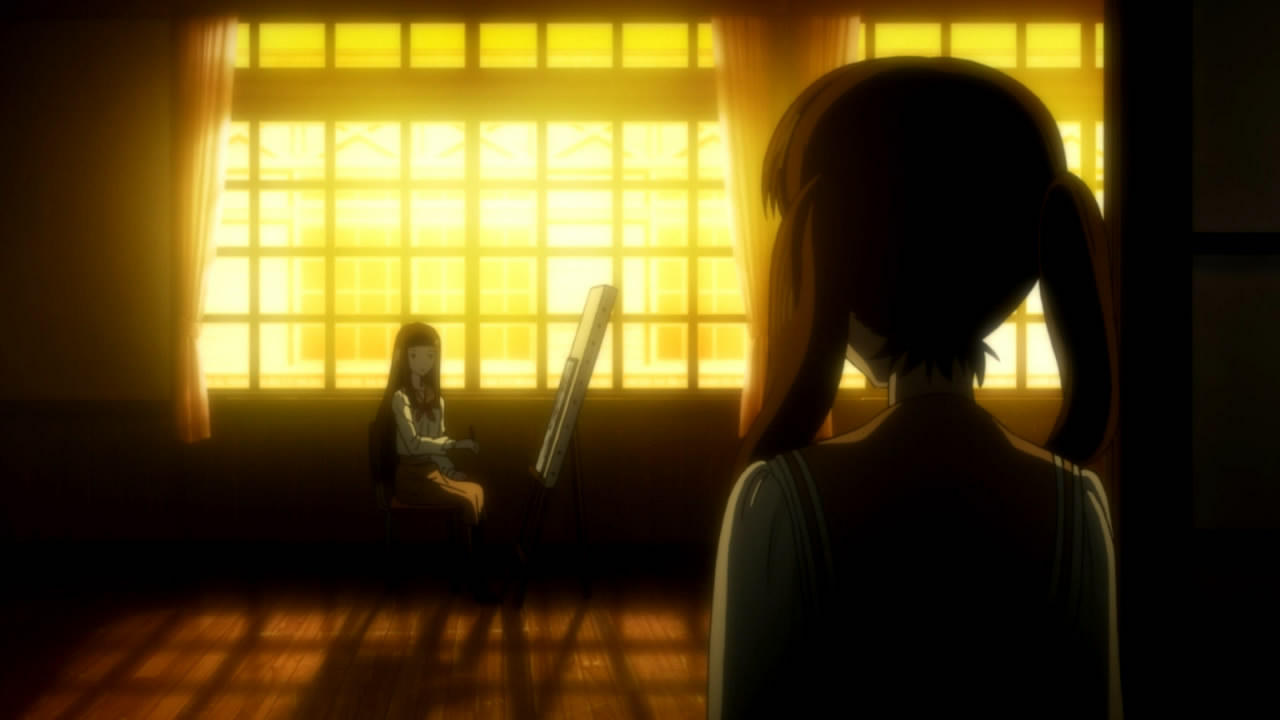
We get an interesting quote from our new killer:
It seems you can’t choose the life you wish. I understand how hard that is. In this era, the System determines everyone’s aptitudes and we all have no choice but to live by it and be satisfied with only a happiness forced upon us… as we are unable to make our real dreams come true. The person you desire to be… Your true worth… Don’t you want to try discovering them?
There are a couple interesting ideas to unpack here. Obviously, these words don’t conclusively prove whether we have free will or that everything’s deterministic (or perhaps both if you’re a compatibilist!). Even if the world is wholly deterministic, however, the writer has taken the stance that the mere illusion of choice is superior to accepting that the “System” can decide everything for us.
More importantly, I think we have to take into account the ideas of transhumanism and its attendant philosophical concerns. First, the “System” is dehumanizing because it alienates the people from their work. After all, you don’t get to choose your occupation unless you’re as talented as Akane; you merely accept what you’ve been assigned. Furthermore, the entire system alienates people from within the society. Latent criminals are shipped off to God knows where for “therapy.” Plus, even young girls are segregated from the rest of the population because there’s a fear that they might act out. We’ve also seen examples of social outcasts retreating to the Internet. From a transhumanist standpoint, you might consider PSYCHO-PASS‘s setting a utopia, but its definition of humanity is restrictive and flawed.
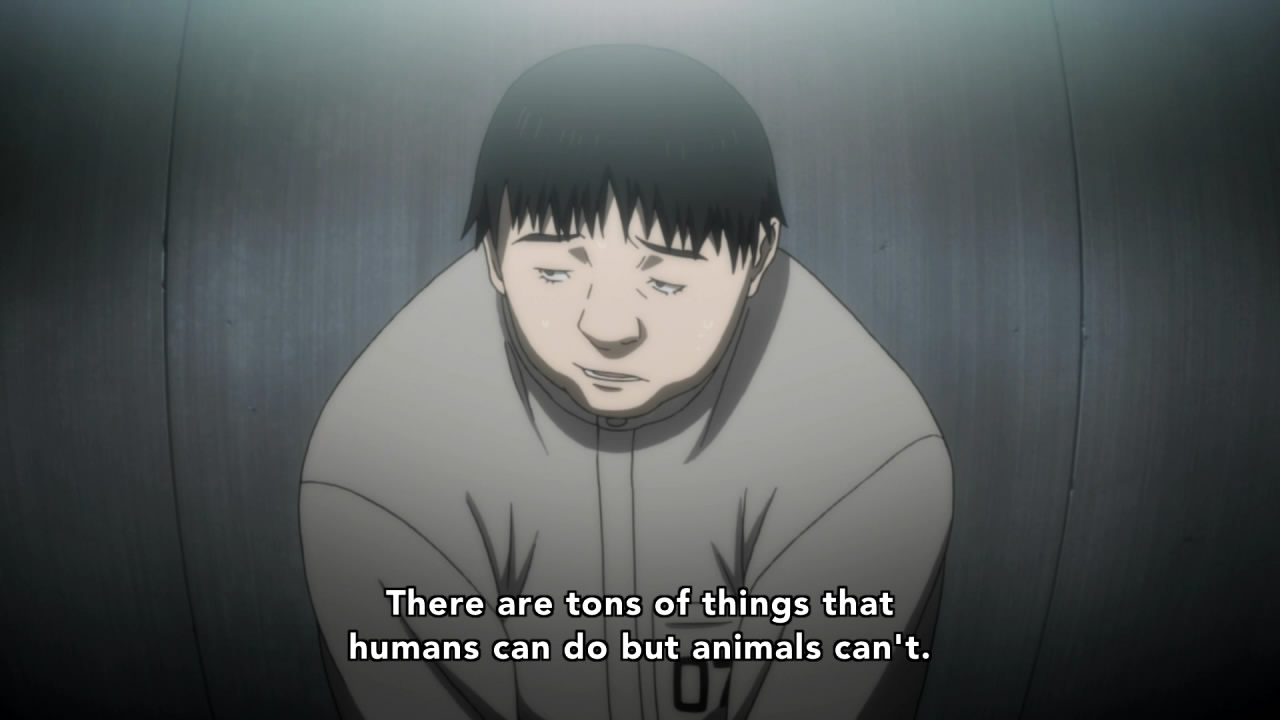
This is thus why Akane’s the main character: what Ginoza considers unprofessional is ultimately her maternal trust and connection to everyone, including latent criminals. For instance, she didn’t need a machine to tell her that the rape victim in the first episode needed help. Even though she is in charge of Shinya and the other Enforcers, she doesn’t take an authoritative stance with them. Instead, she connects with them the same way she connects with the world-at-large, as corny and (perhaps) trite as that might sound. But then what separates Akane from the popular high school girl we meet in this week’s episode? After all, Miss Oryo seems to decry the same dehumanizing System. Rather, it is because Oryo doesn’t nurture, but preys upon others. It’s too early to determine the girl’s true motives, but it is worth keeping in mind that she enjoys Titus Andronicus for its utter cruelty, especially toward the female characters.
Plot summary: We get three related plot threads running in parallel. First, Akane tries to investigate Shinya’s past and what led to his downfall. Next, we see Ginoza and the rest of the team draw a tenuous connection between the drone incident in the third episode and Mido’s hacking from the previous arc. Finally, we meet our latest murderer, a young, high school girl who turns her victims into art.
Notes:
• In the opener, we learn that Shinya’s former codename used to be ‘Shepherd 2.’ I wonder if this is any indication of biblical references to come. Plus, it’s rather patronizing that an Inspector is represented as a shepherd, and the Enforcer represented as a hound.
• I wish you could get a good look at what happened to Sasayama, Shinya’s former partner. I know it’s usually effective to leave it up to the imagination, but it seems as though Sasayama’s body had been contorted unnaturally, and I can’t make any heads or tails of it.

• Y’know, I just thought of something. This isn’t really pertinent to the narrative of the anime, but it’s something to think about… the PSYCHO-PASS system is obviously designed to prevent crime, right? Would it flag a suicidal person then? Does the society in this anime even consider suicide a problem? Hell, nevermind suicide — if you could quantify a person’s mental state to such a degree that it allows you to prevent crime, would you use it to detect depression or any other form of mental illnesses that could lead to danger to oneself or others? Why or why not?
• We see Ginoza talking to his chief. The two of them are discussing Akane’s performance thus far, and the lady says something that I find odd: “There’s still at least a chance she’ll end up in an unfortunate state similar to that of your partner, who started the same year as you.” I guess Shinya used to be a bright, wide-eyed idealist like Akane (we later learn that Shinya scored high on tests as well). Otherwise, the comparison wouldn’t make any sense. As an aside, the “who started the same year as you” part is clumsy writing.
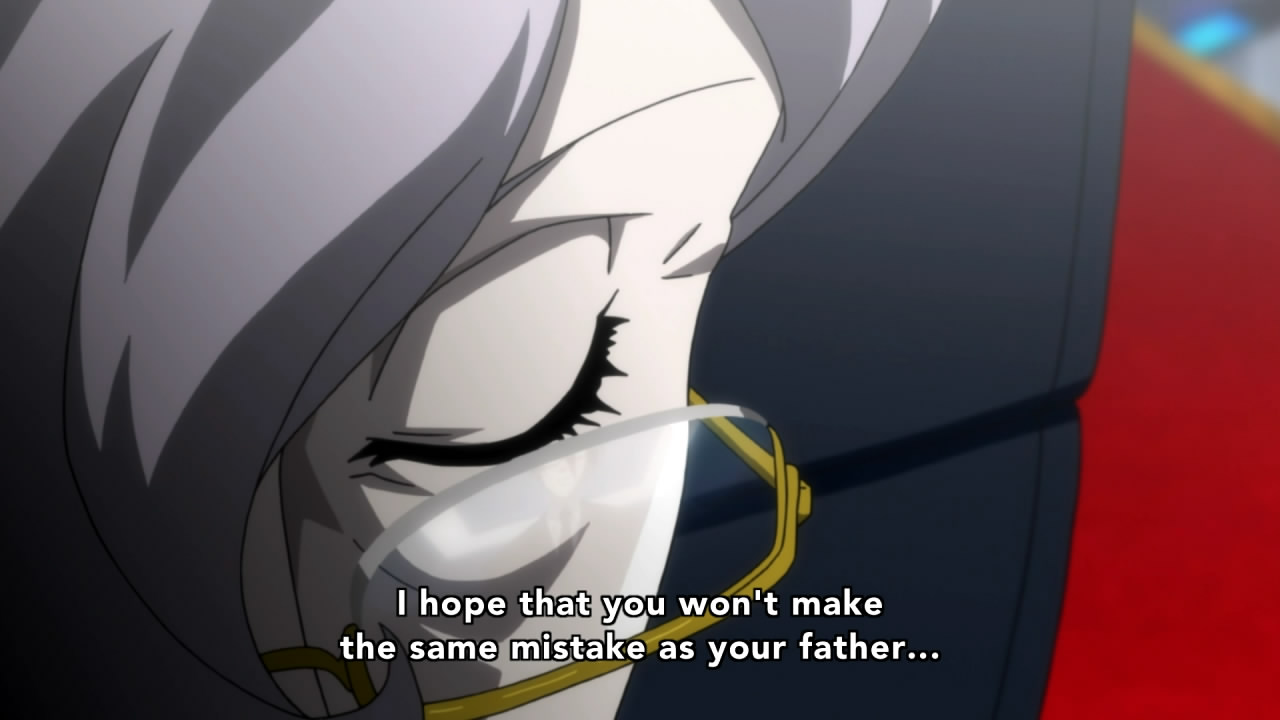
• First, the old lady says, “A causal relationship between genes and Crime Coefficients still hasn’t been scientifically proven. However, that also means that it hasn’t been scientifically disproven.” Then she goes on to condescend to Ginoza: “I hope you won’t make the same mistake as your father…” The first line is fatalistic, i.e. if there is a causal relationship between genes and Crime Coefficients, Ginoza’s going to end up a bad guy no matter what because ‘badness’ is apparently hardwired into his genes. But then she warns him not to make the same mistake as though he has any control over it… which would sort of imply that there isn’t a causal relationship between genes and Crime Coefficients. She only gives him that warning, however, if there’s a chance that a casual relationship exists! Otherwise, why would she even bring it up? Oy vey.
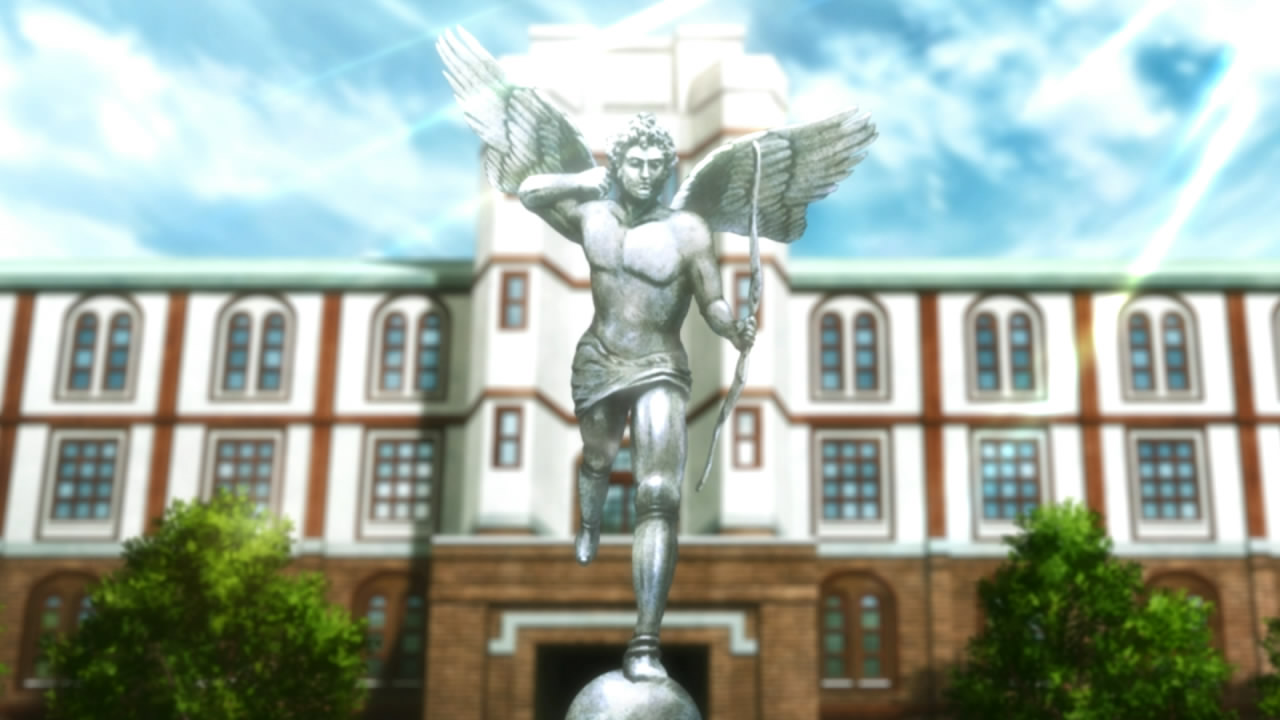
• What’s with this season and Shakespeare? Oh well, at least the playwright is better than that other recurring topic.
• When Shusei teased Akane about her possibly being in love with Shinya, her laugh sounded so fake. By the way, where are these two at the moment anyway? It seems like some kitschy, retro arcade. Kinda hipsterish when you consider PSYCHO-PASS‘s setting.
• Shusei has those hairpins in his hair much like Yoshino of Zetsuen no Tempest.
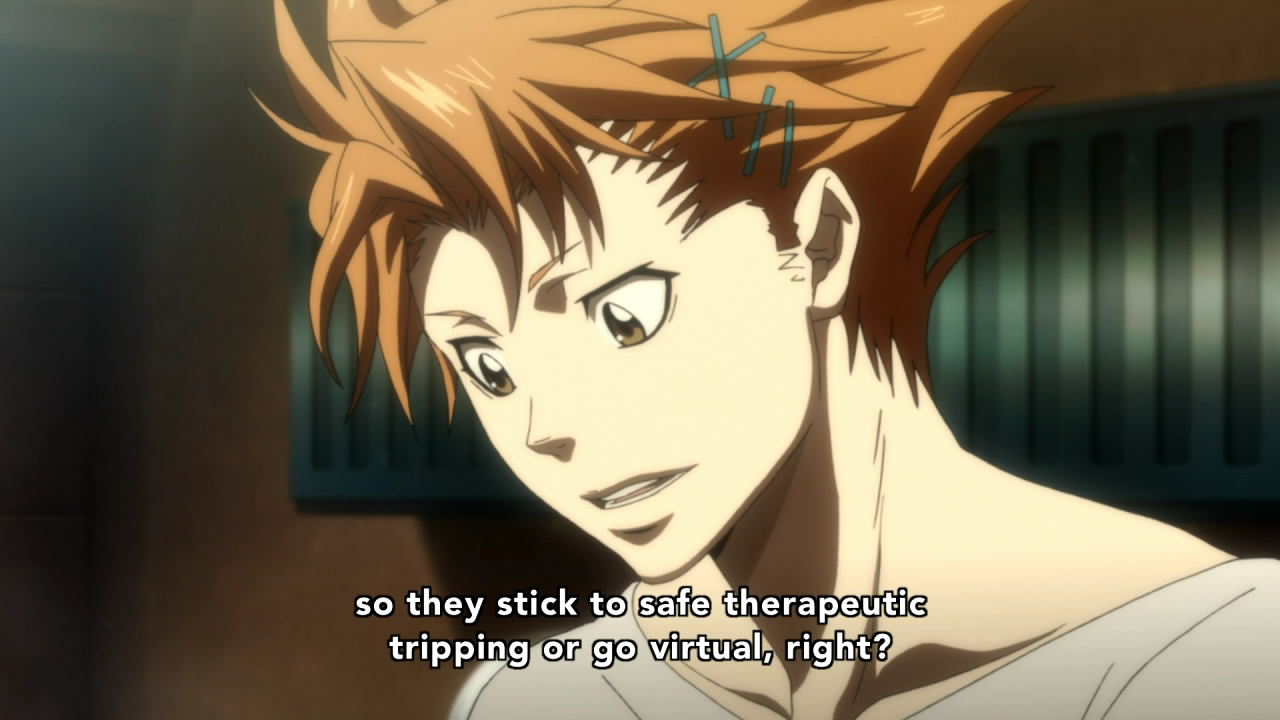
• I guess everything’s virtual now, even getting drunk. People are afraid to drink alcohol because they want to avoid becoming addicted to it. That’s interesting. Is this a fear born out of self-concern, or does alcoholism tie into our crime motif? Certainly, the effects of drunkenness plays a part in lowering our inhibitions, which could raise the possibility of crime. According to Shusei, people will opt instead for “safe therapeutic tripping,” but I’d like to know more what this really means, i.e. how is it different from just getting drunk? Obviously, it’d be done in a way to avoid the physical dependency that results from an addiction like alcoholism, but how does one prevent “safe therapeutic tripping” from lowering one’s inhibitions in a way that would make crime possible and thus flag the PSYCHO-PASS system? Of course, we also learned last week that someone can avoid detection for FOUR years, so I guess you could always trip your balls out as long as you don’t literally walk in front of a scanner.
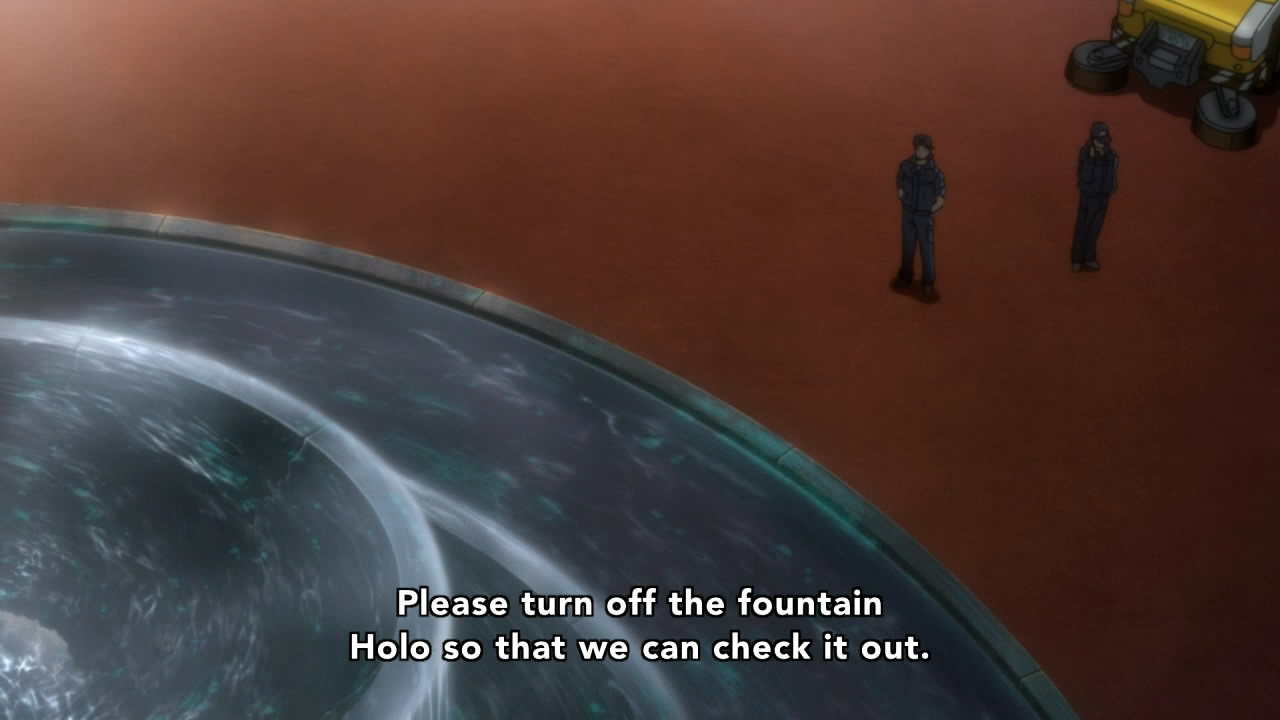
• More instances of the cyberpunk theme: passersby confused the grotesque “plastination” of victims with holograms. It isn’t a stretch of the imagination to think that the impact and gravity of death might be diminished in an increasingly simulacra-driven world, but what are the consequences of a phenomenon like this? It’s a popular belief that certain serial killers crave fame and notoriety. Suppose you have to keep escalating the method of killing because people are desensitized…
• “Right after he went missing, the crimes stopped, so it’s certain that he must’ve been the culprit.” Man, what great detectives you guys are. Shion even later says that the high school teacher knew nothing about chemistry! “Certain,” my ass.
• Huh, a school that keeps “girls of susceptible age isolated from society in a conservatory environment.” May as well just stick them in a nunnery. Honestly though, aren’t these girls in danger of a culture shock anyway once they leave the school? Who hasn’t heard stories of sheltered kids going hog wild once they enter the real world and are left to their own devices? Hell, this is one of the reasons why abstinence-only sex education so often fails.
• A common motif throughout the show: the failure of men. This now seems to extend to fathers as well. I’ve pointed out before how every latent criminal happens to be a man except for the rape victim in the very first episode (this time, however, the killer seems to be a young high school girl). Even then, you could argue that she was forced to have a dangerous hue. So anyway, early in this episode, Ginoza’s superior warns him not to follow in his father’s footsteps. Now, we learn of Yoshika’s former father and how his enormous debt has forced her mother to marry a sketchy man. This sketchy man is now preying upon Yoshika. Again, we see the failure of men, but more specifically, the failure of fathers. What is the point that the writer is trying to make? On the flip side, does this say anything about the role women play in the world of PSYCHO-PASS?
Let’s also consider the patronizing relationship between the common Inspector and his or her Enforcer. We can assume this because the anime makes a point of distinguishing Akane’s behavior as atypical. Did Shinya fail to serve as a proper authority figure to Sasayama? After all, the characters purposely draw a comparison between Akane and Shinya, and it can’t just be due to their high test scores. Akane stands out from the rest of the cast because she’s compassionate, i.e. she doesn’t just follow the protocol like other inspectors. As such, was Shinya, at one point, too compassionate as well?
• Yoshika reveals that her last regular check-up yielded a cloudy hue, so regular check-ups do exist… at least for children. Again, why would the same Big Brother-esque society not extend this to adults as well?

• What can we take away from Miss Oryo’s retelling of Lavinia’s fate in Shakespeare’s Titus Andronicus? On the surface, Lavinia’s tragedy obviously mirrors Yoshika’s current troubles, but perhaps the story also reflects the world of PSYCHO-PASS as a whole: “…[they] cut out her tongue, and cut off her arms as well. … She was killed by her own father.” Right after these words are uttered, the anime cuts to a surveillance camera, and this is hardly accidental. Our “father” here might represent the government itself, and how it has “cut off” its people’s arms and tongue, i.e. limiting their freedom.
Or is it possible that Oryo is actually referring to herself? It’s obvious from this episode that she takes a keen interest in art, but it’s hard to see the same System we’ve been talking about assign people like her to become artists, y’know? Perhaps, then, our killer feels as though her tongue and arms have been metaphorically cut off. As a result, she acts out. Over and over, those like Ginoza tries to hammer home the message that criminals cannot be understood. Within this restrictive world where one cannot even choose one’s own fate, then the only meaningful act of rebellion is itself incomprehensible. In some twisted sense, murdering her own classmates might be Oryo’s only chance to display her art in a way that the restrictive System would take seriously.
• Are we just now suddenly addressing the aftermath of the third episode? Hm. Somehow, Shion comes to the conclusion that the same person might be behind both Mido’s hacking from the previous arc and the drone reprogramming because there are “similarities” in the coding. I’m not sure how I feel about this development. I mean, the whole mastermind pulling the strings behind the scenes is just so tacky. Plus, it dehumanizes the criminals.

Rather than random people committing crimes because of their individual situations, we instead have one evil dude leading everyone astray… like Satan, even. Similar to the oft-lambasted System, the idea that we can blame everything on a singular, corruptive force diminishes a person’s agency, even if it’s a bad guy. Shinya then goes on a hunch and suspects that the person behind the “plasination” murders is also the culprit behind both the drone reprogramming and Mido’s hacking.
• This time, however, rather than a murder victim being mistaken for a hologram, the victim herself disturbs the peace. Her corpse becomes the abjection that pierces through the illusion of the simulacra, causing the water fountain hologram to malfunction. But isn’t it interesting how a disfigured corpse can pass off as a hologram, but the young girl’s pristine body is easily spotted? Again, this plays into the idea of the hyperreal that we talked about last week.
• Yoshika’s body invokes crucifixion imagery, but with key differences. Her legs have been attached to her shoulders, and her arms have been twisted and attached to her thighs. You can even see in a later sketch where Oryo has dismembered the poor girl. Her head has been removed completely from the neck, and in its place is a flower. You don’t need Georgia O’Keefe to realize that flowers represent a woman’s vagina. By inverting the young girl, her vagina now becomes her “head,” but why? Is it that a girl’s chastity is her most precious quality? Obviously, the limb dismemberment mirrors Lavinia Andronicus’s fate in Shakespeare’s play. Rather than being disfigured, however, our victim here becomes a monument, but a monument to what?

It’s too early to say, but time for speculation. It is perhaps a monument to the girl’s innocence. After all, Yoshika had been so concerned about the mere threat of her stepfather’s “obscene” actions that her hue turned cloudy. Did Oryo target her because of this? Did Oryo seek to slay Yoshika before the poor girl could either kill her stepfather or, instead, be ravished by him? Makishima (speaking of which, how does he manage to find all these whackos?) talks of how all beauty eventually will wither away: “…it’s just natural for one to want to stop time, while they’re still blossoming in full glory.” By killing Yoshika now, the victim maintains her innocence. More importantly, her virginity blossoms where her head used to be (though, ironically, she had to lose her “maidenhead” for this to happen). The victim’s budding womanhood is kept in perpetuity along with the onset of menstruation (as symbolized by the strikingly red color of the flowers being used in this scene).
If Yoshika is sacrificed at the altar of chastity, Oryo previous words then resonate with a whole new meaning: “I can show you… the true beauty that’s hiding inside you, Yoshika.” Lavinia was killed because, back then, the act of rape shamed the victim and her family (also, Titus was likely mad by that point). Yoshika had not been raped unless you take seriously my analogy of the government restricting a person’s agency. Let’s say, however, she had not been raped yet, and thus her virginity remains intact and in full bloom. But her killing is also ironic in another sense, because Oryo had just previously decried the System for the way it forces people to be happy. Despite this, Oryo steals a life in order to perhaps preserve her own ideas of beauty. She is probably a hypocrite.


About time you updated. I was suffering from Moesucks withdrawal. On a serious note, this show seems pretty deep. Do you believe this show has promise? Are you enjoying it? I may have to look into Psycho-Pass at a later date when I have time… the Winter 2012 anime season feels pretty dry. I am enjoying Btooom’s island survival story, but it’s far from a perfect show. And SAO just sucks.
There aren’t any shows worth writing about on Mondays, Tuesdays, and Wednesdays. I would’ve done another rankings post, but my friend roped me into playing League of Legends for hours everyday. :I
Yeah, I’m enjoying it. It has flaws, of course, but I think it’s more thought-provoking than your average show. That could just be due to my tastes, but I think it’s worth giving the anime a shot. The first three episodes can seem a little slow though.
Oh BTOOOM!… you so crazy.
To be honest, this anime has more of an insight to the Teenage Girl Idealism of Purity (and possible Slut-shaming) that is so rampant nowadays (ESPECIALLY in Himiko’s suicidal speeches in BTOOOM! where she wants to die “as long as she is pure”). Hell, I personally think that that’s what that statue/murder represents: That Purity is more important than life itself and that it represents the entire summary of the woman.
Yeah, the placement of the flower is unmistakeable. I also forgot to mention its color. And since the flower is blooming, you could say the victim is preserved in that budding state of puberty, the onset of menstruation, etc. It’s also clear now that the statue is meant to contrast the plastination examples we got from earlier in the episode. When you preserve someone as tainted as an Enforcer, what you get is a twisted, cadaver-esque result. With a teenage girl, however, not only does she look pristine, her skin has been lightened to conform to a very widespread beauty standard.
I still think there’s an ideological bent to it. Oryo is a hypocrite because she’s an extremist, just on the other side of the issue. She bemoans the restrictive, transhumanist system, but her monument to true beauty appears to invoke antiquated notions of feminine beauty. Of course, it’s still early so let’s see how the rest of the her story plays out.
Yeah, the placement of the flower is unmistakeable. I also forgot to mention its color. And since the flower is blooming, you could say the victim is preserved in that budding state of puberty, the onset of menstruation, etc. It’s also clear now that the statue is meant to contrast the plastination examples we got from earlier in the episode. When you preserve someone as tainted as an Enforcer, what you get is a twisted, cadaver-esque result. With a teenage girl, however, not only does she look pristine, her skin has been lightened to conform to a very widespread beauty standard.
Great eye on the skin color there.
Also, look at the bottom part. the arms replacing the legs are twisted around each other like a coil . Symbolizing the will to never tear it apart even by forceful means. I know it’s censorship shtick, but I was thinking that the bosom/chest part that somewhat looked as hard as a mannequin’s, the only one exposed in the entire art, and where the head replaced somewhat below out of representing comfort from the pain of losing such innocence despite different viewpoints and backgrounds. Hell, that’s what her Yoshiko’s last moments involved: Comfort.
Do you suppose the arms stand for the legs too? After all, if chastity is so important, shouldn’t it be the legs that are bound together? But I think you’re onto something. The girl’s vagina hasn’t moved, just the representation of it, i.e. the flower. The vagina itself is still in the same place, i.e. just above the coiled arms. Instead of them being arms, per se, which is what they literally are, I think the statue instead has two pairs of legs. I wonder if this speaks even further to Oryo’s hypocrisy if purity and innocence is what the statue is trying to represent as true beauty. After all, a woman with two pair of legs is arguably hypersexualized compared to any regular ol’ woman.
We can build upon this if we also remember last week’s theme of the hyperreal. The audience knows that the victim is literally a child, but she’s been put on display in a way that invites sexual interpretation. Even if purity is ultimately being championed, Oryo steals that innocence in order to put it on display. I think he victim’s similarity to a mannequin, especially its distinct lack of crude sexual features such as nipples and whatnot, speaks to a certain ambiguity in the artwork itself: are we looking at a child or a woman?
I think the statue instead has two pairs of legs.
Well, checking the picture again, I can see the two pairs of legs involved. So I’m guessing that there is some mild animalistic tones in this statue as well: maybe to state that even though the woman is pure as snow, she is still an animal thus having primal instinct that is apparently restrained by the vines in the statue and the coiled legs on the bottom. Purity is sort of the restraint of the woman’s animal instinct. Sort of like how Psycho-Pass is preventing potential criminals by generally restraining everything that unleashes their primal instinct.
I’m also not surprised about the two pairs of legs since I know that another student was missing before Yoshika. Do you think that the victim before Yoshika also faced the same Purity-questionable issue like her? (Not the same exact issue, maybe just the gist of it)
No, I meant the arms represented legs anyway so it looks as though she has two pair of legs, not that she literally has two pairs of legs.
> What’s with this season and Shakespeare? Oh well, at least the playwright is better than that other recurring topic.
You mean that four-letter word that starts with the letter “R”? ;)
> It isn’t a stretch of the imagination to think that the impact and gravity of death might be diminished in an increasingly simulacra-driven world
Think of the history of modern society’s steady desensitization to sex and violence. 60 years ago, a passionate lip-to-lip kiss on screen would be considered a moral scandal. Similarly, to show a person spilling blood on screen would be a symbol of moral depravity. Think of how things are different now.
In a similar way, think of how few of us nowadays can watch a film from the early 1900s without getting distracted. Nowadays, with Bourne Ultimatum-esque split-second editing, watching a movie with shots that last 30-40 seconds is a painful experience for all but the most enthusiastic of film-goers.
> Hell, this is one of the reasons why abstinence-only sex education so often fails.
Dystopias and socially-reactionary thought are not reality-based belief systems.
> Again, why would the same Big Brother-esque society not extend this to adults as well?
I thought they did? Didn’t those factory workers have regular check-ups?
> Right after these words are uttered, the anime cuts to a surveillance camera, and this is hardly accidental. Our “father” here might represent the government itself, and how it has “cut off” its people’s arms and tongue, i.e. limiting their freedom.
Yeah, I thought that that was an excellent visual metaphor for surveillance state totalitarianism.
> In some twisted sense, murdering her own classmates might be Oryo’s only chance to display her art in a way that the restrictive System would take seriously.
It makes me think that Gen is a reactionary, the kind who think that different people have different natures that are impervious to change.
> She is probably a hypocrite.
To put it very mildly.
At least in the US, it’s worth noting, however, how cultural depictions of sex have gone backwards since the sexual revolution of the 60s.
There’s some truth to this, but I think your characterization of the average moviegoer is also a little unfair. Over the past century, there have been huge advancements in not just film technology, but the art of cinematography alone, i.e. how to stitch together what is essentially a dreamlike sequence of shots into a compelling sequence of narrative events. For certain films, they’re just more interesting to watch, and I think it’s somewhat cynical to believe that the constant cutting is the only thing keeping moviegoers awake. I can’t speak about the Bourne Ultimatum series, however, since I have yet to watch a single one of those films.
I probably should have said “all adults.”
>The PSYCHO-PASS system is obviously designed to prevent crime, right?
I always thought that since the system is meant to measure a person’s mental condition, it’s possible for it to pick up any mental illness. However, we’re following the enforcement group so we mainly see people who have gone past the crime coefficient. If the show were to follow Akane as she worked in a therapy centre, we might see more individual who are on the borderline. ( cloudy Psycho-Pass with an increasing crime coefficient.)
Anyway I’m loving the show and it’s always great to read your posts afterwards
Well, I was just asking speculative questions. Perhaps the same system is being used in all facets of life, right down to which pair of shoes we’d want to buy. Let’s go check my psycho hue!
Oryo strikes me as a genderbent Jeffrey Dahmer.
All that talk of plastination reminded me of the Body Worlds exhibit, the one where various sections of cadavers are plastinated and displayed for educational purposes concerning human anatomy. It’s been a while since I last saw it, but that shit was crazy weird.
Having a mastermind does minimize the impact of each criminal, doesn’t it? Though, to be fair, the only purpose I can glean from this kind of person is that they just enable people who are already willing to murder, which doesn’t exactly dehumanize them. It just standardizes each criminals’ state of mind (since all of them fall off the deep end once they get their hands on a means to kill without repercussion). Though, It would at least be interesting to know if there’s a sane motivation for providing methods to people’s madness, other than the good ‘ol anarchic “for the lulz.”
Dahmer raped and ate his victims, so I wouldn’t quite draw that comparison just quite yet.
It’s similar to what happens when you try to hold a corporation responsible for its unethical behavior. Because a corporation represents a body of people, there’s a diffusion of responsibility, and not only do people feel less responsible for their actions, they face lesser punishments as well. The same thing happens here. I doubt the guy at the drone plant would’ve killed anyone all by his lonesome, but having an accomplice lets him pin the blame on someone else. Yes, his psychological make-up probably indicates that he has the disposition to kill, but his actions are ultimately orchestrated by another, thereby diminishing his agency. I would say that this is somewhat dehumanizing if not completely.
I noticed that you didn’t talk about how moe Yayoi was while she was sitting down on that lofty couch, eating instant ramen nonchalantly, while the other two were discussing and looking at images of gruesome crimes. :3
Aw man! I knew I forget about something!
It’s not too late to fix it!
But if I do that, it diminishes the impact of your comment! For your sake, I cannot. :I
Then do it for the children!
Given how Libertarian many strains of Transhumanism is, I’d say Psycho Pass would be a dystopia, even to Transhumans. More accurately, Psycho Pass is Urobuchi’s take of the Post Human Dystopia prevalent in western Sci-fi. On a final, unrelated note, I have no doubt the BDs would be even gorier. Never mind that Psycho Pass is not meant to be watched with either Lunch or Dinner.
Libertarian transhumanism is only a subset within the larger transhumanism umbrella. There’s no doubt that it’s a very vocal subset, but I wouldn’t say all transhumanists would deem PSYCHO-PASS a dystopia.
“Posthuman” as a term encapsulates multiple meanings. You’re going to have to be specific as to which one you’re referring to, but to be honest, I don’t see how this show is either posthuman within the context of critical theory, or posthuman in the transhumanist sense.
This episode reminded me of “Mouryou no Hako” with the school girls and creepy statues.
• If you could quantify a person’s mental state to such a degree that it allows you to prevent crime, would you use it to detect depression or any other form of mental illnesses that could lead to danger to oneself or others? Why or why not?
Yes, I think it would flag the suicidal person as someone who has a dangerous hue because they’d have the potential to cause harm. Not sure, how they would handle mental disorders hmm, I imagine the future has a more sophisticated method than locking everyone up in mental hospitals.
@Makishima: I wonder if he’s looking for someone has the most potential to become the most dangerous criminal out of everyone, who is on the edge of sanity. Maybe, these are just trials for his to test them for a future plan.
Mouryou no Hako had a great soundtrack though. On the other hand, I can’t say PSYCHO-PASS’s soundtrack has been all that memorable.
You’d think that, but none of the latent criminals seem all too keen about their second class status.
I dunno… in the end, his killers all arrive at the same end result: death. I can’t really say any one of them has been any more dangerous than the others.
I wonder how Oryo was capable of bypassing the regular check-ups. Can people who are insane incapable of feeling guilt have a flawless psycho-pass after harming someone or was is something else?
Well, we learn in the third episode that a person can appear normal after he or she has committed a crime. Maybe the same thing is happening here. Right before she has a checkup, Oryo murders a classmate and her urges return to normal or something.
The girl’s body is a mockery of CID’s Caduceus logo. See how the arms twist around each other?
That’s possible, but why mock that specific logo?
The better question is why is a police force using the caduceus, typically a symbol for the medical profession, as its logo. There are also the scales on there that represent the justice side of things. Someone on another blog was making an argument that their symbol was also a symbol of purity but in a cleansing sense. The scales suggest that they are rather forceful about assuring purity of mind. Whether it mockery of the logo was encouraged by mastermind guy or not I wouldn’t be surprised if Kagami interprets it as a challenge.
Unless the System believes you’re too far gone, the MWPSB merely ships latent criminals off for “rehabilitation.” You never hear of a trial process. You never hear of sentencing or deterrence. These people actually think they’re helping the latent criminals; it’s a stark contrast on the retributive justice commonly adopted in our contemporary society. To the latent criminals, the “rehabilitation” is likely nothing more than punishment, but the System itself has to believe that it’s healing not just its people, but its society as well. Characters on the show even refer to the PSYCHO-PASS scans as check-ups, which itself has a medical connotation. Anyway, I don’t find the police force using a medical logo all that puzzling.
Well I would suggest it’s somewhat puzzling because they seem to be violating the whole “first do no harm” thing they like to use in medical ethics. There is also the argument that the creators may be aware of the incorrect adoption of the caduceus as a medical symbol when they really mean the rod of Asclepius. The use of the caduceus as a medical logo is itself erroneous so perhaps the “mockery” bit is drawing attention to the hypocrisy of the MWPSB.