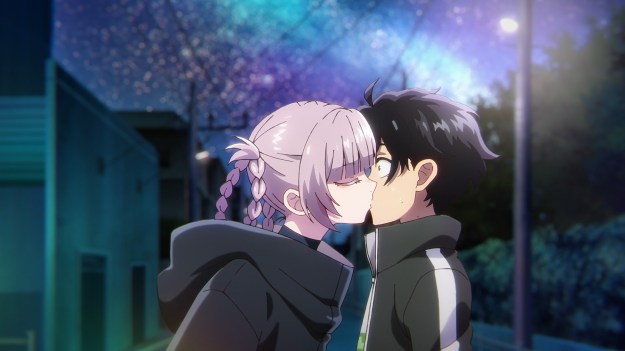
I’ve watched over 20 episodes of Call of the Night, but I still don’t really know what to make of the anime. For starters, it’s a rather awkward vampire story. Vampires already have a lot of rules that you must adhere to. They hate garlic. Sunlight hurts them, but barring that, you can kill them with a stake through the heart. Now, this next part sounds ridiculous, but they supposedly can’t enter your home unless you invite them in first. Silly, right? There are probably more rules than that, but those are the ones that immediately come to me when I think of vampires. Well, Call of the Night has its own set of rules. If a human falls in love with a vampire, they get turned when the vampire feeds on them. If you’re not in love, however, and don’t fall in love within a year, then it’s over. You’ll never become a vampire. You lose that chance completely. Why? Beats me. It just seems like an arbitrary deadline to prevent Kou from dragging his feet. In any case, vampires refer to those they’ve turned as their offspring. So even though you’re in love with them, there will eventually be a strange parent-child dynamic on top of it. What kind of weird psychosexual trauma are you trying to inflict on me here? But wait, there’s more!
If and when a person turns into a vampire, they’ll begin to slowly lose memories from their time as a human. At the same time, however, Kabura tells us that you “can get a sense for what that person is feeling or thinking” by drinking their blood. But haven’t vampires been drinking Kou’s blood throughout this story? How come we haven’t brought this mechanic up until now? And if we have, why is Kabura explaining this to Nazuna as if the latter is unaware? Whatever, let’s move on. Personal items from a vampire’s human past can serve as a source of weakness. When Anko slides Akihito’s old pair of glasses onto his face, they completely debilitate him. This last part becomes the major impetus of the second season. All of Kou’s vampire buddies are scurrying about, hoping to rid themselves of any connections to their past lest the detective snuff them out for good. Nevertheless, this whole setup in Call of the Night is not just convoluted, the overall picture doesn’t feel particularly vampiric to me. Other than the fact that our creatures of the night must feed on blood (so do mosquitoes and leeches), I wouldn’t have pegged this as a story about vampires whatsoever.
With all the talk about falling in love, you wouldn’t be wrong to assume that this is also a love story — one where Kou tries to fall in love with Nazuna within a year before he loses his chance to become a vampire altogether. To make a long story short, he’s jaded about the drudgery of daily life, so he wants to roam the nights with his new friend. It’s a little more nuanced than that, but for now, this will suffice. My point is that this is the wrong way to go about falling in love. You don’t fall in love to achieve x or y goal. You fall in love because you’re in love — because you love that person. But Kou is still a child, so he doesn’t understand what he’s working with. Likewise, ignore the fact that Nazuna has been around for 30 to 40 years (the exact amount is never specified). Just accept that she’s somehow the same mental age as Kou, so she’s just as clueless as he is. Actually, it’s worse than that. The girl (woman?) can’t even broach the topic without suffering some sort of BSOD. Love is that embarrassing to her. None of this adds up to an anime that feels particularly romantic. To put it another way, Call of the Night is a story about love, but it’s not a story about romance. This is especially true when you look across the entire breadth of the relationship dynamics presented to us.

In order to protect Nazuna, our duo explore her past and origins. For example why can’t Nazuna remember anything from her time as a human? Why can’t she remember who turned her? As it turns out, she never had a human past nor was she ever in love. Convenient, isn’t it? The show hammers home the arbitrary rule that you must fall in love in order to be turned into a vampire, but Nazuna gets to remain pure for Kou. But silly and unnecessary pandering aside, we only learn anything about Nazuna’s past by speaking to Kabura. More specifically, Kabura’s unrequited love for Haru, Nazuna’s vampire mother. And when I say mother here, I mean an actual mother and not this weird offspring nonsense the other vampires have going for them. Kabura had her reasons for becoming one of the living dead: she was always sickly and her friends suck. There are a lot more details to it than that, but they’re not wholly relevant to this post. What’s important is that Haru was the only person who ever truly tried to understand Kabura and not just pay lipservice to the idea of friendship. And thus Kabura fell in love with the vampire. Unfortunately, Haru didn’t love her back in that way. Maybe she turned Kabura into a vampire because she loved her friend, but she certainly didn’t do it out of romantic love. There is romantic love for her, but it bizarrely occurs offscreen. Haru just showed up one day and confessed to Kabura that she got pregnant. She disappeared, found a human man, fell in love, got married, and all of a sudden a baby was on the way. Again, there is romance, but we don’t get to see any of it. We don’t even get to see what the dad looked like. Huh?
But this is a consistent theme in Call of the Night. Across the board, there is love but no actual couples. No one actually gets together. Is there a purer love than the one LoveGreen has for his master and idol Midori? But he doesn’t actually get to be with her. He just gets to worship her. Akihito and Seri used to be great friends until he fell in love with her. Unfortunately, she doesn’t like romance; she just wants to hang out with him. Nevertheless, he becomes one of her offspring even though he knows she can’t return his love. Even worse, she’ll one day think of him as her child, and he can’t really fight that. Moving along, there’s definitely something brewing between Kiku and Mahiru, but I bet you anything it won’t be healthy. Kiku seems like the yandere type, so Mahiru is probably in for a world of hurt. But wait, what about Nazuna’s mother and her human father? They certainly fell in love and had a child. Yay, romance prevails! Well, not quite. Again, it was all offscreen, but it’s even more tragic than that. Haru stopped wanting to feed after she fell in love, and as a result, she wasted away and died shortly after giving birth to Nazuna. Her love story barely existed. Even the humans don’t fare any better. Why does Anko (a.k.a. Mejiro) hate vampires so much? Because her family was arguably destroyed due to a vampire seducing her father. Obviously, you can’t put all of the blame on the vampire; her father is equally culpable. But that’s not the point. Rather, love in this world is fleeting. It’s either short-lived, or it never was in the first place. So what hope does Kou and Nazuna really have? Even if he does fall in love, will she love him back? And even then, can they actually stay together?
All in all, it’s a strange show. I can’t say that it’s bad, because it’s not. Call of the Night is made with a lot of care. The nightscapes are absolutely gorgeous, Nazuna’s VA puts in a laudable performance, and I rather like the soundtrack. But at the same time, I can’t quite say that I like the anime either. Between all the arbitrary rules and the doomed-to-fail love stories, Call of the Night leaves me cold and pessimistic. There is hope that Kou will find his way in life. After all, this is a coming-of-age story (what anime isn’t?). But reality is often sobering, and statistically, most people do not stay with their first love. Even worse, when love fails, it fails hard and rebounds into tragedy. Anko’s revenge is all about this. Her father cheated, her mother neglected her, and even though Nazuna didn’t do anything wrong, she couldn’t save her friend. As a result, the inability to genuinely love and care for one another is coming home to roost.
Stray thoughts and observations:
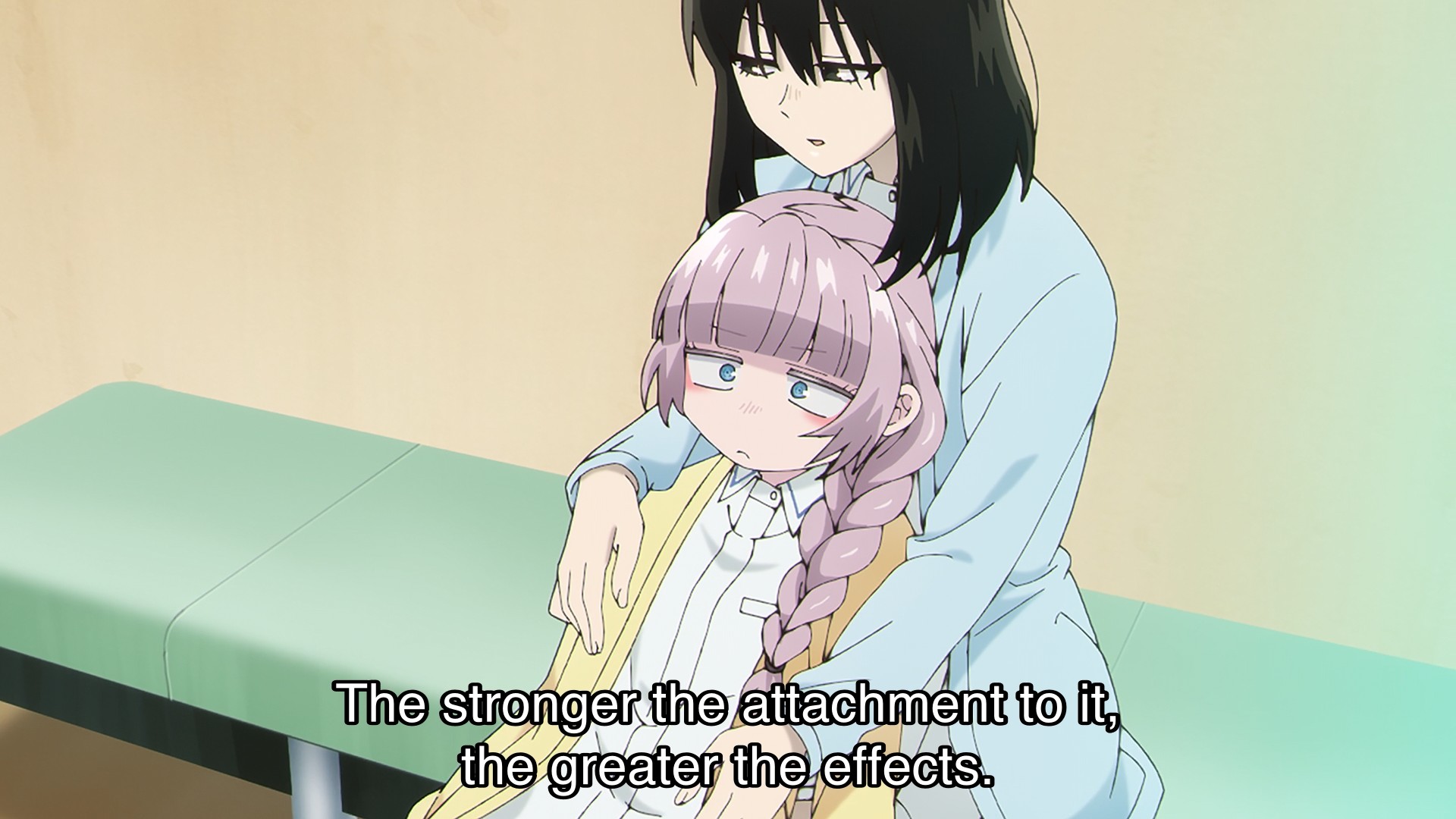
• Kabura raised Nazuna as if the latter was her own daughter. And yet because Nazuna resembles her mother to a tee, Kabura can’t help but feel arousal whenever Nazuna is around. She even refuses to talk unless her unrequited lover’s daughter dons a nurse’s uniform to make the transformation complete. That’s creepy, but I guess it’s on par with pairing a middle schooler with a middle aged woman.
• There isn’t much parental love either. I’m sure Haru loved her daughter, but she never got to stick around and raise her. Neither did her father. And where on earth are Kou’s parents?
• Anko’s anger and hatred stems from not just her father’s betrayal, but her mother’s neglect. Love in all of its nurturing qualities — romantic or not — is in short supply here. The closest thing we get is Kabura doing Nazuna’s hair, but again, there’s that weird dynamic where she also confuses her for Haru, so… yeah…
• They’re so reckless about turning people in vampires. Anko felt abandoned, so Nazuna offered to turn her. Basically, fall in love with me. “Do that,” she says blithely, “and I’ll stay with you forever!” You can’t declare such a bold promise on a whim! Luckily, or not so luckily, neither of them were in love.
• I’m not a big fan when it turns out that everything is all connected. More specifically, Nazuna is actually intimately familiar with Anko. What a small world we live in. Of course our antagonist just happens to be former best friends with Nazuna! Moreover, I find the overuse of flashbacks in the second season to be rather clumsy storytelling.
• I also have to quibble with Call of the Night’s over-reliance on narrative contrivances. Like how Kabura’s handy-dandy blood just happens to show Nazuna exactly the memories she needs to see. Or how Kou just happens to walk into the right room where Anko’s diary is conveniently sitting there for him to read.

Just my opinion, but I think you’re kind of missing the point. Vampire stories are always metaphors, often for sex and power. Each story therefore tends to have its own set of rules. In fact, that’s one of the things that makes vampire tales so popular.
You’re right that Call of the Night certainly has elements of a romcom, but much more important is the fact that it’s using vampirism as a metaphor for fitting in. Vampires don’t really fit into society, and that appeals to Ko, who feels like an outcast himself.
All of the show’s characters prefer the nighttime, which is the time to break norms. (Note that except for rare flashbacks, the entire story takes place during the night.)
There’s no sex because, well, this is anime, and outside of hentai there’s hardly ever sex in anime! More importantly, though, there are strong signs that Ko, for all of his emotional intelligence, is aromantic. Indeed, although since the end of the first season Nazuna seems to be falling in love with Ko, there are plenty of signs that she, too, is largely a stranger to romance.
Although to become a vampire you have to fall in love with one, it’s not really clear to what extent the vampires in this world feel love themselves.
Anyway, I have eschewed reading the manga so I can enjoy the anime with fresh eyes, so maybe my interpretations are off, but I honestly can’t understand anyone finding that this show leaves them cold.
Call of the Night is a pretty profoundly emotional story about finding your place in the world and I would argue that the first season—built as it was largely on vignettes and character studies—is one of the best anime I’ve ever seen, taking full advantage of what animation can add to a story, while still grounded in brilliant and subtle development of both its protagonists and supporting players.
I’m not sure why someone who was “left cold” by the final episode of that first season would even bother with the sequel.
I’m a little less sure about the second season, which has become much more plot driven than the first, though I’m happy to wait and watch this story arc finish developing.
Finally, I would note that this is fiction, and “narrative contrivances” are pretty much the coin of the realm. Granted, there are plenty of stories where the contrivances become too much, but I vehemently disagree that Call of the Night—a story about the insular world of vampires—is one of them.
Well, I tried to explain why it leaves me cold, but if you don’t understand my perspective, then I failed to communicate that to you.