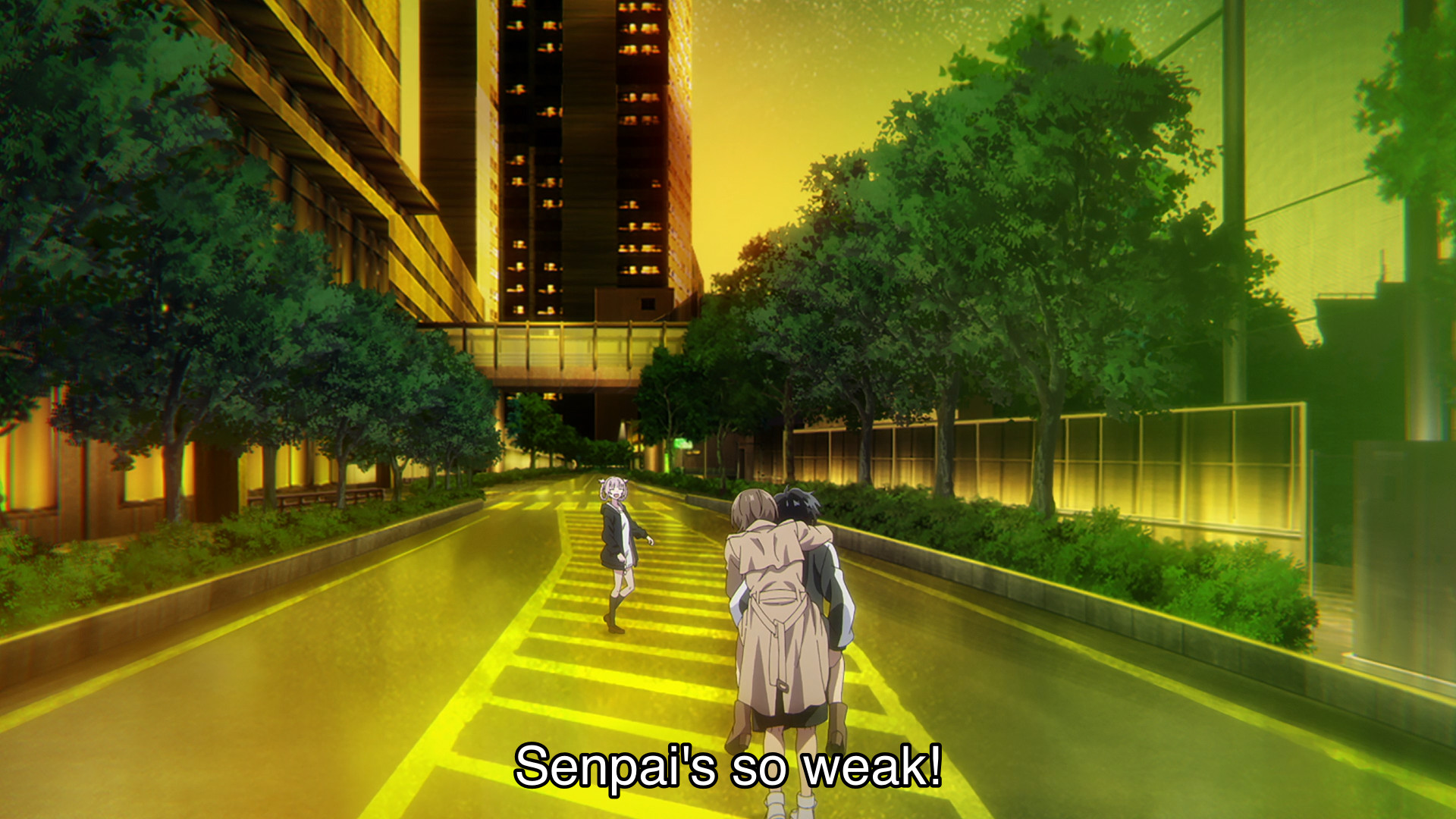
When the story resumes, Kou and Nazuna are still hanging out with Mejiro — well, a very drunk Mejiro who needs help just getting back to her apartment. This is a far cry from the tense atmosphere just two mere episodes ago. I take things too seriously, so I can’t exactly let bygones by bygones. Mejiro has admitted to torturing and experimenting on at least one vampire. Was it an evil vampire? I don’t remember. But does that even matter? We have laws against cruel and unusual punishment for a reason. It’s great that Mejiro and Nazuna can be friends again, but the former didn’t just do fucked up things. She had a fucked up mentality. Yes, there’s a reason she turned out this way, i.e. losing her family, but I don’t like wiping the slate clean like this. I don’t like erasing any part of our history. I’m not saying Nazuna and Kou should abandon Mejiro. Nor do I need to see the woman self-flagellate until I feel as though she has atoned. But the atmosphere is all hunky-dory now, and it doesn’t feel right.
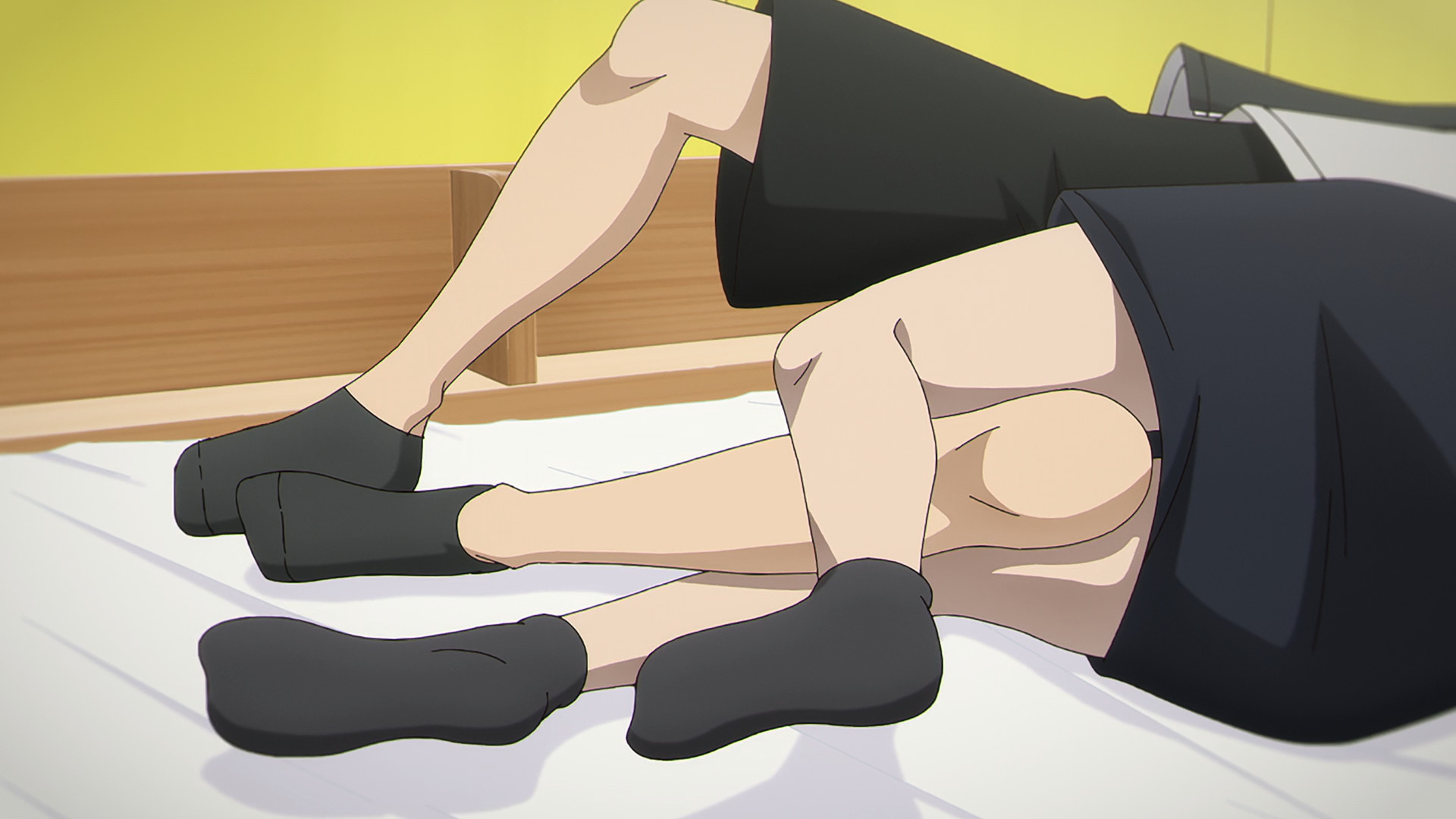
As we’ve often seen in the past, the show can be somewhat poignant but also profoundly stupid at the same time. Not only did Mejiro waste the last ten years of her life on what Kou sums up as “an elaborate suicide attempt… that failed,” she also lost out on her coming-of-age. She now wants to reclaim it for all the good and bad. Maybe if she experiences every mundane event along the thorny path to adulthood, she can feel “ordinary” like the rest of us. She can feel something other than depression and suicidal thoughts. I totally get that. I totally feel for her. But then she goes and tackles Kou to the bed. If she needs a shoulder to cry on, why him and not Nazuna? We can charitably assume that she’s simply teasing him while being vulnerable — it could even be a failed attempt to hide her vulnerability — but that’s still a 14 year old kid. There are things you can take back — life experiences that you can reclaim — but messing around with a teen isn’t one of them. It can’t be one of them. Go live vicariously through romcom manga like the rest of us.
What does ordinary mean anyway? Ordinary is relative. Ordinary shifts and morphs with the times and location. Ordinary changes, then it changes back. Fifty years ago, it was ordinary for someone like me to use separate drinking fountains. And maybe with the way things are going these days, separate drinking fountains will become ordinary again. Who can really say? By the time you feel normal, the baseline will have likely changed beneath your very feet. Chasing normality thus feels like a lost cause. If you even have to try to be normal, then you’re already kinda not normal (just ask the Shoshimin couple). All I know is that as long as you’re not hurting anybody, who cares about what is or isn’t ordinary?
After much reflection, Kou decides that he wants to find the vampire responsible for destroying Mejiro’s family. But he’s not seeking revenge. Rather, he wants to “hear them out.” That’s a touch naive, isn’t it? I get that he’s a kid, so naiveté is part and parcel with his identity. He needs to understand how lucky he is, though. He’s so lucky to have met such a good and well-intentioned group of vampires. That doesn’t mean they’re all like that. It’s no different than with humans. There are good eggs, and there are bad eggs. I’m just not sure what Kou’s hoping to achieve. Some sort of emotional catharsis for Mejiro? Even if that vampire isn’t dangerous anymore (assuming it’s still around), what if this encounter retriggers Mejiro’s feelings of loathing and hatred for both herself and vampires? I feel like there’s a lot at risk here. Yeah, we still have questions, but sometimes those are best left unanswered. Closure isn’t always what it’s cracked up to be.

The rest of the episode feels like a victory lap of sorts. Or the concluding paragraph to an essay, i.e. a lot of repeated themes. Talking about love. Talking about change. Talking about growing up. Talking about finding one’s place in life. These are all relatable topics to ponder about. Call of the Night doesn’t have anything new to say, but neither do most of us. Clearly, the show’s just not for me. I enjoyed Call of the Night the most when Mejiro represented a real and tangible threat to the vampires’ existence. But now that we’re back to holding hands and slinging back pints of beer, it feels, well, ordinary.