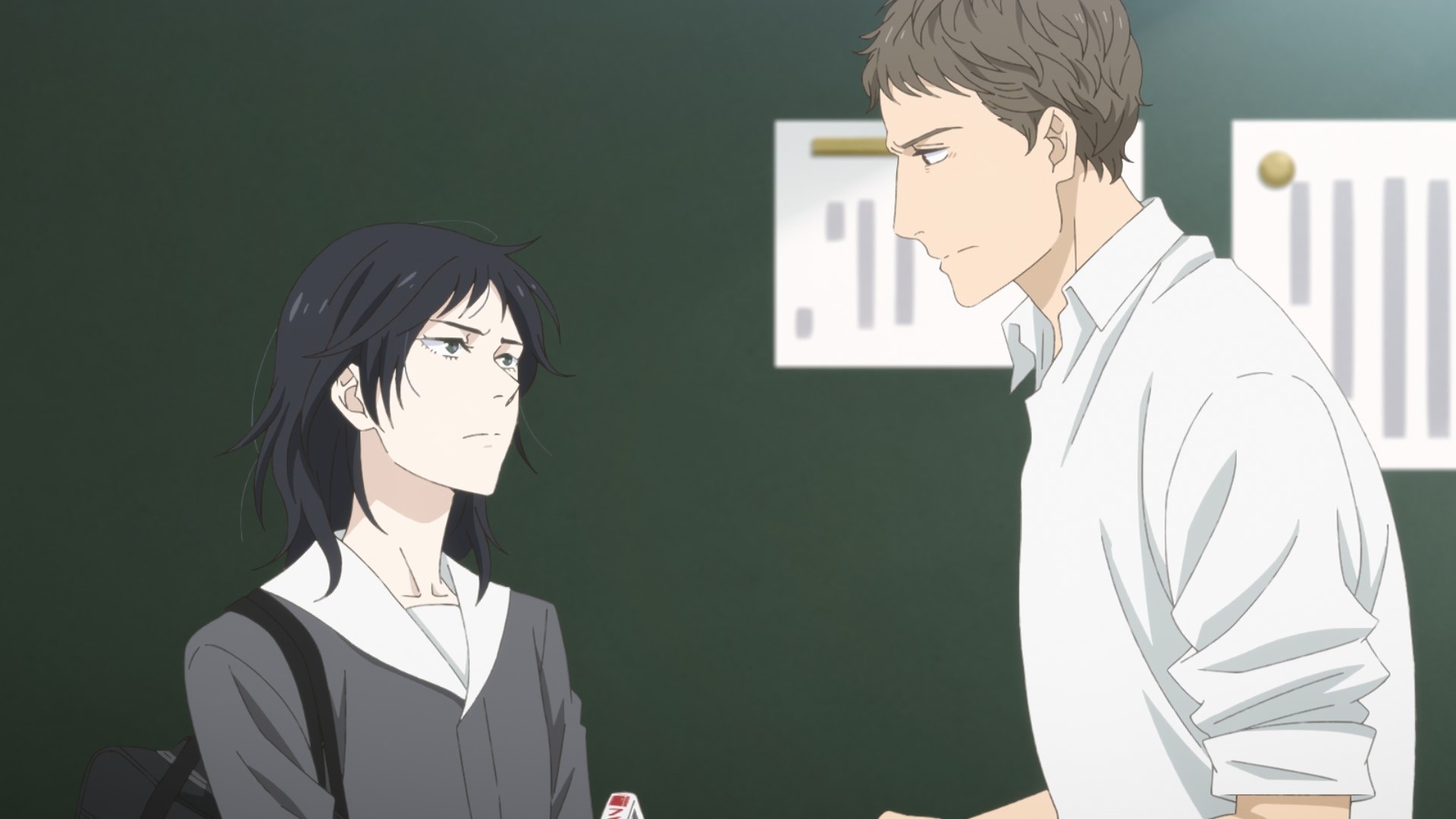
“Actually, I’m not really okay, but it’s fine” is certainly a mood. Chiyo asks Asa an even more pointed question a little later: “Did you think your life was over [after your parents died]?” The answer changes depend on when the question is asked. At the start of the series? Asa probably wouldn’t have an answer for Chiyo. These days, however, it’s an emphatic no: “It’s not over, because I’m alive!” And Chiyo can take solace from that. The sexist university administrators being caught red-handed won’t solve systemic discrimination overnight or even anytime soon. But unless she’s six feet under (or in an urn), she can keep fighting the good fight. She can keep trying to make the world better not just for herself, but for future generations of girls like her. And sometimes, we don’t need to score big wins. Simply going to school shows that you haven’t given up, and that’s a win in itself. A small one, but it’s fine, right?
Did Chiyo’s book friend — his name is Togo, apparently — also help give her a push back to normalcy? He had previously messaged her. It often helps to reach out if only to show people that they’re not alone. He’s now telling her about some petition, saying how he’s trying to get all of his friends involved too. Well, at least it seems like he has good intentions even though it might be difficult to take him seriously. She looks a bit disdainful, which is perhaps understandable considering the circumstances. Petitions rarely ever work. It’s a shame that some of the students around them are busy gossiping over whether or not he and Chiyo are potentially romantically involved. Kinda vapid considering the seriousness of the scandal.
“I mean, does anyone actually spend their time for the sake of others?” asks the woman who literally took in her dead sister’s child. “No matter what you do for others, it’s very unlikely that you’ll change their heart or actions.” That’s patently wrong, but okay. As Asa listens to Makio go on yet another cynical tangent, she can’t help but think back to Togo’s conversation with Chiyo. Did his words help? Did he manage to move Chiyo’s heart? How ’bout her own talk with Chiyo? There might not be an answer, or rather, there might not be an answer for a long time. Maybe Togo and Asa’s words won’t have an effect on Chiyo’s heart today, but things might be different if you check back in a year. Or maybe even ten. You never know. It takes forever for a trickle of water to carve out a canyon, but it still happens. And this is maybe why deep down Makio still believes in the good fight. She just won’t allow herself to believe that it’ll bear fruit. All of this comes across a woman who has had a lot of experience having to shield herself from hurt and disappointment.
“It might be lame, but getting hurt constantly wears you down.” It’s true. Death by a thousand cuts, they say. Little by little, Asa is understanding her aunt a little better. Makio suggests desensitizing yourself, hardening your heart so that negative outcomes can’t bring you down. But at the same time, positive outcomes won’t make you happy either. Is that really a way to live life? Well, kinda…? I mean, it’s an aspect of stoicism. Some people stand by this philosophy. But that’s besides the point. As I was saying, these conversations, as pessimistic as they might sound, help Asa peel back the layers and get to the core of what truly makes her aunt tick. You can infer a lot from what Makio is saying. Who wore her down? Why does she not want to talk about her sister, i.e. Asa’s mother? Anyone can easily put two and two together. Asa jabs at Makio, teasingly asking the woman, “Can you speak Japanese?” She pretends as if she doesn’t understand — as if the words aren’t sinking in — but when she looks back on these moments later in life, she comes to cherish them. Whether or not she agrees with her aunt’s life philosophy is, again, irrelevant.
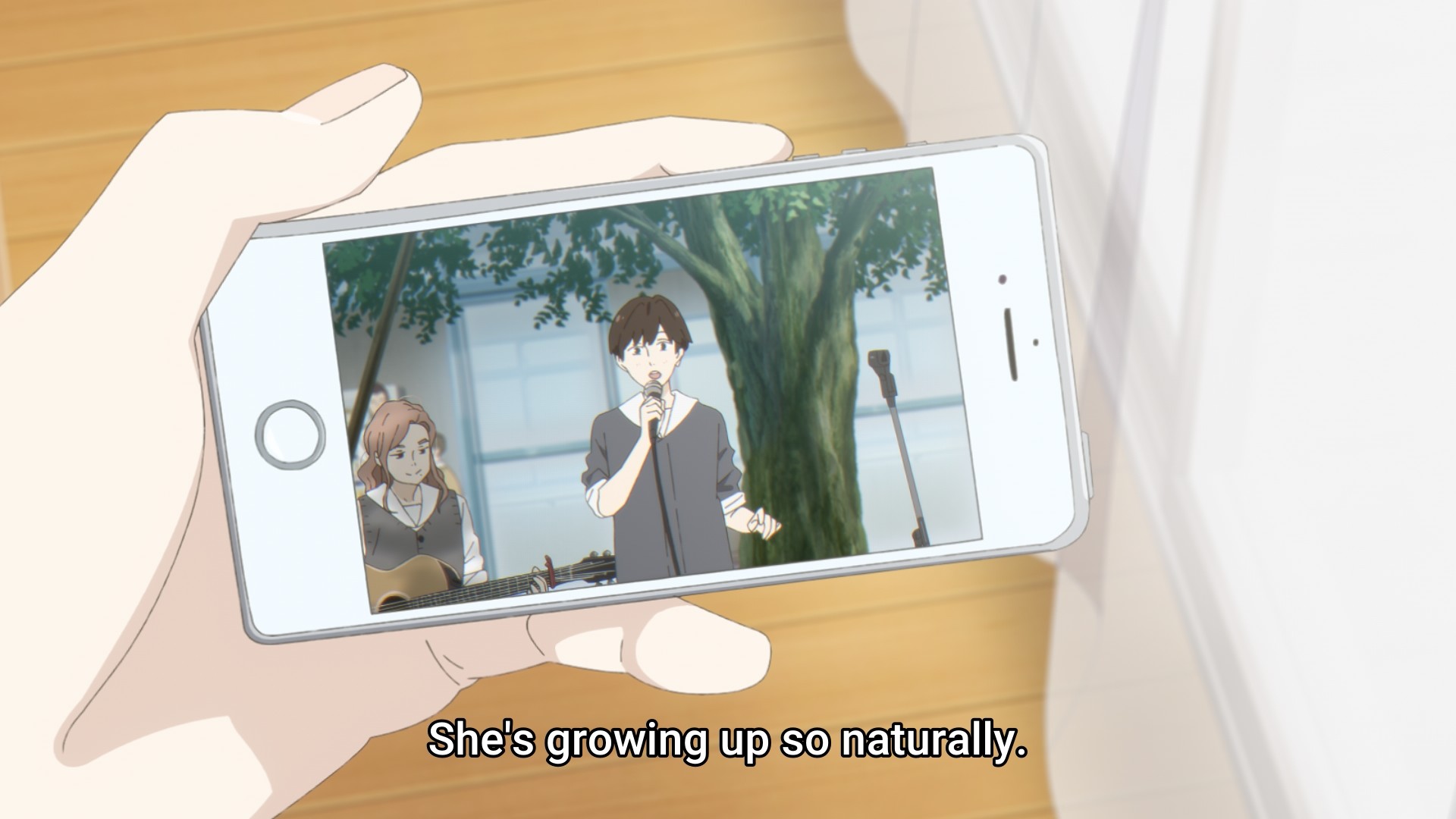
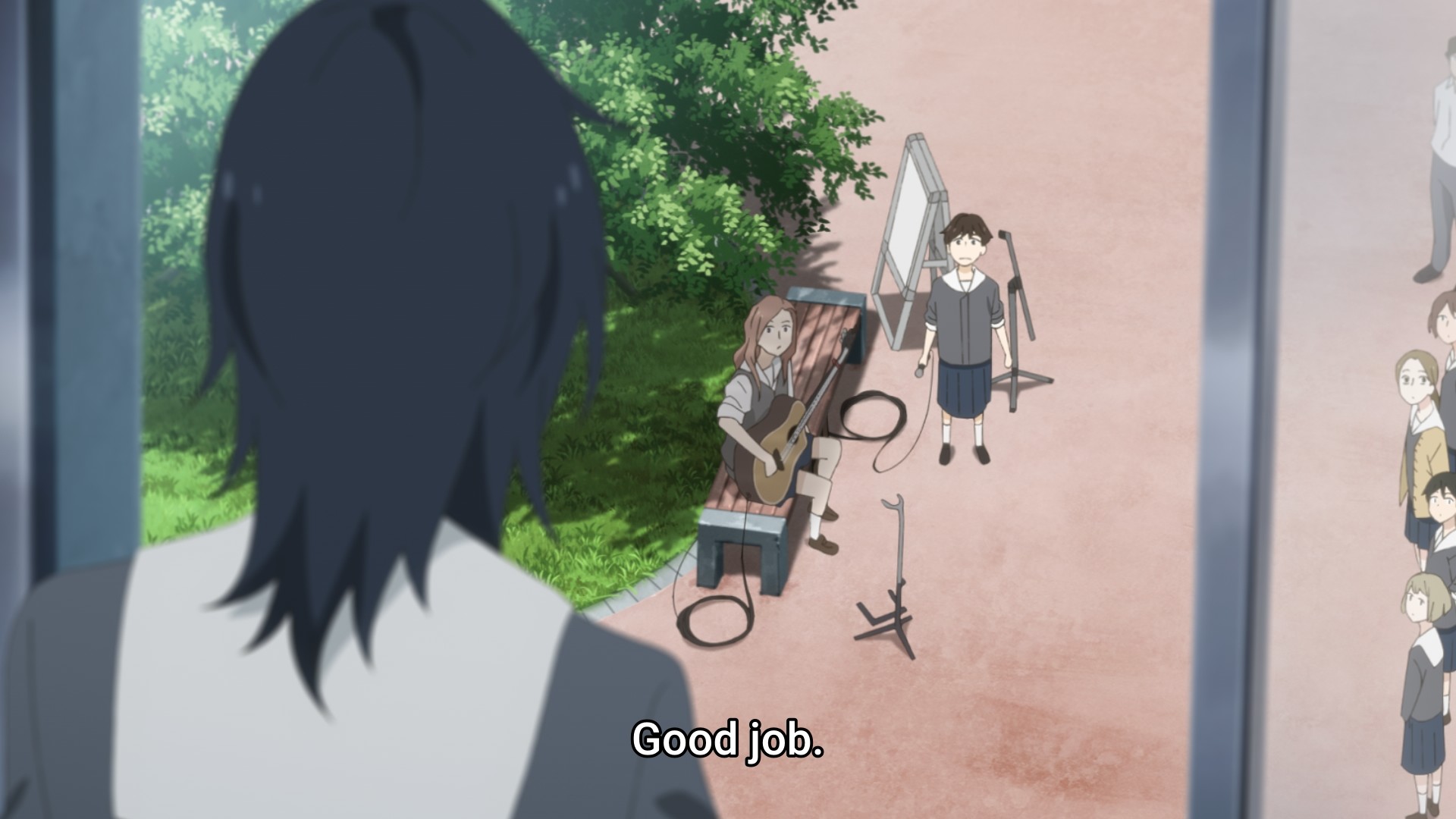
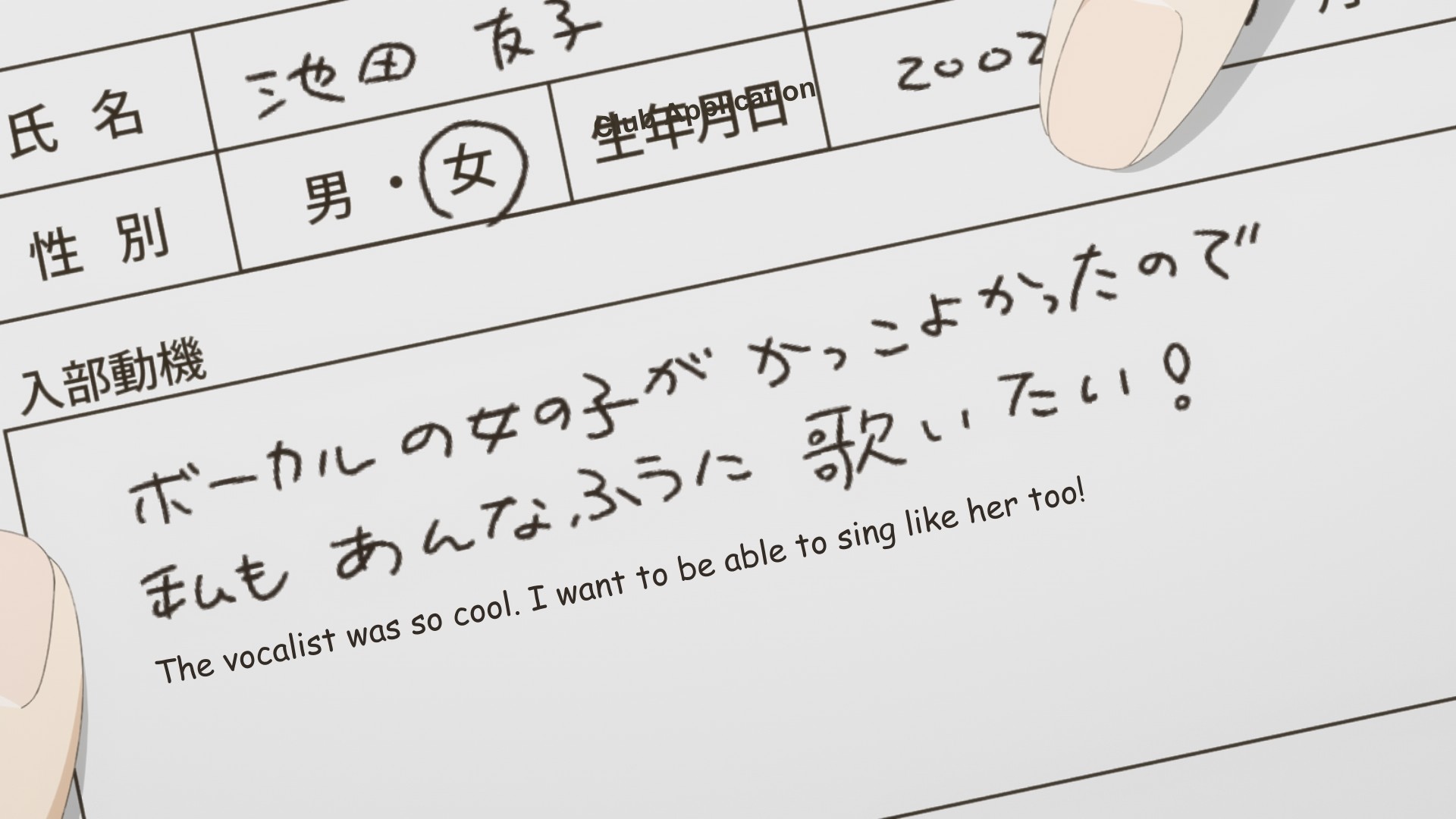
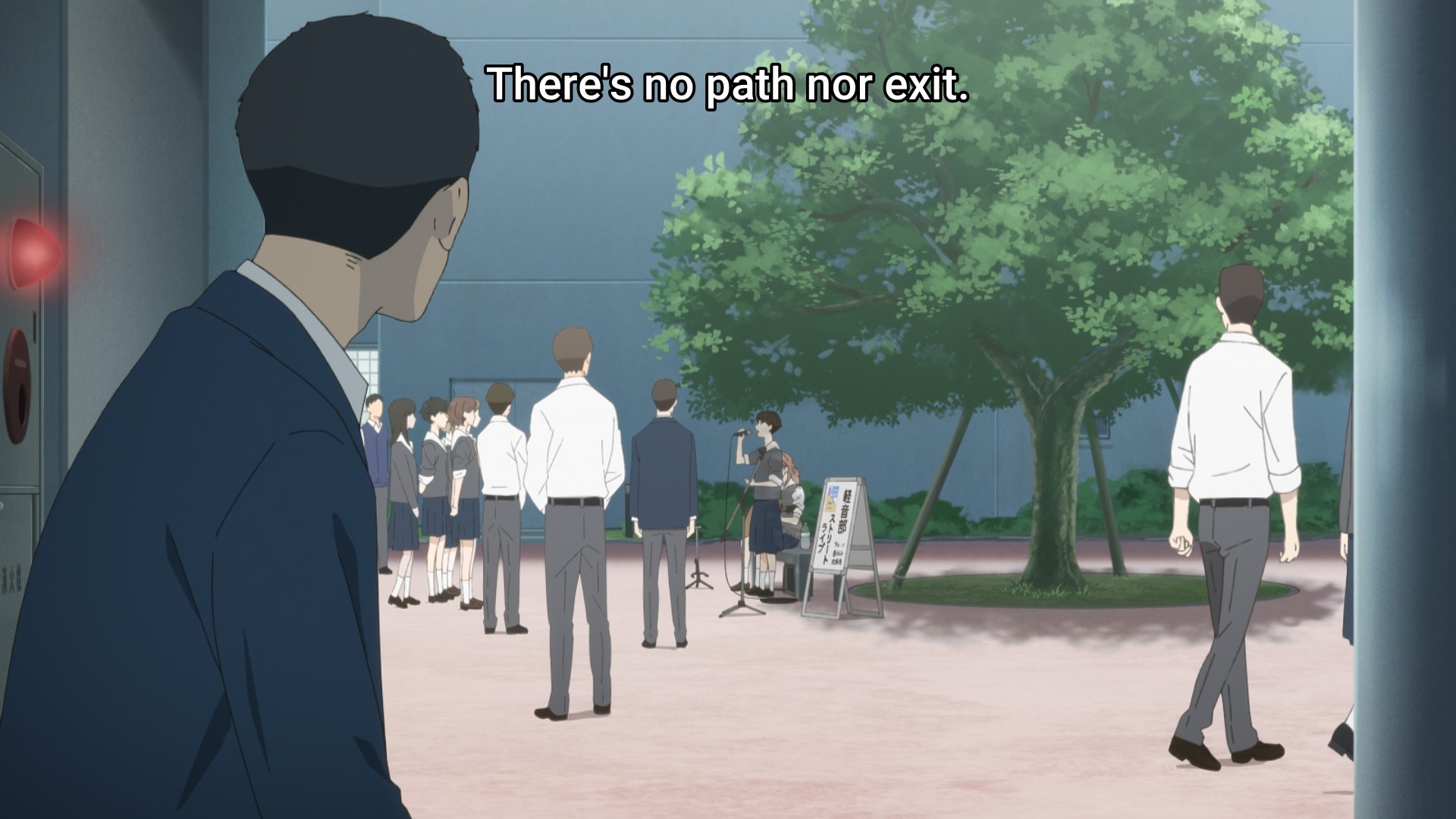
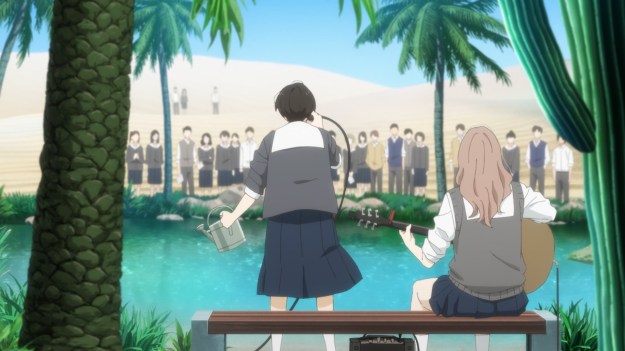
After steeling her nerves, Asa sings her song in front of a crowd at school. Her performance draws an applause. Afterwards, Chiyo starts going to school regularly again. You can’t attribute that to just Asa’s singing, because correlation doesn’t always mean causation. But we do know Chiyo liked the song. Plus, Asa’s performance did at least earn her club a recruit or two. In the moment, Asa doesn’t know whether or not she can change the world. She doesn’t know if her words and actions will eventually carve out that canyon. Who can say if a flower will bloom in the desert if you keep watering it? But she wants to hold onto that desire anyway. It’s more important to continue wanting to change the world even if you believe you can’t.
We get a ten year time skip, but we oddly never get a clear look of Asa. Just Emiri.
Stray thoughts & observations:
— Oh good, Asa didn’t trash her mother’s journal.
— Everyone has problems, but concerns do have a hierarchy. We can’t deny that. That’s why triaging is even a thing. But it also makes little sense to compare big problems like the death of one’s parents to, say, systemic discrimination.
— Speaking of systemic discrimination, intent is often irrelevant. For university admissions, you could try to ignore the applicant’s stated sex or race and only look at their test scores and grades. But even then, there’s a good chance that an implicit bias will still exist. For example, maybe young girls are expected to help around the house more, which has an impact on their performance in school. “But they score higher on average anyway.” Which only tells us they should be even more qualified than they seem. I’m not saying that they are or aren’t, but there are factors which cannot be quantified. That’s why there have been attempts to try and look beyond test scores and grades. These measurements are not as objective as you think. Every time someone screams, “Just hire the most qualified person!” I automatically know they’re a chud who can’t look beyond the “hard facts.” It’s just not that simple. Over and over again, we have people thinking that the world can be solved with a dose of “common sense” and elbow grease only to find out why things are the way that they are.
— Makio asks, “What kind of fan wants an autograph?” She’s kidding, right? Lots of fans do, and for obvious reasons. Hell, I would too if I weren’t so cynical about meeting our “heroes.” For example, I enjoyed The Martian on a casual level, but Project Hail Mary has been a tough pill to swallow. Why? Because Andy Weir has pretty much confirmed that he’s a dumbass in multiple recent interviews. But seriously, if I could get a signed copy of, say, Crime & Punishment, how cool would that be? I didn’t get bad grades in English class, but I often struggled to care because I simply didn’t like the books we were assigned to read. Look, Jane Eyre is probably a great book. It’s just not for me. A lot of English classics — English as in literally from England — are not for me. I don’t want to read another word of Dickens or Thomas Hardy. Crime & Punishment, on the other hand, was the first time I read a book for school and thought to myself, “Holy shit, this is amazing.”
— Geez, take a hint, man. There are lots of reasons why Emiri can’t explain (read: out) herself.
— Asa hopes that her song helps cheer Chiyo up. But across the school, every dejected kid is listening. For example, there’s the guy who quit his baseball team due to abuse. Wonder what he’ll do going forward, though.
— Will Makio ever come to forgive her sister or even love her again? Like with a lot of questions in this episode, the actual answer probably doesn’t matter. She does gain a newfound appreciation for her sister, though.
— Similarly, Makio and Shingo might never make their relationship official again, but they continue seeing each other regularly. You could say they’re a de facto couple already.
— Makio writes an essay about Asa, but she uses a puppy as a metaphor for the kid. Hm, dunno if I’d ever want to be referred to as a creature. There were certainly some trying times with Asa, though. Like that runaway incident.
— We never did see any of the relatives again, huh? Well, we paid a visit to grandma once, but the rest of them pretty much fucked off, never to be seen or heard from again. Well, good riddance, I suppose.
— For what it’s worth, which isn’t much, this is hands down the best show of the season in my humble opinion. But I didn’t watch everything, so take that with a grain of salt. Maybe Jujutsu Kaisen was better or whatever. I wouldn’t know.