
Oshare, a young school girl, comes home one day to discover that her widowed father plans remarry. Angry and distraught from the news, Oshare cancels the summer trip she and her father had been planning, opting instead visit her aunt in the country. She invites her friends to come along and the results are, well, quite a sight to behold.
I found Hausu to be pretty funny. It is definitely not a traditional Japanese horror movie as we know the genre, an identity largely due to recent films like Ringu and Ju-on. Released in 1977, Hausu is full of bad acting and even worse special effects. If a bit of schoolgirl fetishism, lots of corny music and lame screenwipes happen to be your cup of tea, you can enjoy this movie superficially at the very least. A lot of people come away from Hausu with the idea that it’s just a wacky, silly Japanese film, but I think it’s a lot more interesting than that.
(Before we get started, if the opposite of exegetic analysis deeply bothers you, I’d turn away now.)
Let’s take note of several things:
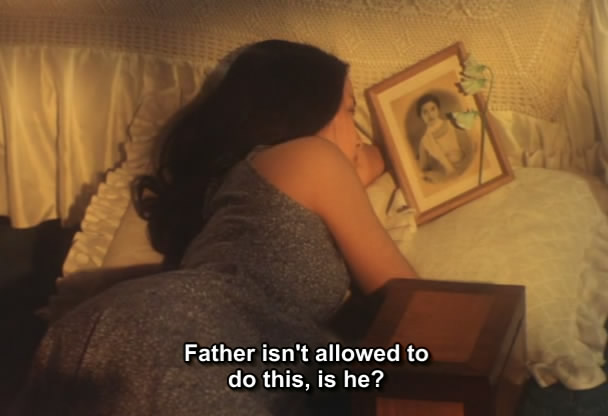
• At first, I thought Oshare was mad at her father for remarrying because this represented some act of betrayal of Oshare’s mother. The ending, however, suggests to me something completely different. To say the least, Oshare’s journey from the start of the film to the end doesn’t seem to accomplish anything that would vindicate her dead mother or even suggest that this is Oshare’s underlying motives.

• The backdrops are always painted scenes. The movie’s early color palette is often hyper-saturated and unreal.
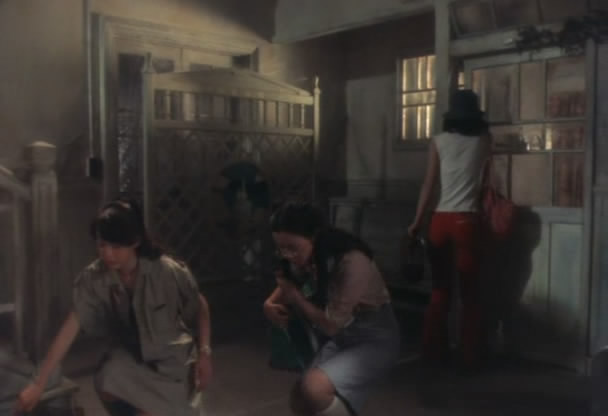
• On the other hand, the titular house serves as a stark contrast to the first half of the movie. Entangled in vines and probably caked in dust, the interior scenes are composed of earthier shades.
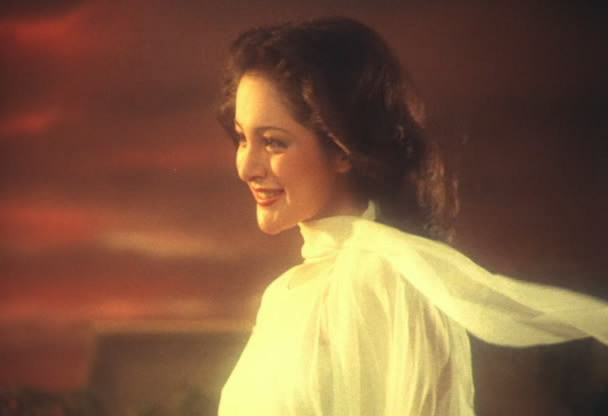
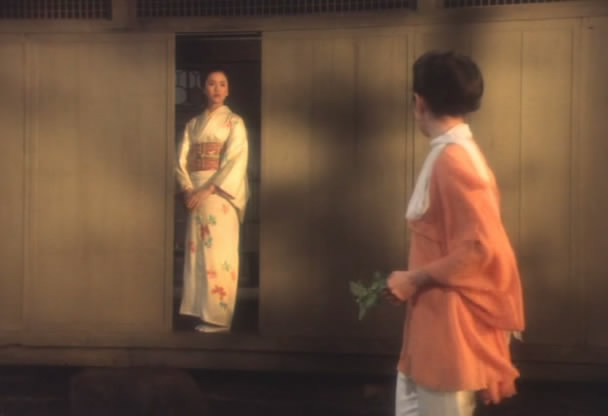
• With the wind blowing and the scarf floating in the wind, the introduction of the stepmother is itself another unreal spectacle.
• The perception of time in the movie continually pushes forward, but not in a fashion that suggests connectedness.
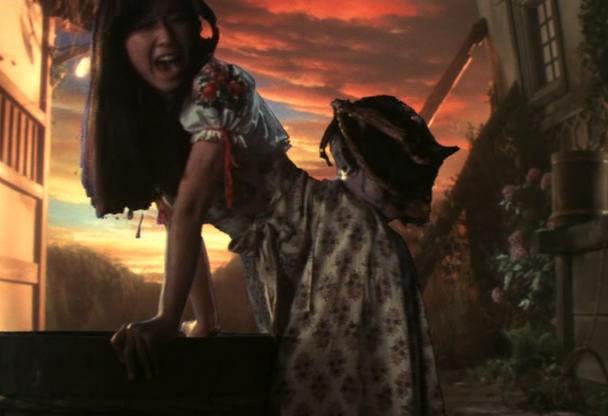
• At times, the campiness of the movie acquires an “after school TV show” taste as the — in Fin’s words — “ridiculously upbeat and naive” girls sing, dance and eat their way through their merry lives. Landon of Mecha Guignol makes a comparison of the girls to the cast of K-On!

• When the girls reminisce or daydream (e.g. the train scene where Oshare describes her aunt to her friends), the movie plunges itself even further away from reality into stylized artifice.
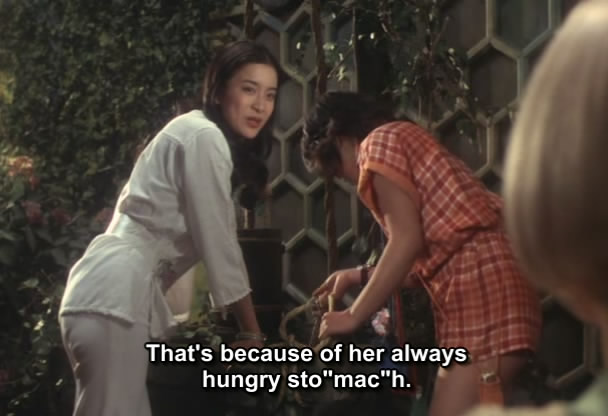
• None of Oshare’s friends are particularly developed characters and neither is Oshare herself. Her friends are almost nothing more than personality traits. As for Oshare, she is often dressed in white so much that she most resembles a blank canvas.
• As the house slowly eliminates each of Oshare’s friends one by one, they are never destroyed. Instead, they are absorbed into the house through the furniture (including the well) — eaten in another sense.
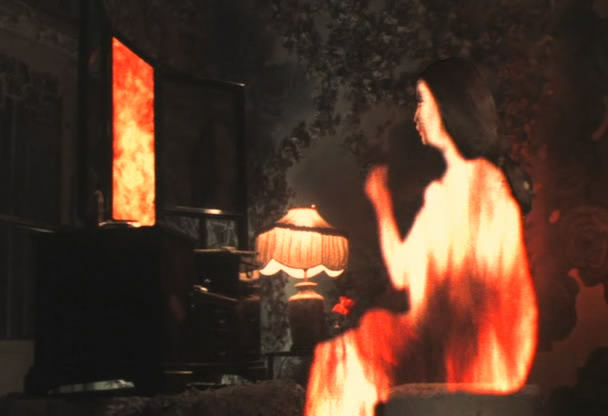
• The burning mirror scene seems to be the turning point for Oshare’s character. What does it mean? In the mirror, she sees the images of herself and her aunt continually alternating before both Oshare and the mirror crack and burn (with cheap fx). Does she become one with the mirror? With the house?

• Why do we see Oshare in her mother’s wedding clothes near the end? Is she now her mother or her aunt? Or does she become something that resembles them both?
What do these observations all add up to? First, let’s discard the literal events of the plot as they are nonsensical. People put way too much emphasis on plot when films should be about the aesthetic. In examining the latter, it becomes fairly evident that the story is very much grounded in Oshare’s subjectivity. It’s not quite “it’s all in her head, but bear with me.
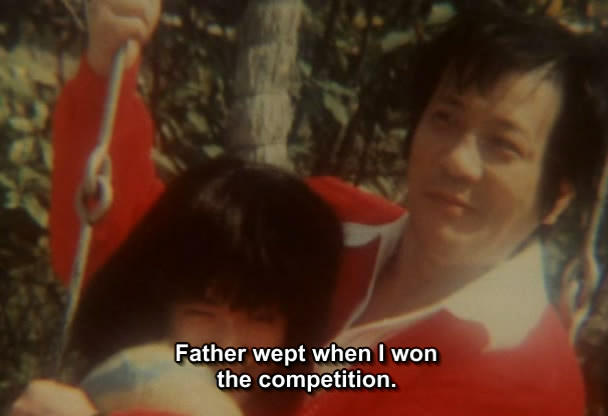
Ever since Oshare’s mother died, she had long been in possession of her father’s attention and time. The introduction of the stepmother, however, tells us a few things. Her father is ready to move on and replace Oshare’s long deceased mother, with whom she has a strong connection. We can also see that Oshare absolutely doesn’t want to share her father with anyone else anymore, most certainly not a woman she has never met. Implicitly, however, we also realize that her father needs more than just a childish schoolgirl.
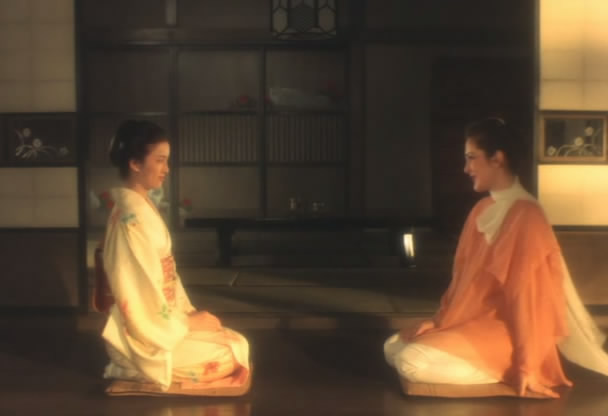
Out of jealousy and feelings of inadequacy, Oshare gathers her friends to go on a trip. They enter a house and are “eaten” one by one until only Oshare remains. She escapes their fate somehow older and more mature. Her hair is now done up, she is in traditional Japanese garb, and her very last act in the movie is confronting her stepmother. What just happened?
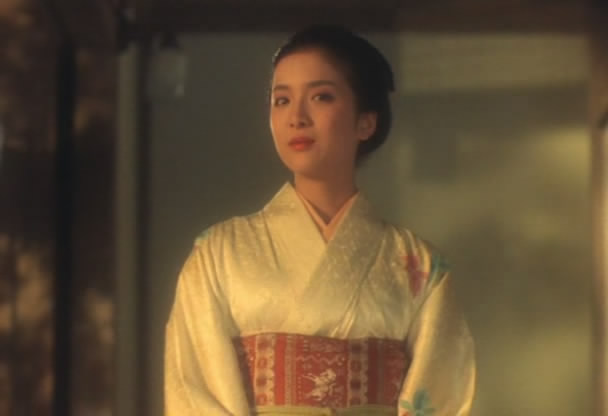 Her face here kinda reminds me of smugcat.
I think it’s a twisted coming-of-age story. The Oshare at the start of the movie is a bit of a Plain Jane. She really has no discernible personality other than her pathos. On the other hand, her friends are almost all personality and no substance. The aunt, being so closely related to Oshare’s mother, is a vision of who Oshare is to become. Finally, the house is where the growth takes place — Oshare is the house and vice versa; they merely represent different facets of one complex character.
Maturation, however, requires “nutrients,” so to speak, and I called Oshare a blank canvas. This is where her friends come in: she assimilates them to become whole and more than just a stereotypical naive schoolgirl. Her friends become distinct parts of her and when the process is complete, a grown woman is revealed at the end, ready to compete with the stepmother.

The aesthetics are important; the composition of scenes reveal a lot in my opinion. Compare how Oshare appears in relation to the stepmother when they first meet and how this is represented at the end once Oshare has undergone her transformation:

When I saw it I thought her aunt had been consumed by jealousy and being a lone and all that good stuff that she became sort of a vindictive spirit and integrated into the house that way. At the end of the movie I thought she had taken over Oshare. I still don’t buy some of these deeper analyses but I did want to give quick anecdote with relation to the special effects used (and certain aspects of the cinematography) and the maybe a bit about the music.
When I was watching the film the effects reminded me of the first time I discovered power point. I was supposed to be doing a interactive presentation for parts of the brain for my psychology class and I went completely overboard with screen wipes and the effects. Every word and picture swirled or faded in or had dancing rainbow ants surrounding it; with zero rhyme or reason. I read somewhere (and I can’t confirm) that Hausu was one of the first films to be heavily effects laden. To me the director seemed to be trying to include as many effects (and as many types of camera angles/music) as he possibly could.
And that’s why I laughed, quite hard, at Hausu on Halloween Night.
That’s quite literally the plot. I’m not disagreeing with you that that is what happened. Don’t get me wrong — if you want to emphasize the plot, what you said is a perfectly fair interpretation. I’m just not personally interested in a story about girls being killed one by one because that’s pretty much every horror movie. What I am interested in is the unique presentation of the same cliché horror story, which is both funny (something we seem to both agree on), complex and not merely gimmicky for just the sake of humor.