
Somewhere behind all the glitz and nonsense of the first three episodes, there’s something compelling about Tiger & Bunny. I actually look forward to watching each episode every week even though it’s not blowing me out of the water by any means. I have too many various thoughts about the anime, however, to collect into one unified body of text so a disorganized jumble to follow.
As a quick refresher, Tiger & Bunny takes place in some strange alternate universe where corporations have seized the day to day activities of superheroes, broadcasting their exploits on Japanese TV. We specifically follow Kaburagi, the Tiger in the title’s pair. He’s an “old” hero who has seen better days, and he’s being pushed aside for the younger, glitzier Barnaby, the other guy named in the title. Since Barnaby’s the fresh, new face, the powers that be want to milk his image for all its worth. They’ve decided to relegate poor Tiger to sidekick status, i.e., a foil to the debonair and blond Barnaby.
• So it’s just a small twist on the cop duo dynamics in comedies. We tread familiar ground here: the young cop versus the old cop, the serious cop versus the reckless cop, instincts versus “going by the books,” etc. The only thing of note is that the younger Barnaby is actually the stoic one. Even the conflicts are downright lifted from other stories, right down to the ubiquitous “which wire do I cut” moment in the third episode.
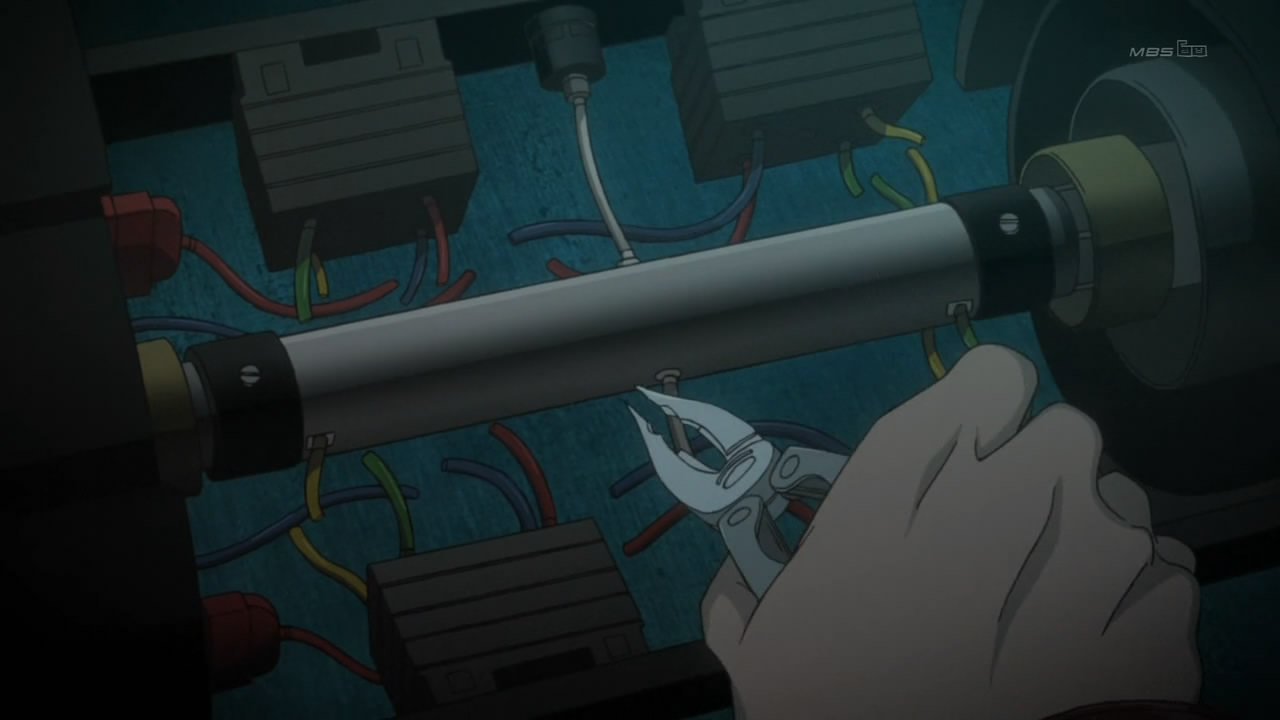
You’d think that, by now, evildoers would have figured out how to rig a bomb where every wire blows your shit up, but what do I know? Tiger & Bunny‘s first task isn’t originality but comedy where it’s doing alright — I smiled a couple times.

• The show seems so light-hearted throughout, but the premise strikes me as somewhat depressing. The anime’s universe seems to have taken commercialism to a ludicrous extreme: heroism has become a commodity. The most obvious example of this are all the advertising logos emblazoned on every hero’s suit. I’ve already mentioned that Tiger has been pushed aside, rescued from potential superhero retirement only to help maximize Barnaby’s image. Other examples include an incident early in the second episode where Barnaby records the positions of his fellow heroes.

Why? So that when he finally makes an appearance, he doesn’t do it alongside the other heroes and thus detract from his own glory.
• For the life of me, I’m not sure what to make of Blue Rose — whether to laugh or to cry. Ridiculous light and music accompanies every one of her appearances in the anime.

She is sexualized up the wazoo and has yet to play any major role in the anime whatsoever. On some level, it’s satirizing feminine portrayals of superheroes, where beauty too often trumps ability, but I can’t help but cringe anyway whenever Blue Rose makes her entrance. Again, the tone of Tiger & Bunny is half-serious, but some things are still hard to laugh at.
• Every hero story features that laboratory scene where a scientist of some sort goes through the various slick gadgets or abilities in the hero’s arsenal. This ubiquitous scene isn’t just purely masturbatory; when properly utilized, it’s a key character development point in every superhero story. For example, James Bond — not a superhero in a traditional sense, but normally unstoppable nevertheless — usually gets a light-hearted scene full of gags with his buddy Q. Not only does this scene offers a breather for the audience to sit back and relax after sitting through some (hopefully) exhilarating action, it also demonstrates just how great James Bond is. He’s a one man killing machine. He’s double-oh-freaking-seven in case you didn’t realize. The gadgets are therefore often silly in Bond movies because they don’t make the man; the man’s already got it made. Oh, they’re still useful when combined with Bond’s ingenuity, but at first glance, the gadgets often make you go “What? Why would you invent that?”
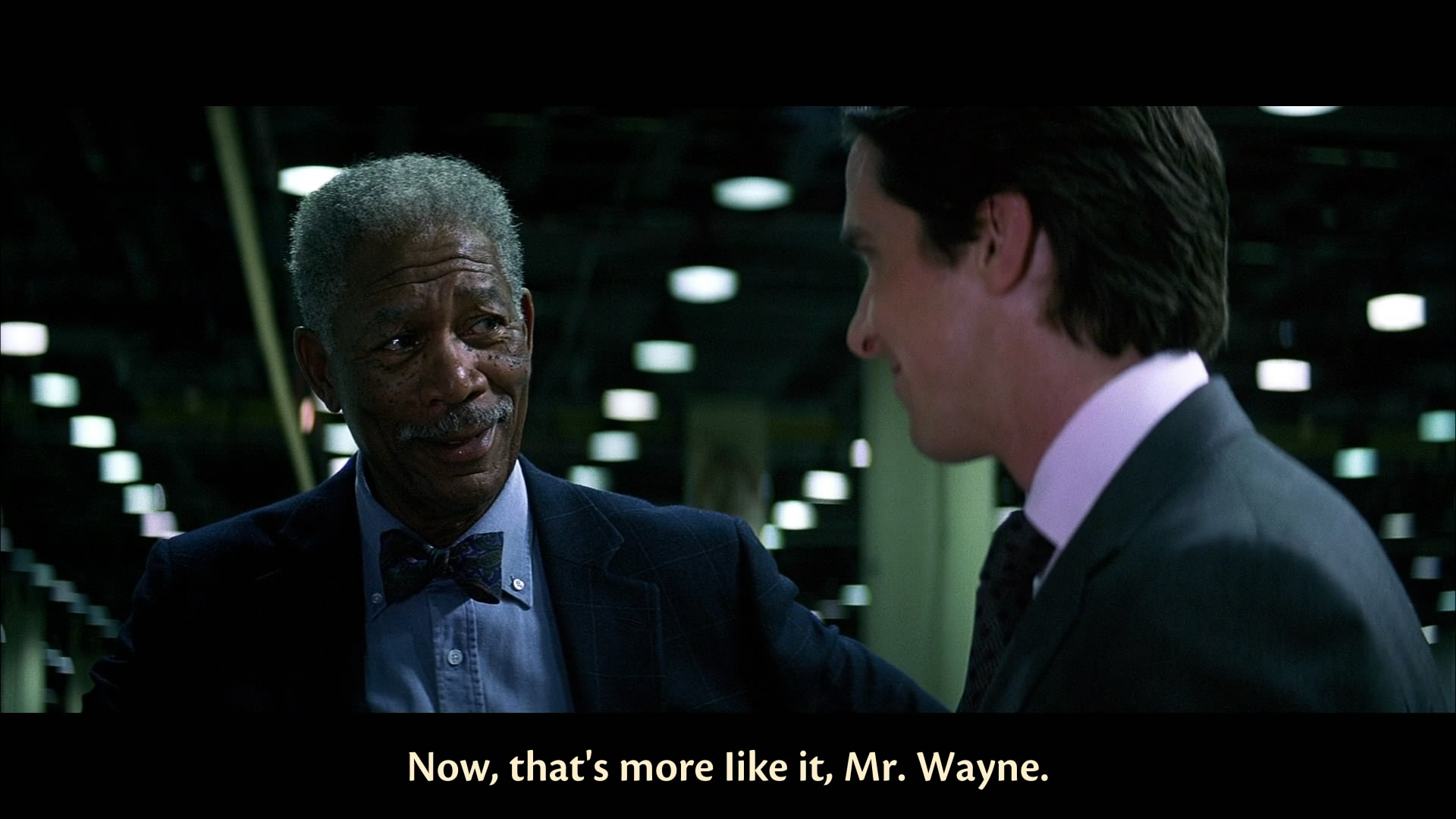
It’s a little different for something like the recent Batman flicks. The tone of the scene remains largely the same: a light-hearted lowpoint in the story so that the audience can relax. Other things have changed, however. We are all familiar of the caped crusader who can do it all in the comics and cartoons, but these recent stories are of a younger, more inexperienced Batman. As such, it’s obvious why Morgan Freeman, who plays every wizened black man ever, was chosen to play Lucious Fox. Just compare Fox’s speech and actions with the bumbling, somewhat crotchety Q. Would it make sense to pair someone like Lucious Fox with Bond? Aside from the newer, sadly grittier Bond movies, the Bale Batman is also less invulnerable. Fittingly, the gadgets that Fox presents to Batman are often less silly.
Compared to either Q or Fox, the scientist in episode two of Tiger & Bunny doesn’t even have a voice apparently. Rather than showing off the various features of Tiger’s new suit, as one might expect from superhero stories, the scientist proceeds to burn the hell out of Tiger’s old suit.
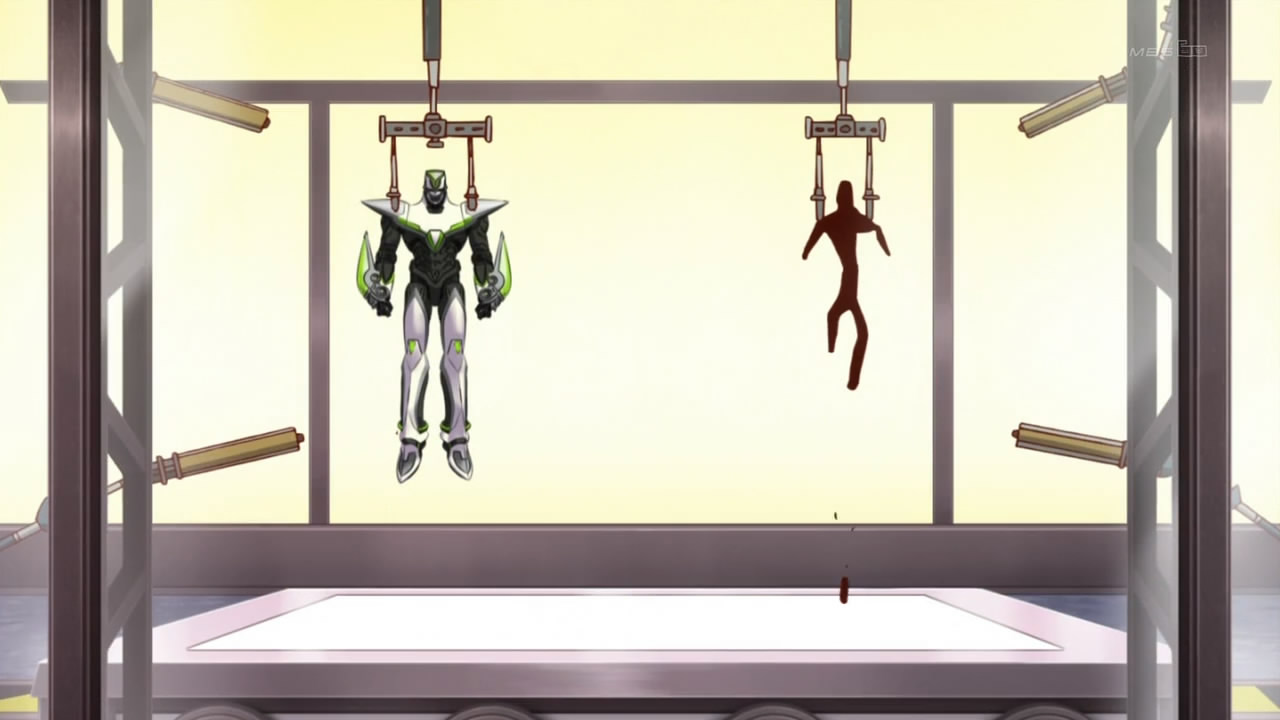
Not satisfied with the initial results, the scientist burns the suit some more until nothing’s left but a few charred remains on the ground. At this point, the scientist turns and creepily smirks at Tiger.

By itself, the scene doesn’t say a whole lot, but within the context of the rest of the anime, we get the impression that heroes are so disposable in the world of Tiger & Bunny. Not only that, but superheroes are so replaceable too. Just as easily as the scientist had burnt the suit, he slides another one in to do more destructive tests. Each time he succeeds in making Tiger grimace, he turns and smirks. Finally, he shows off a new gadget in the suit: a clock. To me, this says that the heroes themselves are so human and the suits are everything, so much that the heroes even need the suit to keep track of something as mundane as time.
• Speaking of Batman, Barnaby’s origin seems mighty familiar.

Batman was also a loner with serious friend issues. I doubt Tiger will ever play a role as creepy as Robin’s though.
• Agnes Joubert’s portrayal somewhat reminds me of Inari Shoko of Kuragehime: a strong woman who will do anything to get the job done, even if it means breaching a few morality rules.

Is it unfair and one-sided? I thought so for Shoko, but the jury’s still out for Agnes. At least Agnes hasn’t started using her feminine wiles to get her way like Shoko did. Enough has been said about Shoko elsewhere on the blog — let’s just hope it doesn’t come to that again here.
• Of the three episodes so far, my favorite is the second episode. This applies to all three episodes to some degree, but the second is the one where you can most easily abstract away the superhero element of the story. Why would I want to do that, you might ask? I don’t have a beef with the superhero aspects of the show at all — after all, it’s the text and you can’t just disregard that.
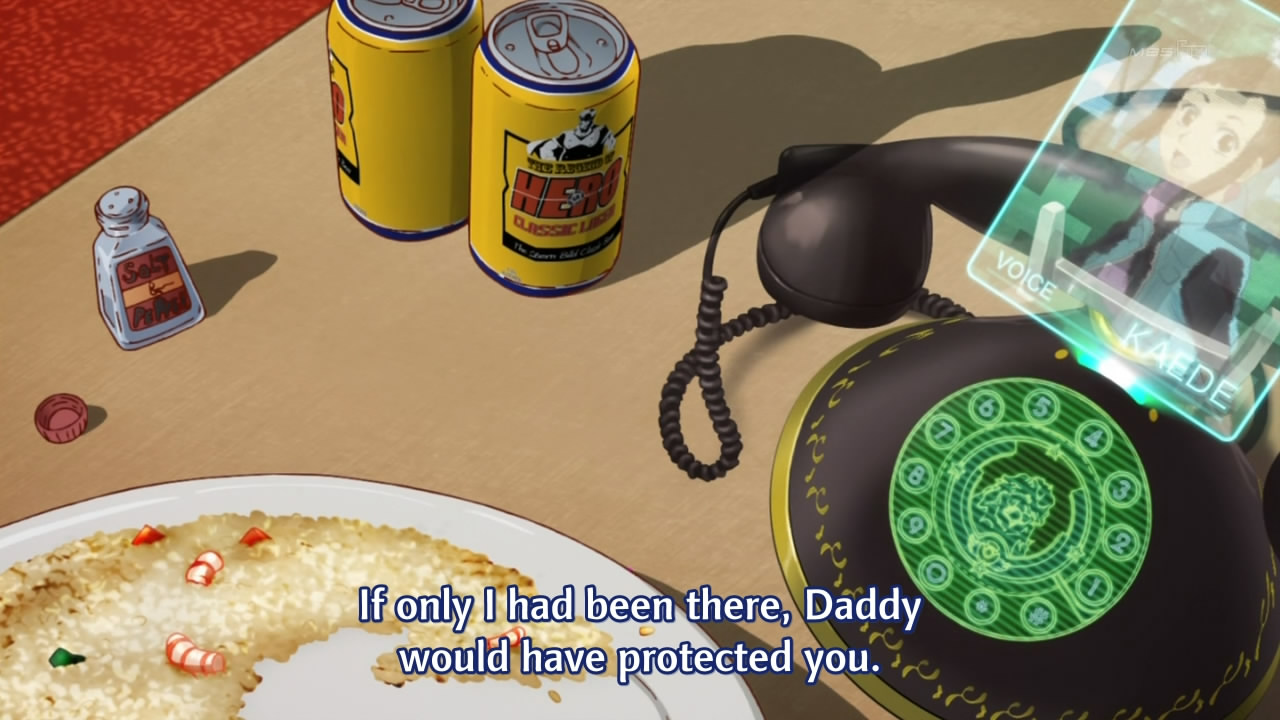
Still, I’m particularly interested in the side plot where Tiger’s struggling to be there for his daughter yet nevertheless fail due to work obligations. Deep within Tiger & Bunny, there’s a story of a working man just trying to be a good father. Again, not amazingly new territory, but how many recent anime protagonists have actually been old enough to even have a daughter?

If I could be cynical, I would say it’s rather eyebrow-raising that Tiger failed to keep his promise to his daughter in the second episode so that he could instead play a surrogate father to a wayward young NEXT. This could mean nothing now or mean everything as the story develops, i.e. we’ll see how it goes.
As for the rest of the show, it’s not that there’s anything wrong about Tiger and Barnaby’s budding friendship (we all know they’re gonna be friends at some point). I can also view this part of the story as an example of older and younger generations trying to get along in Japan’s workforce. It’s just not as interesting somehow; it’s probably because iterations of the odd couple is a little more prevalent in anime than the father-daughter relationship.
*****
So to wrap things up, what exactly is it about Tiger & Bunny that makes me want to keep watching? I’m not sure I can really nail just one thing down, but I do have three main reasons to cull from the observations above. First, our protagonist is an adult, but not only that, he also has a daughter. Second, I want to see where this voyeuristic, commercial world of Tiger & Bunny goes. Tiger often voices his displeasure that money and ratings dictate his job, but what does this honestly mean within the context of giant logos littering the rest of the anime? Does the anime agree or disagree with Tiger? Finally, there’s a bit of a tussle between competing values: Tiger and Barnaby’s petty issues with each other represent a microcosm of a larger conflict: older generations of the Japanese workforce integrating with the new blood. In the end, of least interest to me is any of the actual heroic feats in the anime, but don’t take it the wrong way — I think that’s a good thing.

I’m drawn to Tiger & Bunny for seemingly difficult to elaborate reasons as well. I also enjoy wondering where the setting is going, and the subtext within the show that goes along with that, but for the most part I enjoy Tiger.
My impression is that we are thrown into a world where super heroes have become packaged and for want of a better word “sluts” to the media and corporations they belong to. Thus Tiger, who appears to be an old school kind of super hero, appeals to me because he is somewhat above it all. For the moment they’ve made him have enough problems to not be a complete Mary Sue but I see frightening things coming down the pipeline judging from the way he interacted with Blue Rose in the bar at the end of episode 3. Granted next episode looks to be her main feature. I suppose in a cliched sort of way Tiger is the “heart” of the series for me. Perhaps it’s easier to forgive the faults of someone prone to rash decisions than some other people who seem to be at the beck and call of traditionally unsavory corporations and media.
Whatever the case I also see so much cliche taken from other super hero stories and anime but even with that knowledge I’m still enjoying the show. The direction and execution might have something to do with it. Beyond the narrative aspects of the show I think the production has also been stellar at making Tiger a sympathetic character.
Is it just me or does it seem like there aren’t many people talking about this anime? I like Tiger as a character overall, but I wonder if he’s someone that would draw viewers in. I half-expected Barnaby to really be the focus initially.