
Adil: How can you defend a country where 5 percent of the people control 95 percent of the wealth?
Lisa: I’m defending a country where people can think, and act, and worship any way they want!
Adil: Can not.
Lisa: Can too.
Adil: Can not!
Lisa: Can too!
Homer: Please, please kids! Stop fighting. Maybe Lisa’s right about America being the land of opportunity, and maybe Adil has a point about the machinery of capitalism being oiled with the blood of the workers.
The Simpsons did it first, did it better.
There are such huge differences between the Japanese and French cultures. This is true now and it was doubly true during the late 19th century. For any Japanese person to wake up one day and find him or herself in the middle of Paris, this has to be a major culture shock.
From religious to philosophical to political issues, you name it — the French and Japanese cultures couldn’t be more different. Wouldn’t it be awesome, then, for these two cultures to meet, discuss, and to try understanding one another? Wouldn’t it be intriguing for a French person and a Japanese person to sit down over a cup of coffee or tea, and challenge each other over life’s most profound questions?
Let’s just toss one example out there. Late 19th century France always had the vigor of liberalism in it, even if the memories of their bloody revolution were just beginning to fade. Japan, like many East Asian cultures, is still somewhat collectivist to this very day, especially when compared to the West. Imagine the debates a French and Japanese person could have on just this very difference?
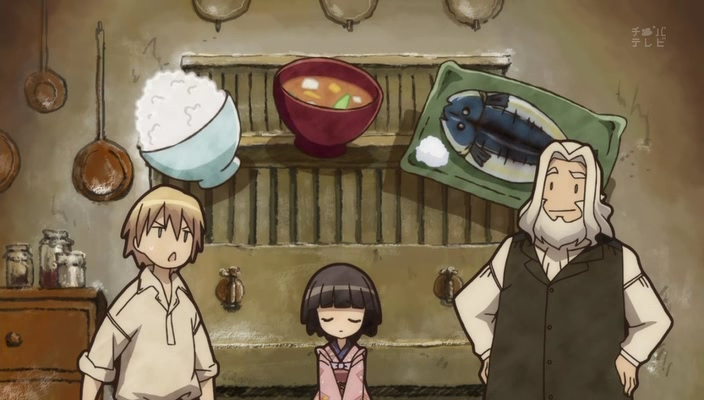
Instead, Ikoku Meiro no Croisée, focuses this week on… breakfast. Oh? The Japanese eat rice and miso soup and fried fish? And the French like to wake up to some butter on baguette and a nice, hot cup of coffee? Gee willikers! Then Claude takes Yune on a scintillating trip through a market where we get to watch the young girl marvel over produce and cured meat. Just when my heart couldn’t possibly handle any more excitement, the anime makes a big deal out of Yune trying to eat pot-au-feu.
Poor Yune is struggling to enjoy things like cheese, but she doesn’t give up. The two men ask her why she’s trying so hard. She tells them that — can you guess it? Can you guess why she wants to like cheese so badly? I bet you can’t! — she just wants to learn how to cook delicious meals for them. Awwwww. 
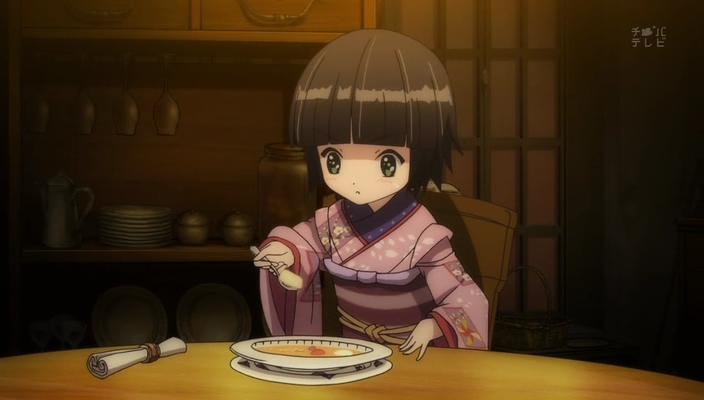
I know Yune is cute and adorable, and people have already fallen in love with her, but this is precisely why I didn’t want her character to be so young and simple-minded. We won’t and can’t engage in any truly thought-provoking differences between the two distinct cultures because she’s nothing more than a child. So instead, we sit here and watch a cute girl fumble around with a spoon.
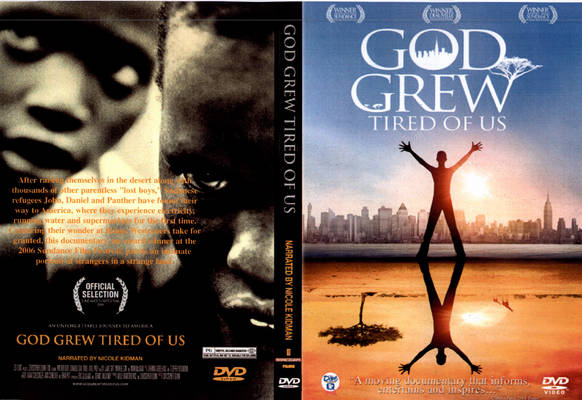
I’m reminded of God Grew Tired of Us, a 2006 documentary. The film tracked the lives of Sudanese refugees invited to live in the US:
“They must now learn to adapt to the shock of being thrust into the economically intense culture of the United States, learning new customs, adapting to new and strange foods, coping with the ordeal of getting, and keeping a job, or multiple jobs, while never forgetting the loved ones they left behind in Africa.”
I then look at Ikoku Meiro no Croisée and see a wasted opportunity. Sure, adapting to unfamiliar food is also a topic in God Grew Tired of Us, but only briefly. The rest of the documentary is actually thought-provoking. I don’t expect an anime to live up to a serious documentary, but Ikoku Meiro no Croisée can do so much better. But instead, it’s going for broad appeal and what’s broad appeal? The cute but pleasantly banal.

This anime’s biggest fault is a complete lack of vision hiding behind adorable visuals. That’s why these shows only ever feature a child, especially a female child.
B-but learning how to cook a delicious meal for the men in your lives is so important!
Oh please.

You know, I’d have to agree. I’ll be honest and say that I enjoy IkoMeiro enough not to drop it, but I’m fully aware of the potential that they waste just having a little girl act all hunky dory with everyone while attempting to adapt to the French way of life. It gets boring after awhile when there’s no conflict or development beyond feeling marginally more comfortable in Paris.
Adorable and charming is apparently what makes a great story.
To many people, I suppose so. Thus far, I don’t see the merits in it beyond a decent way to spend 22 minutes.
I wouldn’t even say decent, but you’ve always been generous to anime.
I think it’s a bit early to start criticizing this way, but I agree that it feels like it’s establishing itself as little more than fluff. There are some hints that it’s going to explorer slightly darker territory, what with Yune’s fear of doing a bad job and the poor kids we see from time to time. But I suspect it will be well-trodden territory.
I’m not necessarily asking for the anime to explore darker territory; I’m just asking for a compelling contrast between the two cultures. Spending five minutes plus on coffee and buttered baguettes isn’t exactly my idea of interesting.
True, and their choice of setting sure doesn’t lend itself to the Aria style of world-building either. I’m just willing to be a sucker and wait to see if they’re going anywhere with it. I’ve given lesser shows more of my time, and once in a while they’ve surprised me by not just serving the purpose of being a good way to knock myself out for sleep.
Well, I didn’t say I was going to stop watching it. I’m just merely trying to provide criticism that isn’t just “this is boring;” this is a blog and I want to generate discussion. I don’t subscribe to the idea that I should only watch shows I like and never have a negative word to say. And hey, if the anime does get better, I’ll swallow my pride and admit it, but this won’t change the fact the first two episodes are banal, though.
I use Dave Chappelle’s trusted method to combat insomnia: ribs. But say… you don’t happen to subscribe to inushinde’s school of viewing Aria till you fall asleep, do you?
> I want to generate discussion
That’s why I’m here.. didn’t mean to put words in your mouth, of course. Nice to post on a blog that has standards.
> you don’t happen to subscribe to inushinde’s school of viewing Aria till you fall asleep, do you?
On the days I feel I need it, sure (often depends on the wife). I might also knock myself out with something rote and technical, like studying odd bits of Japanese or computer-sciencey stuff.
I must say I never saw Aria; it didn’t look like something I thought I’d enjoy.
I certainly won’t be the one to convince you, but after a good season-and-a-half of wistful, childish meandering, you realize that it’s actually been steadily building up to a decent, but not over-the-top payoff. It’s one of those slow burn series that grows on you in spite of itself, yet you miss it once it’s over.
But it IS a kind of world-building, for the Japanese viewer who knows very little about Paris besides what they’ve seen in their Blu-Rays of Amelie,, let alone 19th century Paris when everything was cooler. :)
The Aria comparison might be more apt than you think, especially if they don’t pursue any form of culture shock in this show.
Oh come on. There’s a difference between world building and “In France, we use the spoon to eat stew!”
Well, that might be the unique pleasure of “people in the past were so much more ignorant than we are” that we get quite often in shows set in the past, no? I won’t deny that you find it banal, but there’s a joy of discovery here that might turn out to be similar to what happens in Aria or Yokohama Kaidashi Kikou.
By the way, if you want a taste of good iyashi-kei, Aria’s good, but YKK is the gold standard. I think you’ll quite like it, actually!
I don’t think I can put this nicely, but it sure seems like they could do anything and you’d be okay with it. Where do we draw the line or is everything relative?
I’ll wait. Stage one of culture shock lasts for five to six weeks, you know. ;)
Even if you’re right, that’s no reason for the first two episodes to be so banal. And if past performance is a decent indicator for future success, why would later episodes be any different?
Oh dear… Let’s hope Ikoku Meiro becomes a lot more than just fluff. :(
On another note, I’d mention Japan syndrome. It only ever happens to Japanese tourists in Paris, and it’s extremely strange…. It’s caused by a Japanese tourist having such an extremely romanticised view of la France that when they get there, all the beautiful art galleries, architecture, and history aren’t enough to disguise the fact that Paris isn’t quite as génial as they’d first hoped. The Japanese embassy in Paris even has a 24 hour hotline for tourists…
At least Yune isn’t going mad from culture clash and is instead being ridiculously tiny and adorable and innocent, I guess.
Hm, I hadn’t heard of this, but somehow, what you described doesn’t surprise me. Still, I don’t need the poor girl to break down over the culture clash. I just want something meatier. Let’s take the cuisine comparison for instance. Instead of just saying “Oh, we eat this and you eat that,” why not have the characters discuss the finer details of the two different cuisines? For example, compare the skill and dedication the French put into baking to the way Japanese chefs take pride in preparing sushi. Why not contrast the flavor profiles of the two cultures, especially the way cream is so heavily used in French cooking but Japanese cooking usually allows the ingredients to speak for themselves? We don’t need to get serious and discuss philosophy, but if we’re going to talk about food, why not tell me, the viewer, something I don’t already know?
Its commonly referred to as Paris Syndrome.
http://en.wikipedia.org/wiki/Paris_syndrome
That’s why these shows only ever feature a child, especially a female child.
When I first heard of Ikoku’s premise I immediately thought it’d be kind of cool and hilarious it’d be if it were some old/grown up dude instead of Yune. A kawaii bald Japanese man trying to learn how to use spoons! Too kawaii!
Imagine if classic literature became anime. The Tsundere and the Sea. The Invisible Loli. The Sisters Karamazov-chan. Portrait of a Young Miku. Lolita — oh hey!
Whoops, my bad. Commented late at night. Been a while since I studied it in psychology as one of those geography bound conditions. There’s a similar condition for western pilgrims to Jerusalem. Fascinating stuff.
And I’d be interested in the cuisine aspect too if they seriously went into it. French food is amazing. In fact, France is the only country I have been to where you can expect a delicious meal in any random restaurant you stumble across in the whole country. Japanese food, although I have never been to Japan, is also great.
But I agree, this series needs really badly to get rid of the ‘quiet observation of French culture in relation to Japanese culture’ fluff… I just hope there is some conflict soon. :)
I’d love to see Yune eat escargot.
Oh, they did that in Hetalia. :) Yune’s reaction would probably be similar to Japan’s in that episode… ‘What are you eating? Snails….? No, I’m full, thank you, I don’t want to try!’
Escargot isn’t too bad actually. It’s kind of like eating a slimy button mushroom in garlic butter.
Now ortolan would be an interesting dish to see Yune try… o.o
Bourgois! Every time anyone mentions ortolan, I feel compelled to relay the abject carnality of foodies feasting on the poor birds:
Haha, that article is brilliant!
Ortolan is disgusting. I’m surprised it’s still eaten. :/ I would never eat it. Ever. D:
I think you are being too rough on the show. Let’s begin with the feminist critic about preparing food: she’s a maid and a guest that bears great giri towards Oscar and his family that gave her the oppurtunity to come to Paris. Plus we talk about an era where women, especially the Japanese ones, were brought up to be good housewives.
Secondly, let’s go with why they selected Yune, a young female instead of anyone else: why would a grown up Japanese man that most probably has strong nationalistic ideals want to work in Paris more over stay there? It also couldn’t be an old man that wants to stay in his homeland and die at the birthplace of his ancestors. An older woman than Yune would most probably be wedded and stop working -I don’t think women of the upper classes would break a sweat (in Paris)- so we would lose other interactions that have to do with workplace.
Thirdly, with such a moe design nobody would have expectations similar to shows like Bartender or Emma, even more to real life documentaries about immigrants that start life anew without any (financial) support like Yune has from Oscar. This show wasn’t meant to be a drama. Fullstop. As for the cuisine details, I think it would be too much input for a fantasy story with these characters. They don’t own a patisserie or a restaurant after all.
Lastly, although I’m not going in details here, the capitalist criticism part is in my humble opinion not a vital point for the series. It does get commented, but we have the ones losing customers commenting on it (what do you expect? praises?), hence only a single view. And well there isn’t only Alice there, but also the more composed Camille. More over the series hasn’t finished so we could have a more balanced view on the issue, where capitalism appears also to bring progress… I just say…
I’m not asking for giant robots or mahou shoujos. I’m sorry, but it wouldn’t be a huge stretch for Yune to be a little less subservient. It wouldn’t be a huge stretch for Yune to be a little older or a different gender. Why would an old man come to Paris? I dunno, I’m sure the writers could come up with a decent reason. You can make exceptions because this is fiction, and fiction is full of exceptional characters!
Plus, why does realism matter so much? Isn’t it more important to have a good, thought-provoking story as opposed to an absolutely realistic one?
I don’t even understand your capitalism rebuttal. Other than “The Simpsons” quote, which was in the post for humor, who mentioned anything about capitalism?