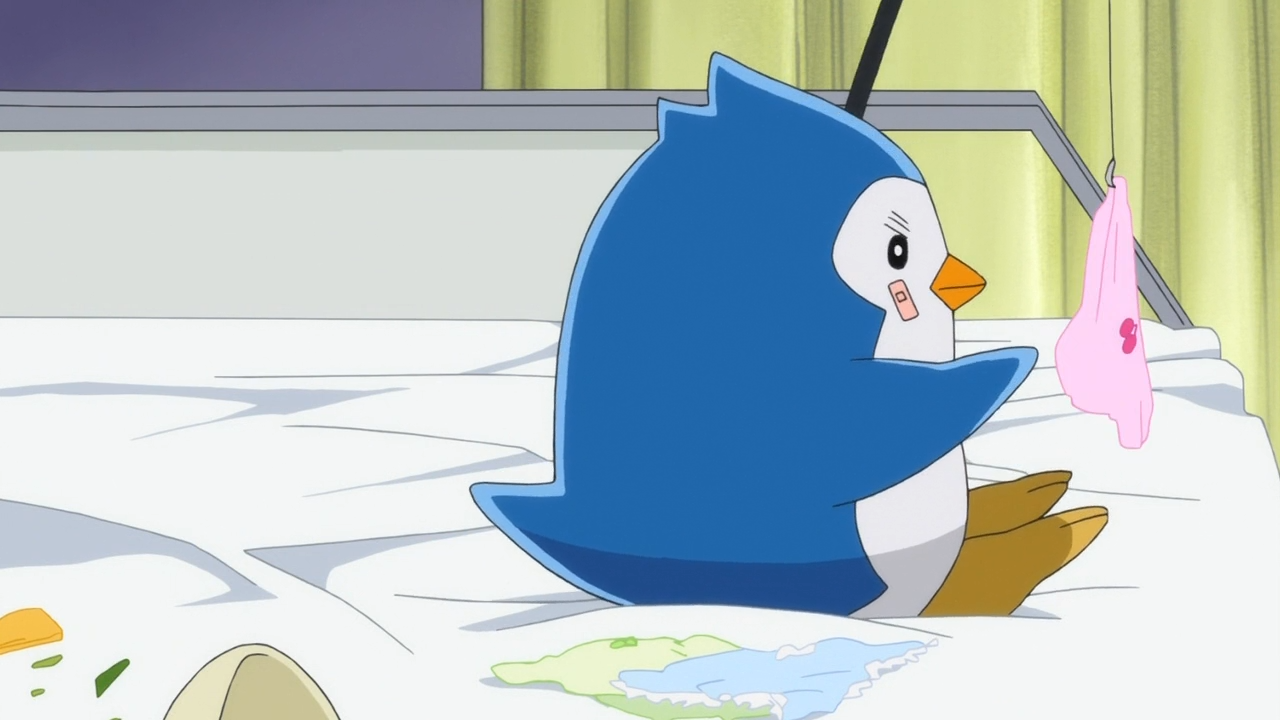
You’d be hard-pressed to find a Mawaru Penguindrum fan who isn’t also a fan of the penguins on the show. After all, what isn’t there to love? The penguins are cute, funny, and silly. I want to use this post to suggest, however, that the penguins’ greatest appeal is in their voicelessness.
The penguins are voiceless characters, and very much like the early Charlie Chaplin films of the silent movie era, the penguins depend upon their exaggerated actions and gesticulation for characterization. With the advent of sound in cinema, however, an actor’s physicality became toned down or replaced with the subtler, more nuanced depth of interiority that a voice can provide. The spirit of the silent actor exists nowadays mostly in children’s cartoons.
The reckless abandon with which cartoon characters act is what I find notable. Silent figures often lack a fear of death and almost never burden themselves with worldly concerns. Cartoon characters don’t know real pain or suffering — they don’t even know sexuality. When #1 peeks up a nurse’s skirt or steals panties, we laugh at his lechery because we assume that there is a childish sense of perversity here; we do not believe that the penguin has any intentions to commit harm.
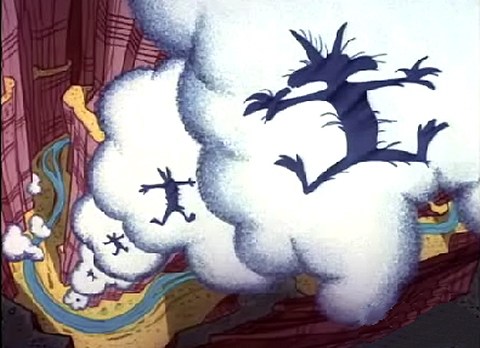
In any case, the cartoon character possesses boundless energy. For example, Wile E. Coyote and The Road Runner are locked in an eternal game of cat and mouse, each striving to obey their basic impulses: the coyote wants to eat and his foe essentially toys with him. Of course, that isn’t to say that cartoon characters lack morality, but if they are ever “evil,” it is a very childish, egotistical sense of evil. For instance, #2 steals food but only to satiate its immense appetite; it doesn’t relish in other people’s despair.
So what does this all mean? So the penguins are cartoonish and childish — aren’t they cartoon characters to begin with? Aren’t they obviously childish because they are animals and most animals are not complex thinking creatures? It is apparent that the penguins seem to perform actions that their owners might want to do, but, for whatever reason, they cannot. Somewhere in the back of his mind, Kanba might want to steal panties and look up girls’ skirts, but he can’t for a plethora of reasons. As a result, #1 will do it for him. The penguins lack a voice, but what does the silence really entail? The crucial difference between the penguins and their owners is guilt.
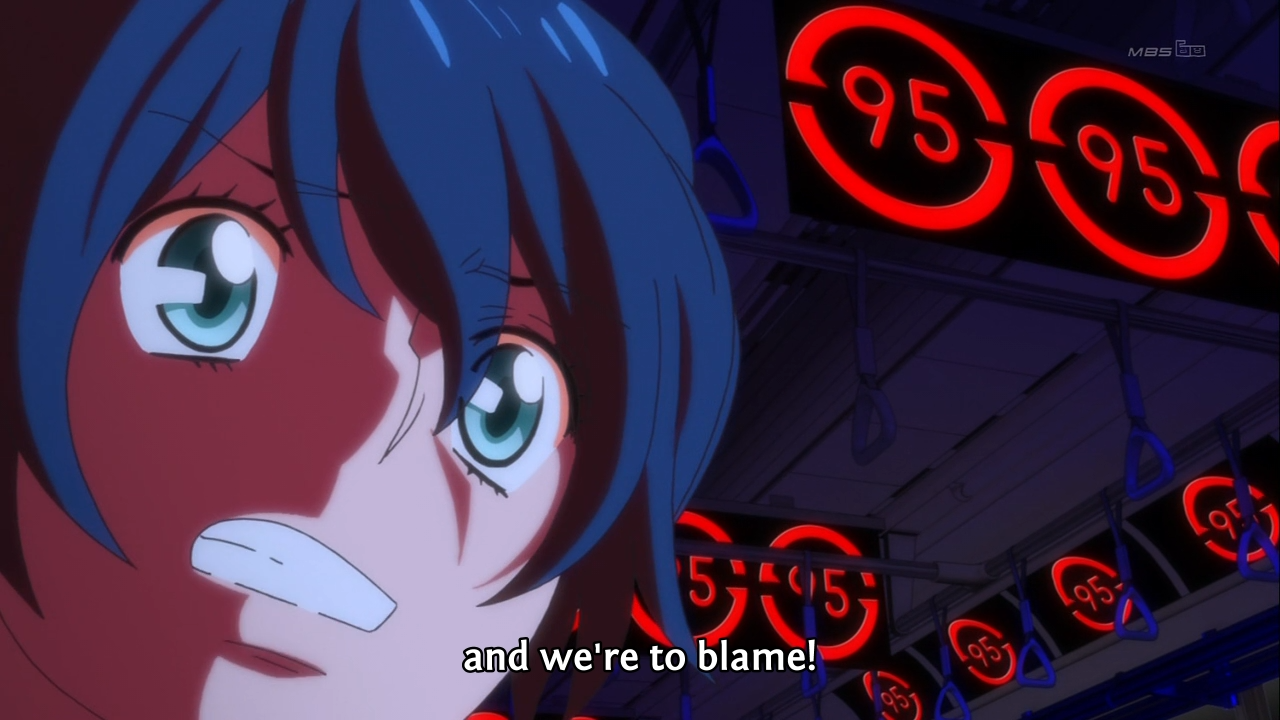
Within the voice, we find guilt and culpability. Speaking characters are able to voice their concerns, feelings, doubts, etc. The penguins obviously cannot do the same. How might this be pertinent to the anime? The ending to Mawaru Penguindrum‘s latest episode confused me: why would Shoma and his brother feel any guilt whatsoever over Momoka’s death? A few passages from the very first episode might provide us with some clues:
“Because, ever since that day, none of us had a future and the only certain thing was that we wouldn’t amount to anything.”
It’s reasonable to assume that “that day” refers to March 20, 1995, i.e. the day of the sarin gas attacks on Tokyo’s subway, but, of course, we can’t know for sure at the moment. Then later in the same episode, when Shoma questions Kanba on why Himari had to die, his brother gives the following reply:
“Most likely… that’s the punishment bestowed upon us.”
It has been suggested by a commenter (hurin) that Kanba might be referring to the fact that the siblings have inherited their parnets’ sins. How important is guilt to Mawaru Penguindrum? Ruth Benedict was made famous when she distinguished Japanese culture from the West as a culture built on guilt and shame. This became a controversial statement, taken by many Japanese as a pejorative. Was her observation, however, off the mark? We’re not here to debate the finer points of Japanese sociology, so let’s just speak generally of guilt.
Guilt handcuffs the ego from pursuing its inner desires. To borrow from Freud, we all have an id, a basic component within each of us that acts accordingly with a “pleasure principle.” In simpler terms, the id wants to maximize satisfaction. One level above the id is the ego, which — I realize I’m vastly oversimplifying — attempts to obey the id as realistically as it can. But what if we could separate the id from the rest of the person? Hopefully, I’ll answer this question by the end of the post.

For most people, however, the id is not unrestrained. I’ve already mentioned how the ego will only satisfy the id if it can realistically do so. Still, most men don’t go around groping women even if they could get away with it (even so, an alarming 15% of surveyed college students confess they would commit rape if they knew they wouldn’t get caught). Most of us have a conscience to differentiate right behavior from wrong behavior. In other words, we don’t always obey the id because we’d then feel guilty. Even if I could get away with stealing a bite off of every hors d’oeuvre on a table, I don’t because I think this is the wrong thing to do. But #2 doesn’t feel guilty and it thus has no issues eating anything it comes across. Unlike Shoma, the character it represents, the penguin lacks a voice and, as a result, it lacks culpability. The penguins then present the unrestrained id that can do as it pleases.
But then where is the superego, the last mental faculty to be mentioned — the one that helps to regulate our wants and desires? I will answer this question with even more questions: from where do we get our guilt? Isn’t guilt instilled in us by society? Doesn’t our upbringing teach us to tell right from wrong? It’s not crucially important whether or not Japanese society is more guilt- or shame-based than the West; regardless of where or when you come from, your guilt is shaped by the community you grew up in. So if the penguins in the anime represent the id, then the very world around the show’s characters represents the superego. For example, sex and the desire to have sex is a very natural, biological impulse. We are only ashamed of sex because society says we should be.

What is the problem the twins want to resolve? On the surface, Shoma and Kanba are doing their damndest to keep Himari alive. There is also, however, the more formal problem: how to tame the voice — the voice both inside and outside us, i.e. the ego and the superego respectively — so that we can find true happiness. No doubt, the unrestrained id can be dangerous and Masako might represent the possibility of the pendulum swinging too far in one direction. In the brothers’ case, however, might guilt play too big of a factor that it prevents them from finding true happiness? After all, Kanba has to always convince Shoma that they are acting out of Himari’s sake; the latter constantly feels the nagging insistence of morality, i.e. society’s morality.
Sometimes, it is necessary to let go of one’s voice and simply take action. Nothing epitomizes this sentiment more than the ending to the show’s fifth episode. Kanba risks life and limb to retrieve Himari’s hat from a runaway truck because he knows that his sister’s life is at stake. His feat is physically impossible as the truck seemingly drags Kanba along the road for miles. In this scene, however, Kanba has all but completely abandoned his voice; he utters nothing but grunts and screams as he struggles to get Himari’s hat back. As a result, he takes on his penguin’s resiliency: like a cartoon character who can survive a fall off of a cliff, Kanba emerges from the incident with only scratches and tattered clothing.

Likewise, Shoma didn’t even suffer a single broken bone when he put himself in harm’s way to save Ringo from being run over by a car. We could speculate that the brothers are already dead so they can’t die twice or whatever. But there is another way to read the brothers’ apparent immortality. Often times, the world is at our fingertips. We can do anything, but the only thing stopping us is, well, ourselves. In the brothers’ case, the very barrier that limits their potential might just be guilt.
*#3, i.e. Himari’s penguin, is seemingly content to sit by her master’s side and do whatever it is that Himari is doing. I think, for all intents and purposes, Himari has resolved her guilt. In the ninth episode, Himari appears to have relived any moments of regret in her life, and she seems to have come to terms with her guilt. With her alter-ego actively looking for her true love, #3 may not have any reason act out. Of course, this is all speculation.

To be honest I’ve found the penguins annoying quite often, especially when they’re doing fart gags or similar throughout a dramatic discussion.
Is a discussion between a bland hero and a stalker girl really that dramatic and deserving of seriousness though?
The ‘fart gag’ in the subway is the equivalent of an animal in a cartoon throwing a toy plane into a model skyscraper.
The cultural barrier makes you think of farting as a gag, I doubt anyone in Japan did.
The revelations of guilt at the end of the last episode I immediately took to be a result of the brothers carrying the sins of their parents. I’m thinking it is quite literal (ie shame because what their parents did was wrong/bad consequences/resulted in Momoka’s death) but time will tell whether this is indeed the case.
And if not, the ideas you’ve raised do present an interesting way of looking at the issue. Perhaps the show may explore it and given the point you raised about Himari seemingly having come to terms with her guilt (or perhaps become more comfortable with it) it’d be interesting if the show was to examine how the brothers come to terms with their own guilt.
Well, that’s sort of my point. It’s silly that one can inherit his or her parents’ guilt. Even in a guilt-based society, isn’t this overdoing it?
Whether it’s overdoing it or not, depends on how it is going to be handled over the remainder of the show.
I think it was Wabisabi over at Iwa no Hana who pointed out that #1’s bandage could represent Kanba’s guilt over his father taking the falling mirror for him, and #3’s ribbon could represent Himari’s guilt over her act of childish pettiness that ultimately scarred her mother for life. Blew my mind when I first read it–and makes me think that you may have hit the nail on the head. Think it’s safe to say that guilt is most certainly a major theme in Penguindrum.
Another thing–assuming that Ringo really is the reincarnation of her sister, does she carry her sister’s sins along with her own? If other characters are reincarnated, do they carry the burdens/fates/whatevers of their precursors as well? The sheer number of recycling symbols in this show–in the OP, the statue, around the number 95–makes me think that literal recycling of the spirit or of the body might be at work.
Reincarnation is a possibility, but it’s a hard pill to swallow as the world’s population is ever growing. So my mind has a hard time buying into the idea. I’d like to think Ringo isn’t her sister re-incarnated until the show explicitly says otherwise.
The parents helped with the sarin gas attack? A bit too controversial I believe, but… well, who knows.
But if Id = Pinguins, Ego = Characters, then what is the Super Ego? Also the characters?
Well, I wrote,
So that’s just my theory.
I felt that it was rather overdoing it that Shouma felt such overwhelming guilt at what his parents did, and the lack of penguin gags kind of took away from this episode more than added to it.
Still, maybe the exaggeration of that guilt is kind of the point, and the focus on it with minimal distraction a kind of statement that says “This is our point, people! Too much guilt sucks!”
It’s probably a cultural thing. We’ve got a independent streak here. E.g., “who cares what my ancestors did! Affirmative action is wrong!”
Pingback: Mawaru Penguindrum Ep. 13: A sleeping beauty | Moe Sucks