
It’s been a tough couple of days for me. But you already knew that if you read the side panel. Anyway, I’m still going to blog, but I have no overarching stuff to talk about in this week’s episode. As such, let’s just get right to the notes.
Notes:
• What is this… opening sequence? I guess it’s some place online that you can go and seek advice, but it’s rather ostentatious looking for a one-off thing. I wonder if we’ll ever see the Talisman again. It’s a little ironic that he tells Akane to face Shinya’s true character when the Talisman himself has multiple faces and no body.
• It’s interesting how SD-Akane had a hard time describing Shinya. On the one hand, he’s been doing this work a lot longer than she has, but at the same time, she has authority over him. This is still Japan, after all, with all its silly customs about sempai and whatnot.
• Of course, I assume Akane’s talking about Shinya, but honestly, all of her Enforcer colleagues seem difficult to talk to too. Even the old guy who’s constantly lecturing her. Speaking of which, however, the next scene has Akane asking Masaoka about Shinya, so I guess it was about him after all.
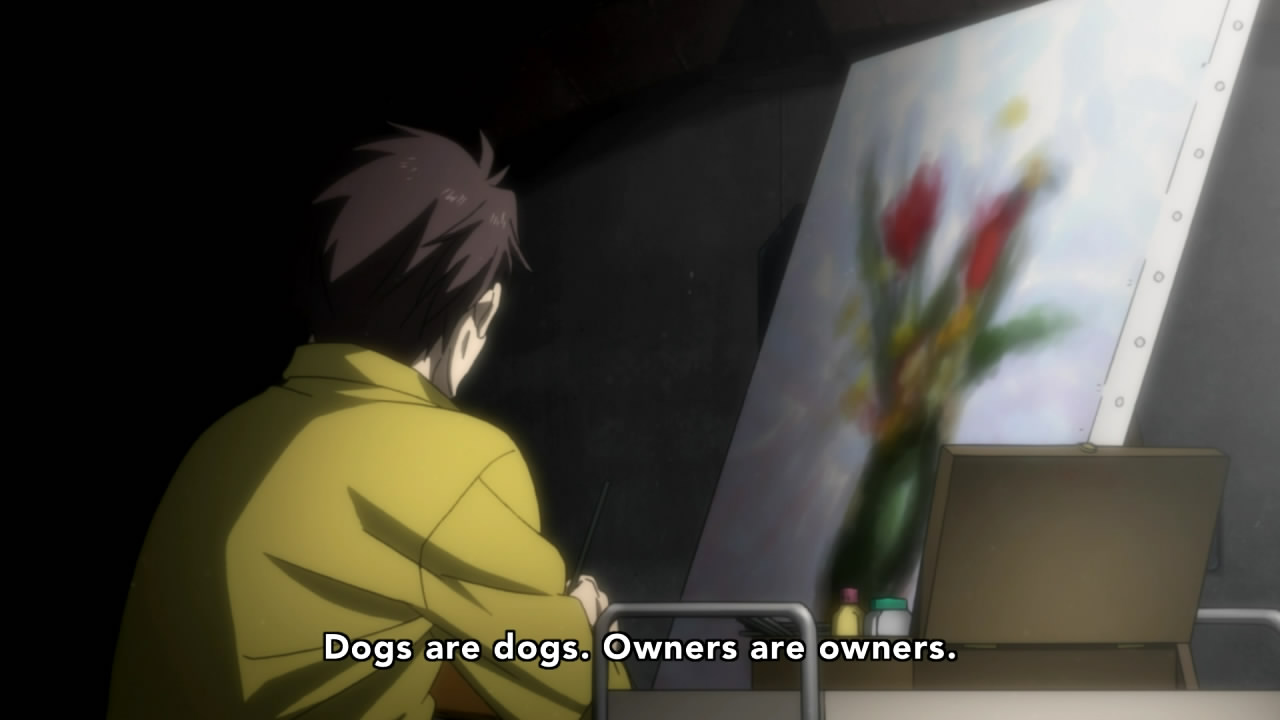
• It might be nothing, it might be something, but we see Masaoka spend his free time by painting happy little trees (actually, I don’t know what he’s painting). It’s decidedly low-tech. You wonder if people in better social positions like Akane can afford to just strap on her pink VR unit and draw on cyberspace or something.
• According to Masaoka, “[Akane is] strangely connected to him by fate, so…” Really? Already? Still, considering what we know of Masaoka, and contrasting him with the more data-driven Ginoza, what the old man is saying here isn’t out of character and really just serves to reinforce the themes his character is meant to represent. I just think it’s a little early to start talking about the intertwining fates of Akane and Shinya.

• Nevertheless, Masaoka warns the girl to stay away from Shinya. The anime then does a close-up of Akane’s perpetually-droopy eyes and what should’ve been an introspective moment made me laugh.
• Masaoka believes that in order to understand Shinya, you have to become as dangerous as him. I don’t think sympathy is supposed to be that hard, yo.
• A new case every week. Let’s see whether or not this one will be wrapped up by the end of the episode. Even so, it wouldn’t bother me as much as it seems to be bothering some people. I guess that’s because I continue to fixate on the developing PSYCHO-PASS system as my overarching plot for the series.
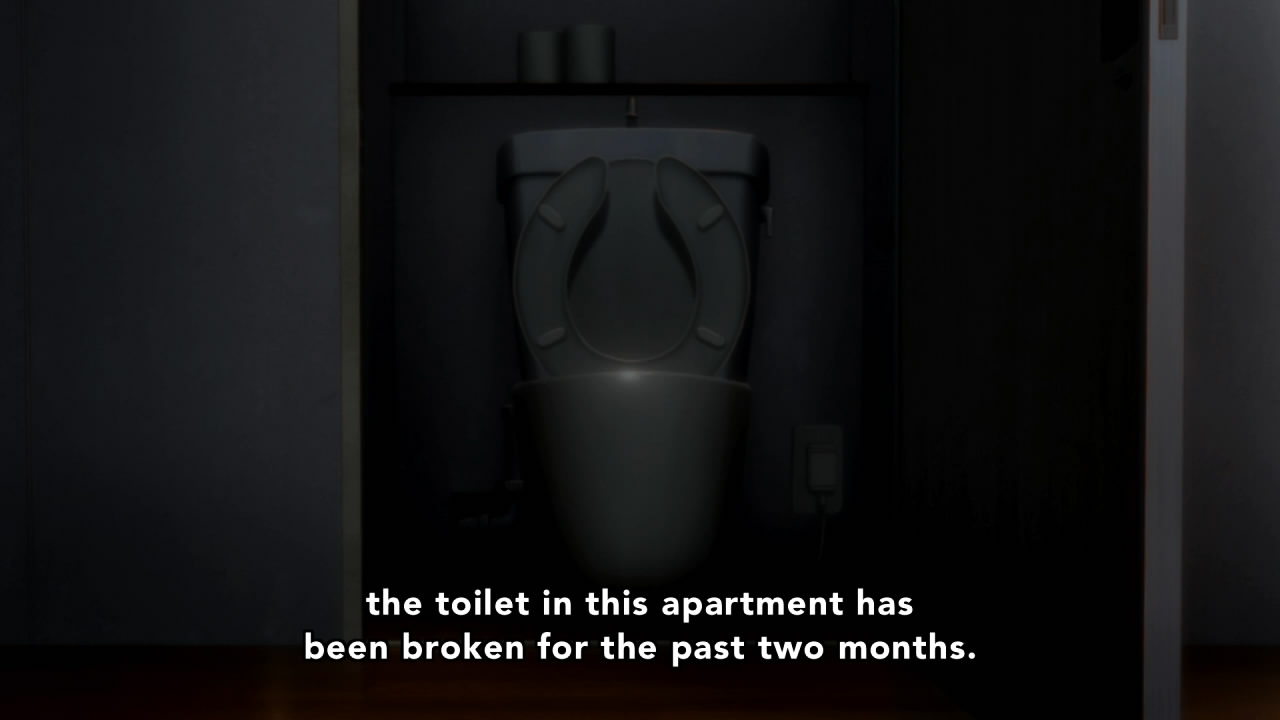
• Wow, really? A broken toilet is the cause for suspicion this time around?
Addendum: Here’s some of my additional thoughts on the scene as a result of a discussion in the comments below.
The suspect’s description is certainly no accident. Considering Japan’s widespread demonization of hikikomori sufferers and those who refuse to get married and help reverse Japan’s negative trending birth rate, what we have here is a somewhat balding man who is single and derives pleasure from his escapist fantasies online as some sort of self-important seer. The suspect is everything that a productive member of a modernist Japanese society is not: he creates nothing of value nor does he embody any sort of Japanese ideal. If anything, he is society’s abject: those on the fringe who are simultaneously too self-absorbed in their own affairs to effect any substantive change, but, at the same time, lacks the sort of moral fibre to satisfy the typical nationalist. He only even appears on anyone’s radar as the result of an anomaly in the capitalist structure: a management company found it odd that he did not report a broken toilet. In fact, the example itself makes me wonder if there isn’t some perverse humor in this entire situation (intentional or not) after all.
Allow me to explain. Hayama’s death means utterly nothing until someone decided that the “shit(er) don’t work.” And what should they find in the sewer pipes connected to the “shitter?” Supposedly, the “atoms” of the suspect himself. Again, an abject but this time, he has literally been turned to “shit” to be flushed down the toilet and society wouldn’t have even been aware of his disappearance unless his existence or lack thereof somehow impacts something which belongs to those with capital, i.e. the people who own the apartment noticed that their stuff was broken. Why is it that in a Big Brother-esque narrative, they can’t detect that a man has gone missing, but they can sure as hell detect a broken toilet? Like the typical lumpenproletariet, Hayama is nothing to society. Even worse, he’s shit. Is this stupidity on the writer’s part, or is it subversively humorous?
• Our first suspect is another middle-aged man. Other than the rape victim from our very first episode, all of the dangerous people have been male so far, and also single too. Hm.
• Akane is astonished to learn that the suspect is unemployed. I guess the ruling government in PSYCHO-PASS can find you a job if you just so much as ask, but of course, we learned last week that not all jobs are cushy. I’d rather be unemployed than stuck in what is essentially a labor camp full of assholes. But anyway, our suspect is apparently an internet superstar, hence the lack of gainful employment.
• So in this world, you can’t even leave town without being tracked by Big Brother: “…it’s virtually impossible to take a trip without leaving a trace.” Is this safety to anyone?
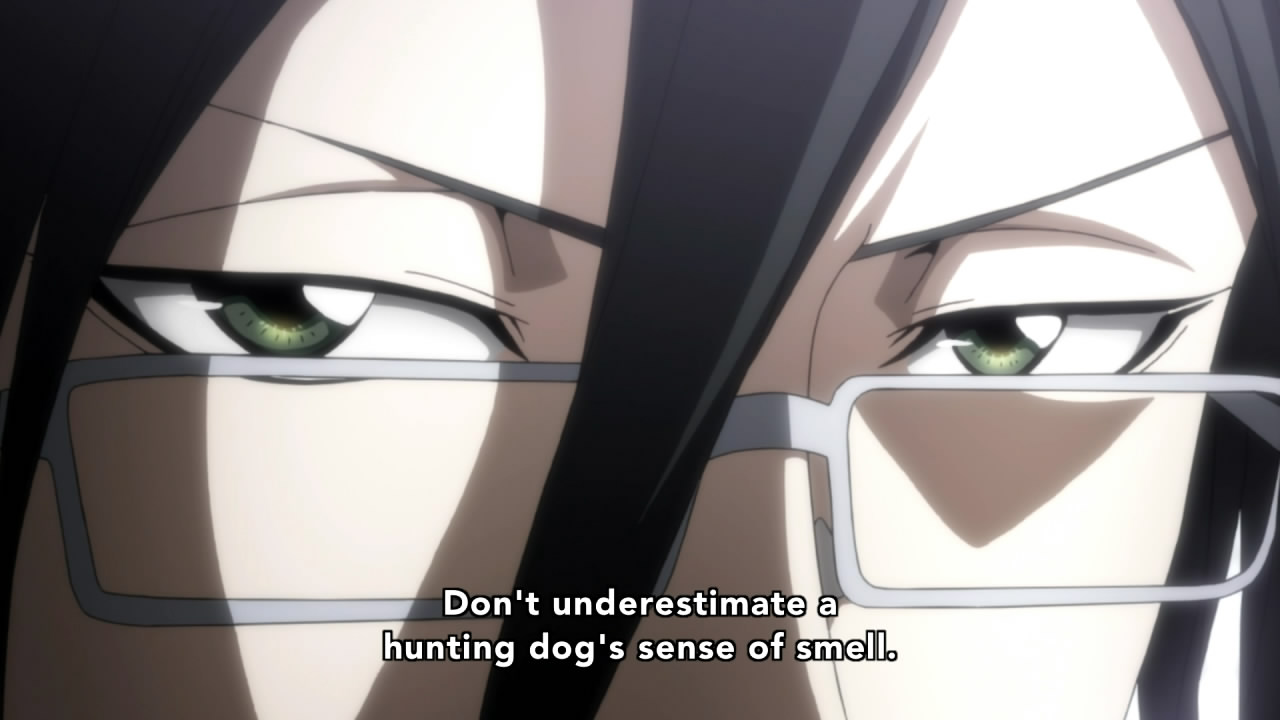
• As usual, the Enforcers and Ginoza engage in that ol’ familiar dance. Using their intuition, our Enforcers instantly discern the truth, but fuddy-duddy Ginoza mutters contemptuously, “It’s too soon to draw a conclusion.”
• Wut: “They first killed the victim in a way that he wouldn’t bleed. Then, they spread out a plastic sheet in the room and dismantled the body into tiny pieces down to atoms so that these pieces could be drained from the bath or toilet.” The emphasis is mine. That sounds… a little outlandish, but hey, this is the future. Maybe that sort of thing is possible. Maybe it’s a translation error or something though, because you certainly don’t need to break a person’s body down to literally atoms to drain it.
• Oh, so we do get to see Talisman again… and presumably, for the last time too. I remarked before how Talisman had multiple countenances even though he advised Akane to find Shinya’s true character. I guess this all comes together now that Talisman is really an imposter.

• Why on earth is Ginoza’s avatar a US coin? I initially thought it was a quarter because the front more resembles a quarter than anything else, but according to the back of his avatar, it’s a dime. It doesn’t matter. The face looks nothing like either Washington or FDR.
• The future internet is seemingly composed of large communities revolved around major personalities. To compound matters, Akane says that they could be in trouble if the community ever found out there were cops amongst them. Why is this? Plus, even if everything is in virtual reality now, what can internet avatars do to you?
• Since the internet is international and everything, would the authorities like Ginoza even have jurisdiction over it? The way Ginoza talks of checking access logs of CommuFields, however, suggests that maybe the authorities do have some control over the internet after all, so I guess I don’t have a clue how it all works.
• Anyway, there’s a good possibility that the internet is being used by the inhabitants of PSYCHO-PASS to escape the real world. This would be an interesting thread for the rest of the series to develop, if it chooses to.
• Akane gets whisked away magically and placed onto a throne. VR worlds are always depicted as unsafe zones full of hacking and whatnot. It always perplexes me too why those like Akane don’t just immediately log out whenever something weird happens.
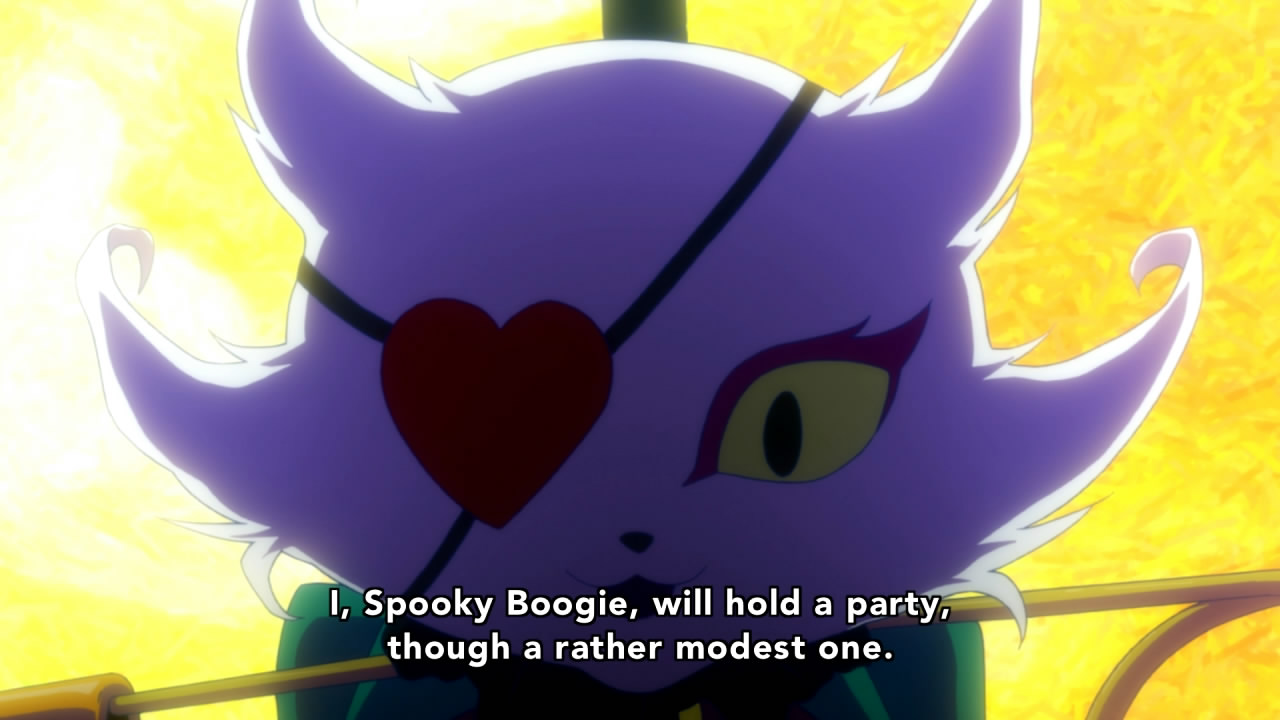
• Spooky Boogie’s chatroom is full of faucets. Any thoughts?
• So here’s how the trap is going to work: Spooky Boogie is hosting a real world party where attendees come dressed as their online avatars. If Talisman shows up, they’ll just nab the guy. The whole thing just sounds so unprofessional for detectives of presumably Akane’s quality. Just because someone shows up at a party as Talisman hardly means that this is the suspect she’s been looking for. After all, can’t people just fake this shit and wear whatever costume they want?
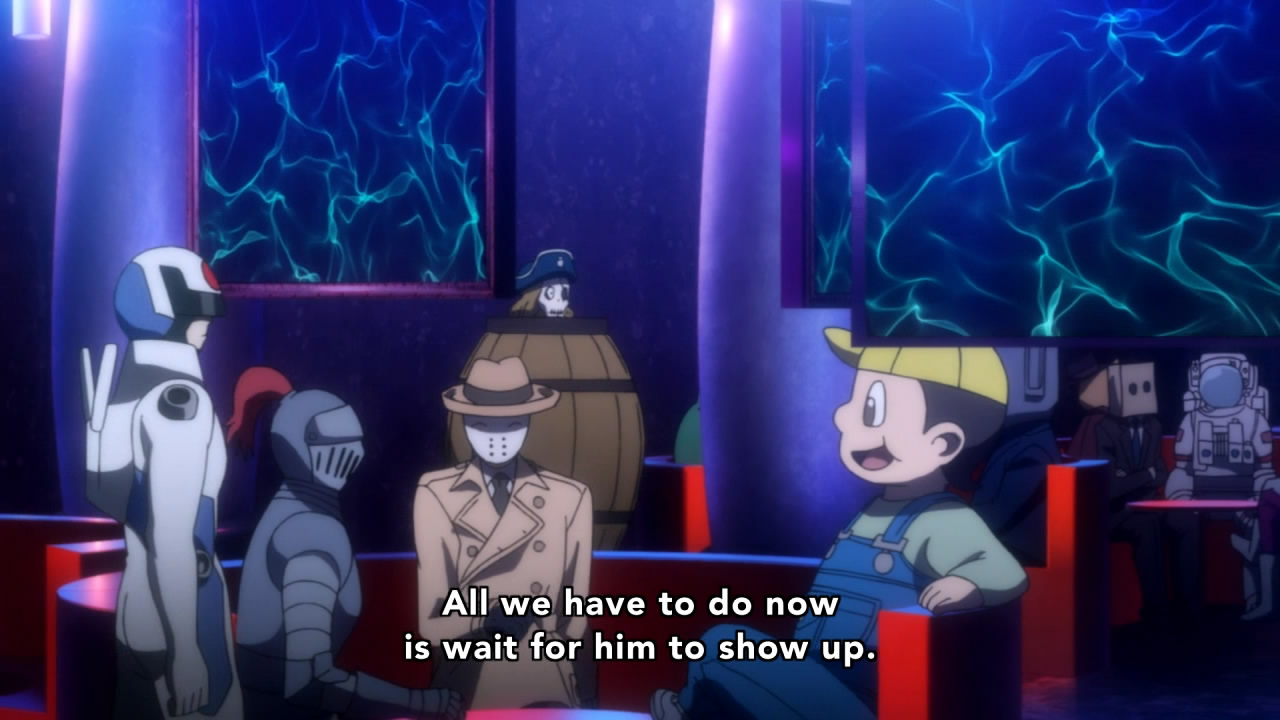
Ginoza then suggests that the suspect could show up dressed as anything, but the PSYCHO-PASS system will identify him or her. But we saw just last week how a person’s Crime Coefficient can be misleading. It’s been two months since the real Talisman was killed, right? What if the suspect no longer shows that he’s a current danger to society?
• Masaoka finds such get-togethers weird, but I guess it’s possible an old fart like Masaoka has little to do with online affairs. Still, this party doesn’t sound any different from the get-togethers we have now. When the detectives finally show up at the party, Masaoka goes on this mini-rant: “Getting cooped up in such a small place not knowing who everyone else is, don’t these guys feel uneasy?” In a way, the writer is using his story to impart commentary on what’s happening in the real world, but the results are sort of… discordant, I guess? Masaoka speaks as though he’s someone from our time period, and perhaps that’s just a part of his characterization, but I still feel as though these lines don’t fit.
• So much for their intuition: as soon as everyone’s avatars got hacked to resemble Talisman, Masaoka and Shinya couldn’t resist jumping into the fray and whipping out their Dominators. The result is mass chaos as everyone at the party scattered. I’m sure they could’ve thought of a better solution than this.
• But hey, the case ain’t over yet.
• Wow, way to be subtle about it, fellas:
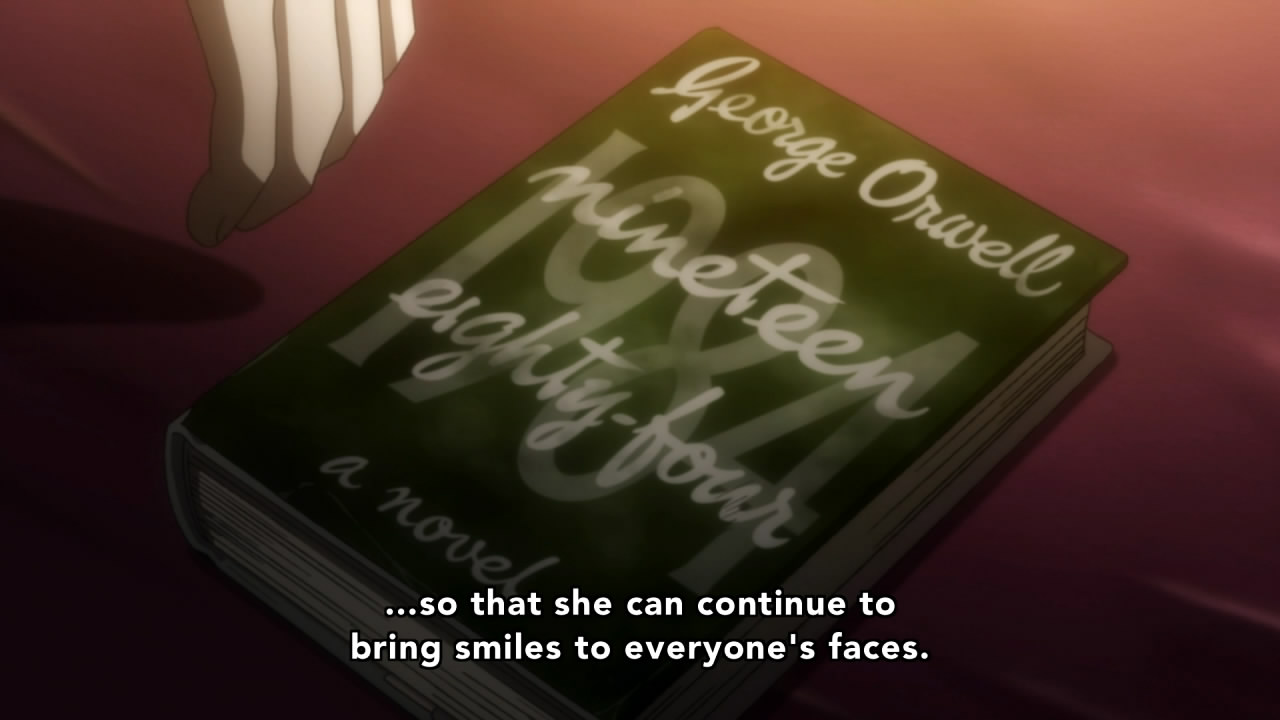
• That ending shot of blended tomatoes was also corny as fuck.

– I believe Masaoka was painting a vase of what seems like.. roses maybe and some small yellow flowers I can’t identify. Probably another attempt on symbolism… they seem to love ’em symbols this episode. Multiple faces – insincerity. Invisibility – anonymity, etc.
– And yes, major WTF moment: The Case of The Broken Toilet! Time to call in the detectives!!11!
– The death of the Spookie Boogie girl was quite sad. I actually found her quite layered and for a character with like, 5 minutes of screentime.
– As for Ginoza’s avatar, the only words I could clearly decipher from the screencap was “in god we trust”; a reference to his utter faith (?) and servitude towards the Sibyl’s system, perhaps? Or maybe he just likes money.
That’s an interesting thought, but the word “LIBERTY” is also plastered across the top, which would seem to counteract the Big Brother atmosphere of the show.
Funny, I didn’t care too much for Spooky Boogie.
Indeed very subtle,
it was an interesting episode, as for how stupid it was from them to just panic and star shooting everybody, as Akane said, that’s why the Psycho-pass gets so cloudy, for policemen, they lack rationality and cool headed thinking.
Anyway, I found the whole thing a bit strange… but we are lightly introduced to, what I think is, our main antagonist, something to look forward to.
Btw, and a bit out of topic but not totally, I watched the 1 ep again and when Shinya was about to shot the victim (now a target for enforcement) the dominator updated to lethal mode, so if Akane hadn’t stop him, she would have been dead.
Also, I mentioned it ( but not here) before, but I wonder if the Op has some meaning behind it or is just a nice intro, We have the Shinya who wants to be a detective yet Akane noticed he enjoyed being a “beast”, as if he had two personalities, so to speak and in the Op we see him fighting with himself….just something I wanted to point out
Surely, being rational and cool-headed is Ginoza’s department. So why did he send in a rookie along with two hot-headed latent criminals? It just feels like a disaster in the making.
> Masaoka believes that in order to understand Shinya, you have to become as dangerous as him. I don’t think sympathy is supposed to be that hard, yo.
It’s the writer’s way of making Shinya seem deeper than he actually is. Basically, the vibes that I got from that conversation was that Shinya is the so-complicated-that-you-have-to-lose-your-soul-in-order-to-understand-him type of person. That’s why Masaoka quoted that overused Nietzsche aphorism about the abyss.
>According to Masaoka, “[Akane is] strangely connected to him by fate, so…” Really? Already?
Again, a pretentious yet awkward attempt at inserting importance into the two main characters’ relationship. I’m fine with making them have a deep relationship, but as you said, “it’s a little early”.
> Our first suspect is another middle-aged man. Other than the rape victim from our very first episode, all of the dangerous people have been male so far, and also single too. Hm.
This is either a case of a lack of creativity or a reflection of the writer’s misanthropic fear of the lumpenproletariat (and of single males too).
> After all, can’t people just fake this shit and wear whatever costume they want? . . . But we saw just last week how a person’s Crime Coefficient can be misleading. It’s been two months since the real Talisman was killed, right? What if the suspect no longer shows that he’s a current danger to society?
Another example of poorly-thought-out world-building and writing. Gen Urobuchi is not too good at this kind of stuff. He made the same mistakes with Madoka, especially with that whole entropy crap. Urobuchi is much better at conversations examining the human psyche, like in saya no Uta (or even Madoka and Fate/Zero).
–
Here’s my question: What does Gen Urobuchi mean by “anarchist”? Does he mean the popular myth of a cloaked man (it’s usually a man) with a Snidely Whiplash-esque mustache and a bunch of daggers and dynamite hidden inside his cape? Or was Gen actually talking about real anarchism, namely, the social philosophy that is against all forms of exploitation and hierarchy and is for a stateless and decentralized confederation of communes?
Judging by the glimpse we get of Spooky Boogie’s real-life room, it is obvious that Gen, like 99 percent of respectable mainstream writers, was defining anarchist as the popular caricature I mentioned above. In other words, anarchist in Gen’s book is a synonym for juvenile troublemaker.
It’s really hard for me to take Gen’s social commentary in this show seriously when he doesn’t even take serious ideas like anarchism seriously. Neither can I take him seriously when he not-too-subtly implies that this show will have LOLDEEP themes with the shot of Orwell’s “1984” (which, being an Orwell fan, I think is overrated. I much prefer his “Homage to Catalonia”, which is a first-hand account of about his life with anarchists during the Spanish Civil War).
Some thoughts before I get started on a BTOOOM! post.
I don’t know if it’s fear so much as disdain. The suspect’s description is certainly no accident. Considering Japan’s widespread demonization of hikikomori sufferers and those who refuse to get married and help reverse Japan’s negative trending birth rate, what we have here is a somewhat balding man who is single and derives pleasure from his escapist fantasies online as some sort of self-important seer. The suspect is everything that a productive member of a modernist Japanese society is not: he creates nothing of value nor does he embody any sort of Japanese ideal. If anything, he is society’s abject: those on the fringe who are simultaneously too self-absorbed in their own affairs to effect any substantive change, but, at the same time, lacks the sort of moral fibre to satisfy the typical nationalist. He only even appears on anyone’s radar as the result of an anomaly in the capitalist structure: a management company found it odd that he did not report a broken toilet. In fact, the example itself makes me wonder if there isn’t some perverse humor in this entire situation (intentional or not) after all.
Allow me to explain. Hayama’s death means utterly nothing until someone decided that the “shit(er) don’t work.” And what should they find in the sewer pipes connected to the “shitter?” Supposedly, the “atoms” of the suspect himself. Again, an abject but this time, he has literally been turned to “shit” to be flushed down the toilet and society wouldn’t have even been aware of his disappearance unless his existence or lack thereof somehow impacts something which belongs to those with capital, i.e. the people who own the apartment noticed that their stuff was broken. Why is it that in a Big Brother-esque narrative, they can’t detect that a man has gone missing, but they can sure as hell detect a broken toilet? Like the typical lumpenproletariet, Hayama is nothing to society. Even worse, he’s shit. Is this stupidity on the writer’s part, or is it subversively humorous? Judging by your take on this Gen Urobochi, you would say the writer has quite unintentionally stumbled upon this interesting metaphor. I haven’t watched Madoka closely enough nor have I seen Fate/Zero, so I can’t yet comment on our writer. I think, however, our example hasn’t quite been given enough credit for what it conveys.
I’d say neither. The ideas and ideals of anarchy have been hijacked, and this reminds me of the unfortunately popular interpretation of Fight Club. Upon viewing the movie, many people began idolizing Tyler Durden. Why? Because impressionable minds will easily cherry-pick what resonates with them, and ignore the rest. For anarchy, it is easy to see it as a feeling rather than a comprehensive philosophy. And this feeling is one of rebellion and anti-conformity (that is ironically conformist in the long run), but as with most feelings unaccompanied by introspection, this “anarchic” path leads nowhere. It is only self-driven and necessarily narcissistic. The feeling feeds into itself until the “anarchist” decides to move on and grow up. And unfortunately, this idea of anarchy being nothing more than a Joker-esque (the Nolan variety) force of nature that seeks to only erode society’s rules and laws dominates our popular perception of what it means to be an anarchist. We easily see this demonstrated by the writer’s depiction of Spooky Boogie.
First off, she, and popular internet figures like her and Talisman, must retreat to a virtual world to have any sort of sway. So right off the bat, the writer has pigeonholed our “anarchist” into some sort of juvenile make-believe world. This is where people like her and her fans can log on for a few hours a day, wear a mask, and pretend to be anarchists. We see, however, how quickly Spooky Boogie’s morals collapse as soon as her interests can be advanced by cooperating with the authorities. As such, she’s more in line with those popular “anarchists” who cherry-pick what they find palatable in the ideas of anarchy, but they have no such sense of what anarchy truly embodies. Unfortunately, this definition of an “anarchist” has become a part of the mainstream, i.e. young people with no proper direction, playing make-believe in their own fantasy worlds because they feel like castoffs from normative society. But once they find a way in, they don’t hesitate to seize it. And it is this strawman that the writer seems to be railing against, especially when he uses Masaoka as a mouthpiece to deride the idea of the party they crash. Even though the party ultimately exists in the real world, everyone there dons their virtual facade. In essence, it is no different from a virtual chatroom. Thus, Masaoka is really criticizing the legitimacy of the virtual world itself, and by extension, the so-called “theories” advanced by these so-called “anarchists.” Again, it must be re-iterated how Masaoka stands for pragmatism against the theoretical purity of those like Akane. And I’ll even add that those of the pragmatic mindset tend to gravitate to the right side of the political spectrum…
Anyway, I suppose the writer is criticizing a caricature of the anarchist, but at the same time, I’d say that the writer most likely has a misconception of what an anarchist even is, and is railing against an easy target. To use our previous analogy, this is like a person believing as though he or she is making some sort of brave stand against Tyler Durden and his destructive ideals when Tyler Durden was never meant to be the hero of the movie Fight Club to begin with. I think it’s equally unlikely that he has two conceptions of an anarchist in mind, and chose one over the other. Rather, the answer is somewhere inbetween. This caricature exists in the real world, and to some degree, it is self-inflicted by clueless impressionable youths, and perhaps the story thinks it’s making some sort of grand statement in standing against these wayward “anarchists.”
>I don’t know if it’s fear so much as disdain.
I wouldn’t be surprised if it was both. Emotions like fear, disdain and hatred are often intertwined. I don’t know of anyone who has one of these, like fear, without having the other, like hatred.
>The suspect is everything that a productive member of a modernist Japanese society is not: he creates nothing of value nor does he embody any sort of Japanese ideal.
It’s not just Japan’s ideal. Productivism–or the idea that constantly working and toiling is the purpose of human life and that idleness is always bad or undesirable–is a modernist ideal all throughout the globalized (or, rather, neo-liberalized or neo-colonized) world.
I’ve spent enough years in the United States to know that the right-wing (and also, to some extent, the center and center-left) has a nearly-psychotic hatred of the the idea of what they variantly call “welfare queens” or “freeloaders”. The former is a self-evidently racist, sexist and classist construct. The latter is a paranoid view that there is someone out there who will take advantage of any situation s/he can to parasitically live off another person. I guess this is what happens when you have a significant segment of the population that thinks Ayn Rand is a great philosopher.
Alternatively, think about how much social shame is attached to the person who is unemployed. I mean, one would think that with up to double digit percentages of joblessness in the populations of so-called First World countries like the United States, Spain and Greece, that people would change the way they think about unemployment — from thinking about it as a fault of “lazy” individuals to a systems-level analysis of a flawed system of capitalism (or if not this, then at least become more empathetic towards jobless individuals). But this doesn’t happen.
Again, there is a deep-seated cultural fear/disdain of idleness in modern society. Bertrand Russell addresses a lot of these concerns in his typically brilliant manner in “In Praise of Idleness” (which is available for free reading online).
Here’s an interesting experiment that anyone here can do: Try to find someone who is really liberal or progressive and tell them that the official workday can and should be reduced to 4 hours. Chances are, they’ll think you’re nuts. (“What will they do with their spare time?” they’ll condescendingly ask. “The young will resort to drugs and violence,” and variations of that.)
>Is this stupidity on the writer’s part, or is it subversively humorous?
I don’t think we’ll get a definite answer until the end of the show, but I wouldn’t be surprised at all if the stupidity was unintentional. After all, one thing everyone should recognize (if they haven’t already) about respectable mainstream writers like Gen Urobuchi is that they have unconsciously internalized the assumptions and ideas of their social environment, which, as every leftist already knows, are the assumptions and ideas of the ruling class.
Think of the idea (or, rather, the myth) that the police and the state are protectors of the weak, or that crime is a problem that requires punishment of “criminal” individuals as opposed to critical examination of the institutions that produced these “criminal” persons. These are ideas that Gen seemingly accepts that very conveniently benefit the ruling class.
Again, we won’t get definitive answers about Gen’s beliefs until the end of the show, so the emphasis in the sentence above should be on the word “seemingly”. For all I know, Gen might have a huge plot twist that subverts society’s most cherished assumptions (although I personally think this is astronomically unlikely).
But judging by Gen’s shallow and pontificating exploration of philosophy in Fate/Zero and Madoka, where in both cases he creates and destroys strawmen of “idealism” and supports the “pragmatic” and “realistic” pseudo-intellectual idea that no one can be better off without making at least one individual worse off (i.e., if I want to save X, I must sacrifice Y, or if I want to save Y, I must sacrifice X), it is obvious Gen is someone who has very much internalized the ideas of the ruling class — whether he realizes it or not.
>The ideas and ideals of anarchy have been hijacked, and this reminds me of the unfortunately popular interpretation of Fight Club.
The sad thing is, Fight Club doesn’t even espouse anarchism (as many historically-illiterate writers have argued). Nor does it espouse nihilism (as some slightly-less-historically-illiterate writers have argued). It doesn’t describe anything coherent except for a macho variation of egotism, hedonism and narcissism. That’s it. There’s nothing profound about it. Calling characters like Tyler Durden anarchists or nihilists is an insult to real anarchists (like Mikhail Bakunin, Leo Tolstoy or Noam Chomsky) or real nihilists (from the late 19th and early 20th century) who believed in ideas higher than themselves and fought for a cause (as opposed to Durden’s crude and personalistic idea of Project Mayhem). I would have loved Fight Club if it supported anarchism or nihilism, but it does neither.
> I’d say that the writer most likely has a misconception of what an anarchist even is, and is railing against an easy target.
Again, I doubt that Gen even knows what an anarchist is. His idea of an “anarchist” is a strawmen of everything he doesn’t like, just like how the “idealism” of certain characters in Fate/Zero and Madoka were also strawmen of things he didn’t like.
To close off: I don’t want to give off the impression that Gen doesn’t have his strengths. He showed real great writing and storytelling in Saya no Uta, which demonstrated that he had a really good capacity for existentialist writing. It showed that he was basically a Dostoevsky-lite (or, more precisely, Dostoevsky-very-lite). Gen knows how to write about the experience of being in the head of a madman. But, again, like Dostoevsky, Gen also has internalized society’s reactionary views, even though he may not be an Orthodox Christian monarchist like Dostoevsky was. My problem with Gen is the same with Dostoevsky. I prefer that both talk about psychology than about politics. I love the portrayal of psychology of Crime and Punishment but I hate the portrayal of philosophy of Demons. Similarly, I love the portrayal of psychology of Saya no Uta but hate the portrayal of philosophy of Fate/Zero.
Sure, but what reason does anyone have to fear the lumpenproletariet? I think just by definition, no one necessarily fears them. If anything, most people seem to see the underclass as nothing more than a nuisance, but more often than not, people don’t even act as though the lumpenproletariet exists as a polity.
That’s what 30 years of the Reagan coalition will get you. One can hardly believed that the sixties with its sexual revolution and civil rights movements — ever existed.
Well, my point wasn’t that Fight Club supported anarchy. Rather, the movie actually condemns people like Tyler Durden, but many fans mistakenly believe the movie tries to advance Durden’s philosophy.
I don’t disagree with the rest of your points, but I’ll just add that few people read Dostoyevsky for his views on politics. Hell, you mentioned Demons and that’s one of his lesser known works. It shouldn’t be all that surprising that his politics is fraught with issues. People often triumph instead Crime & Punishment, The Idiot, and The Brothers Karamazov, and they do so often for these novels’ intimate character studies or, as you’ve suggested, Dostoyevsky’s take on human psychology. I still rather enjoy the interpretation that Raskolnikov’s murder of the old woman is ultimately not some actualization of Nietzchean ubermensch, but rather a conflicted outburst of anger at the quasi-incestuous ties between him, his mother, and his sister. Or, to put it another way, the idea that Raskolnikov was attempting to advance some form of the superman theory is simply an excuse to cover up his deeper issues. Anyway, I’ve digressed enough, but Dostoyevsky is one of my favorite authors.
Sorry to intrude on your conversation, but let me argue about Urobuchi’s writing in Fate/Zero since E Minor hasn’t seen it.
The idealist character from Fate/Zero weren’t thought up by Urobuchi, but the original writer of the Fate series, Kinoko Nasu. All the philosophy no one can be better off without making at least one individual worse off came from Nasu, so Urobuchi had to write around that. And because it was a prequel, the character that represented that “idealistic” idea had to die because he was dead already in the sequel. It’s not that Urobuchi hate’s idealists, that’s just how the story had to unfold. If you read interviews with him, he states that he actually really likes that character and found it sad that he had to suffer so much. Not only that, Kiritsugu’s so called “philosophy” is dumb as shit and the characters in the show call him out for that. The point wasn’t that he was right, but that he stupidly fought so hard for a broken, childish ideal.
It’s the same with Madoka. While Sayaka’s idealistic nature led to her downfall, Madoka pretty much represents the same thing. She embodied hope and did give that hope to the rest of the magical girls. To me, that doesn’t sound “pragmatic” and “realistic.” Sure it wasn’t all rainbows and sunshines afterwards, but it was a better fate than becoming a witch. And again, if you read his interviews, this was his idea of a happy ending.
Oh and also, if I remember correctly, while Urobuchi is writing the script for Psycho-Pass the ideas and scenario actually came from the director. I read somewhere that this director wanted a really good screenwriter for this show and hired Urobuchi so I don’t think we can pin every idea and plot point on Urobuchi.
I’m pretty sure that the man wasn’t cut down into atoms. That is a translation error, and is why I don’t like the lazy translators that work on simulcast streams.
So what was he cut down to then?
To small enough pieces that could go down the toilet. That’s about as specific as Commie would get, and the group’s translator obviously didn’t agree with the notion that he was cut down to atoms, because the script wouldn’t have been changed if that was the case.
“Eh, there’s unemployed man in this country?”
Faceplam.
Of course, Akane dear. It’s a basic knowledge. You’ve seen a beggar at ep 1 right? I’m starting to think that she’s cheating to get high grade at school.
Many adore Akane and pointing her as “hero” because she’s prevent the rape victim at ep 1 from getting shot. BUT, she’s also make the woman Psycho Pass more clouded. If Akane just let the woman getting shot early.
And what’s with her avatar? It resembles her so much yet she’s surprised that her friend easily recognized her?! *sigh*
I get Halloween vibe from this ep. Shogo is awesome that he make those yellow jacket work.
The rape victim’s hue was already cloudy enough to get herself killed. The rapist said so when he was carrying her around.
>A new case every week. Let’s see whether or not this one will be wrapped up by the end of the episode. Even so, it wouldn’t bother me as much as it seems to be bothering some people. I guess that’s because I continue to fixate on the developing PSYCHO-PASS system as my overarching plot for the series.
Hey, it finally ended in a (weak) cliffhanger this week. Cool.
I could see more of what you mean about developing the Psycho-Pass system in this episode, both as to how the crime was reported, and how it might have shaped the anonymous avatar culture on their internet as an escape from a real world that knows too much.
However, the direction is still anchored to these characters, e.g. the fairlly cliche development between Akane and Masaoka in the beginning. If the main character is truly the society, I hope that future episodes can–at least sometimes–break away from the main cast and show the society’s effect on “regular” people. Besides Akane, we’re still mostly being *told* how people live in the world. Maybe these detectives could sit back and just observe for a bit; let the scene linger on the clubgoers and their conversations. Nope, time for shootan.
Other note: as a CS major, I give their short bit of technobabble about tracking the suspect 4/10. I found it a little immersion-breaking that a overbearing government in the physical world (street scanners, toilet operation detectors and so on) would have so little control over the virtual world. I’m pretty sure evidence of a *murder* is good enough grounds for a search warrant for access logs. Then again, networks like Tor today are getting better, and given that Spooky Boogie was popular “anarchist”, she must’ve been behind 7 proxies to avoid getting caught for thoughtcrime (but on the other other hand, righteous, A-student Akane seems to access those avatar rooms just fine, so it’s not highly illegal I guess). In any case, it just seems strange that a society that reads your thoughts would allow such a popular “underground” internet.
Okay, well, I’m not trying to dictate to anyone how they should watch the show. If you find the characters disappointing, so be it. I’m not necessarily disagreeing, but I’m also just explaining why it hasn’t bothered me as much.
Maybe we’re being too harsh. Maybe all they really care about is crime in the real world. You can think and say whatever you want online, but as long as it doesn’t bleed over into the real world, maybe the government just doesn’t give a shit. And perhaps the government is confident enough in their Psycho-Pass system that they don’t need redundancies on the Internet as well.
>I’m not necessarily disagreeing, but I’m also just explaining why it hasn’t bothered me as much.
Fair enough. I still think that a 2-cour series can do better, but such is the nature of criticism.
>Maybe we’re being too harsh.
Reading through the comments again, I can see your point. As you said in a diffferent comment:
>So right off the bat, the writer has pigeonholed our “anarchist” into some sort of juvenile make-believe world.
Maybe the psycho-pass internet is a sort of state-sanctioned place for citizens to relieve stress and act like anarchists; confining such behavior to a virtual world keeps the real world cleaner. I’m having trouble of thinking an example right now, but I’m pretty sure such a system has appeared in other stories.
However, it still doesn’t explain how the Sybil supercomputer has such problems managing another computer network. And, as you’ve explored a bit in your SAO posts, how much can you really separate your online and real persona? Spooky Boogie had a copy of 1984 in her house, though I suppose as a hikkikomori, she didn’t get out much into the view of the street hue scanners.
But hey, we get at least one more episode with the same plotline! These questions might actually be answered!
***
Aside: nice theme upgrade, but I liked having your entire comments with blue backgrounds, rather than just a little “post author” badge by your name.
I don’t think the system cares too much about these philosophical issues. Pragmatically, it only has to worry about how people think in the real world. Even if you are dangerous online, there isn’t much you can effect in the virtual world. So why worry about it? You can just catch them later. If they never even leave their homes, then you doubly don’t have to care. A dangerous person who never goes anywhere is essentially in prison anyway. And if people like Spooky Boogie are all talk, then even better.
I don’t really have any control over that. Well, maybe I do, but I’m not paying extra for it. Overall, I think theme is a little cleaner looking than the previous one, so I might stick with it.
an anime is just one person mind and field work.. but the guy who wrote this article really goes deep on figuring out.. i wonder why? tell me why??