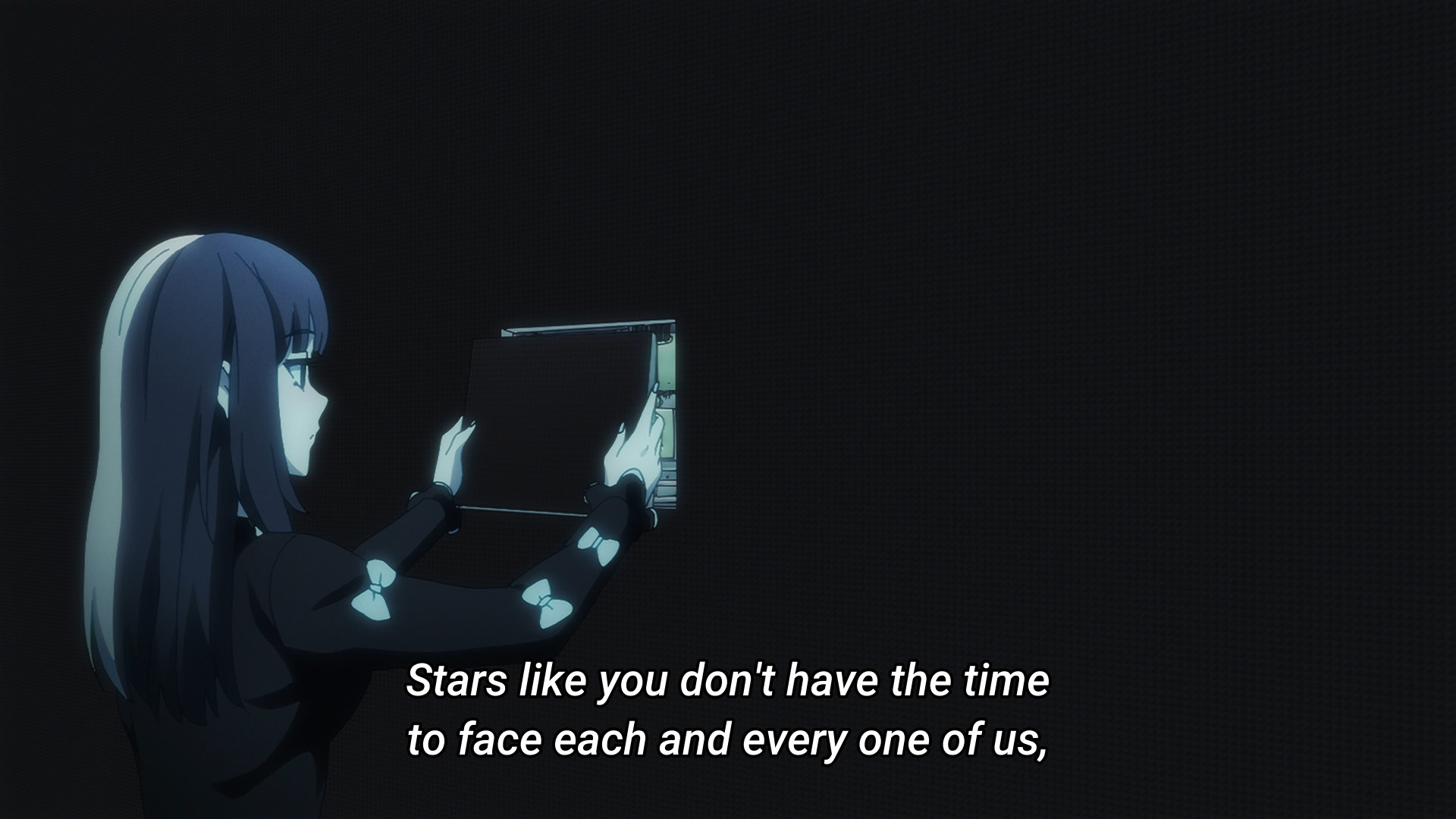
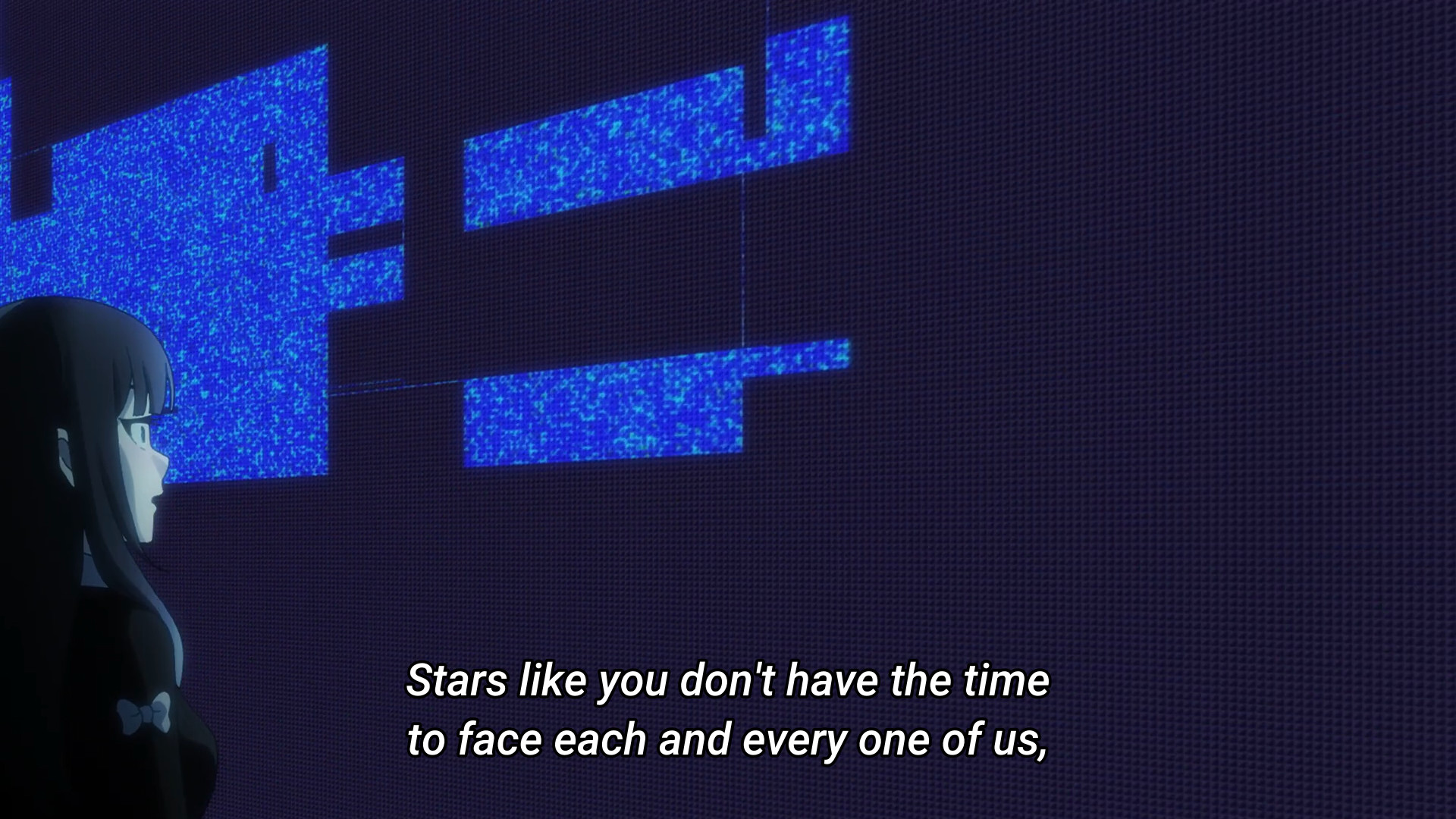
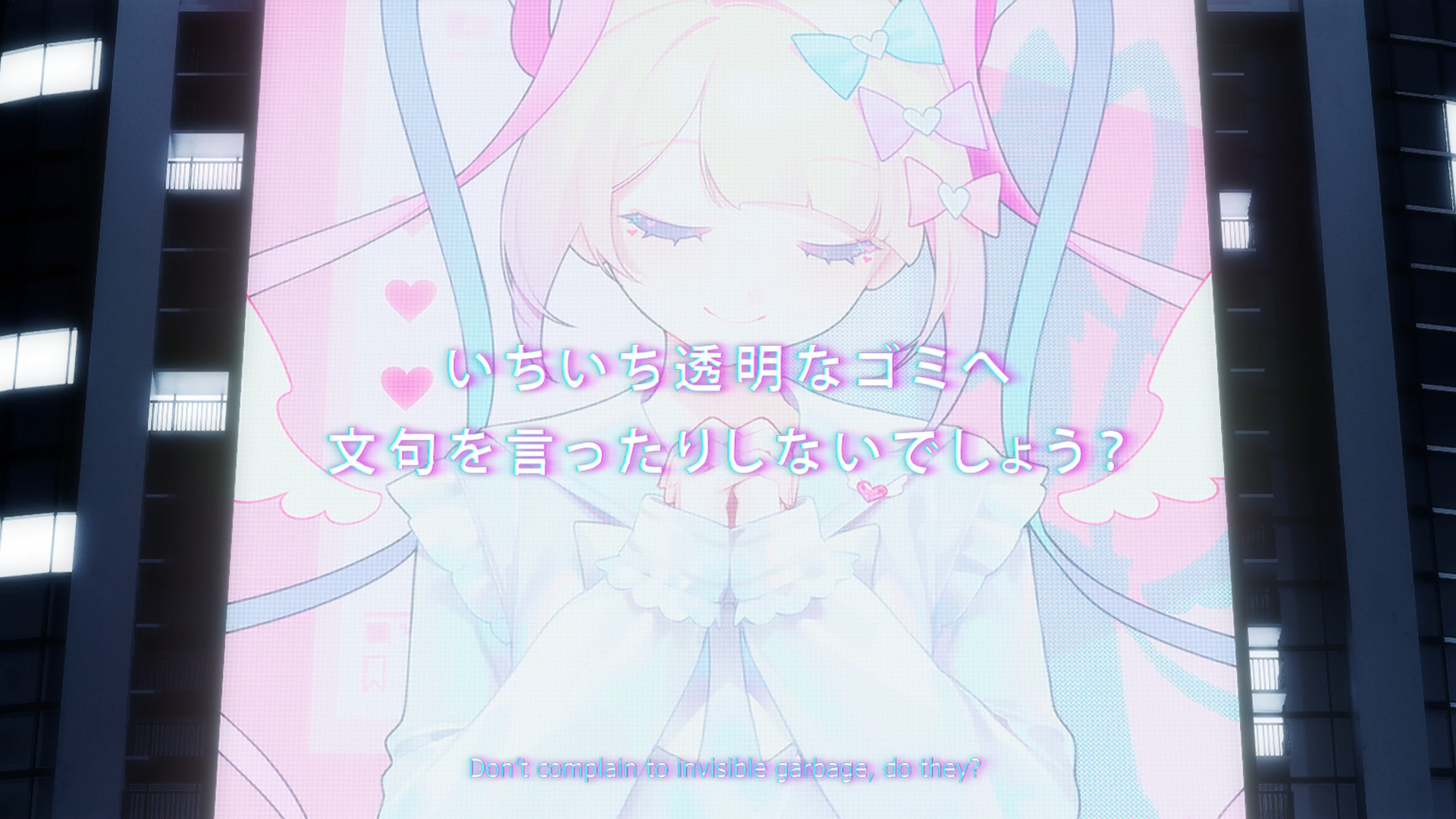
The episode opens with Kache seemingly trying to convince herself that she’s not like the others — that she’s merely ordinary, plain, boring, and thus utterly insignificant before the massive star powers of those like KAngel or Karamazov (though judging by their sub counts, I still don’t think they’re anywhere near the same level). But there’s a moment in this monologue that I find particularly interesting. I dunno what you call them (if they even have an official name), but there are these massive displays made up of smaller, tinier screens. Kache comes across one of them lying on the ground and picks it up. Neither the smaller screen or the bigger one are active. But when she puts the one in her hands back into its rightful place, the whole thing comes to life. Before you know it, KAngel looms over everyone. The internet superstar has her hands clasped together and her eyes closed as if she’s praying. This facade makes me think of the Virgin Mary or religious saints. And again, this display was defunct until Kache completed the “puzzle.” This “monument” to KAngel literally didn’t exist until she had every single “pixel.” It’s like how idols would be nothing without their fans. What even is a goddess without her worshippers? So Kache can lambast her position as a lowly “normie” all she wants, but it’s a reciprocal relationship. Sure, there are way more people like her than there are massive internet superstars, but the fans clearly matter. If they didn’t, content creators wouldn’t need to ego surf. If they didn’t, content creators wouldn’t desperately look for validation. And likewise, if fans were merely insignificant grains of sand, then why would their criticism — even anonymous ones — hurt so much?
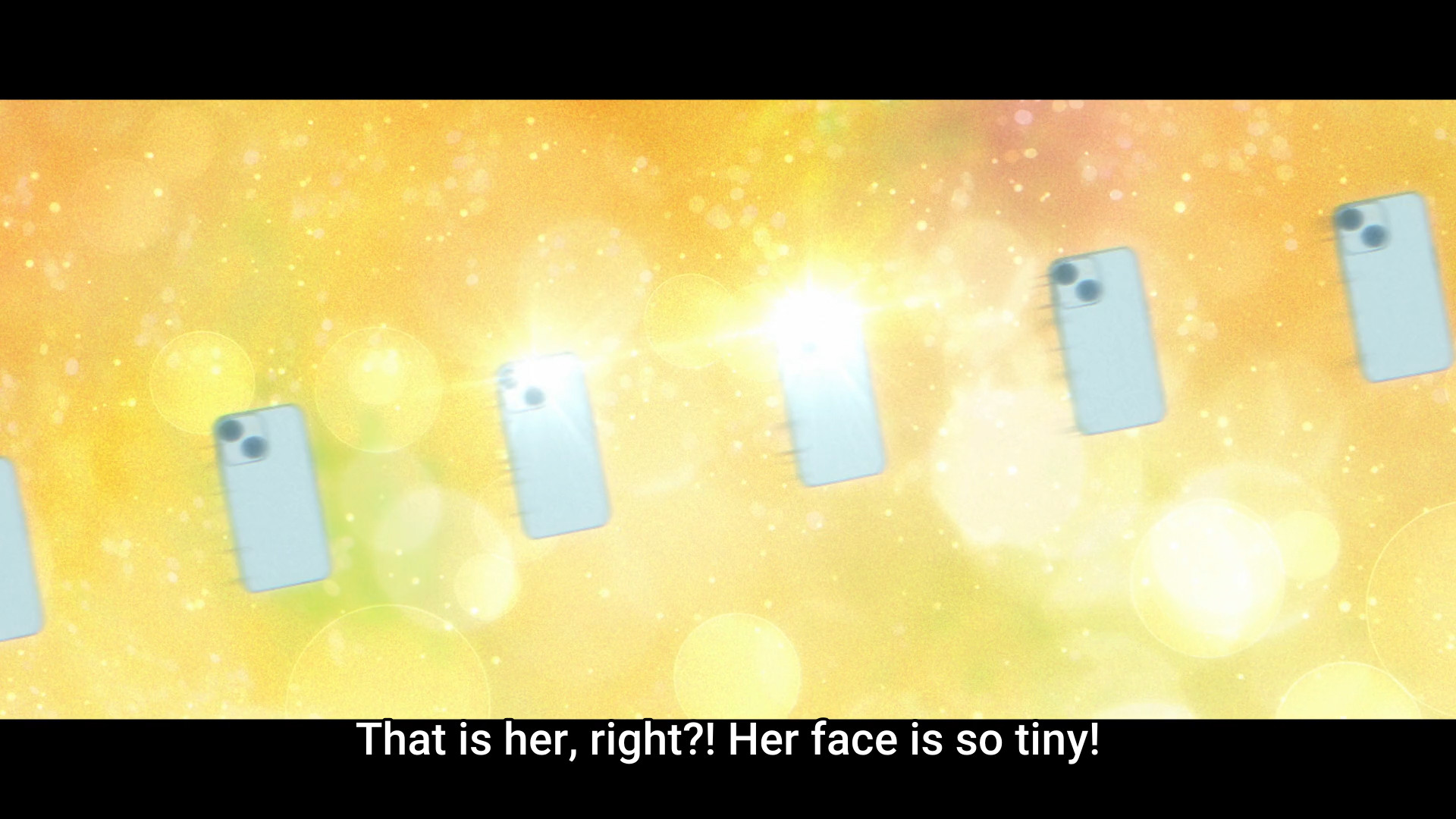
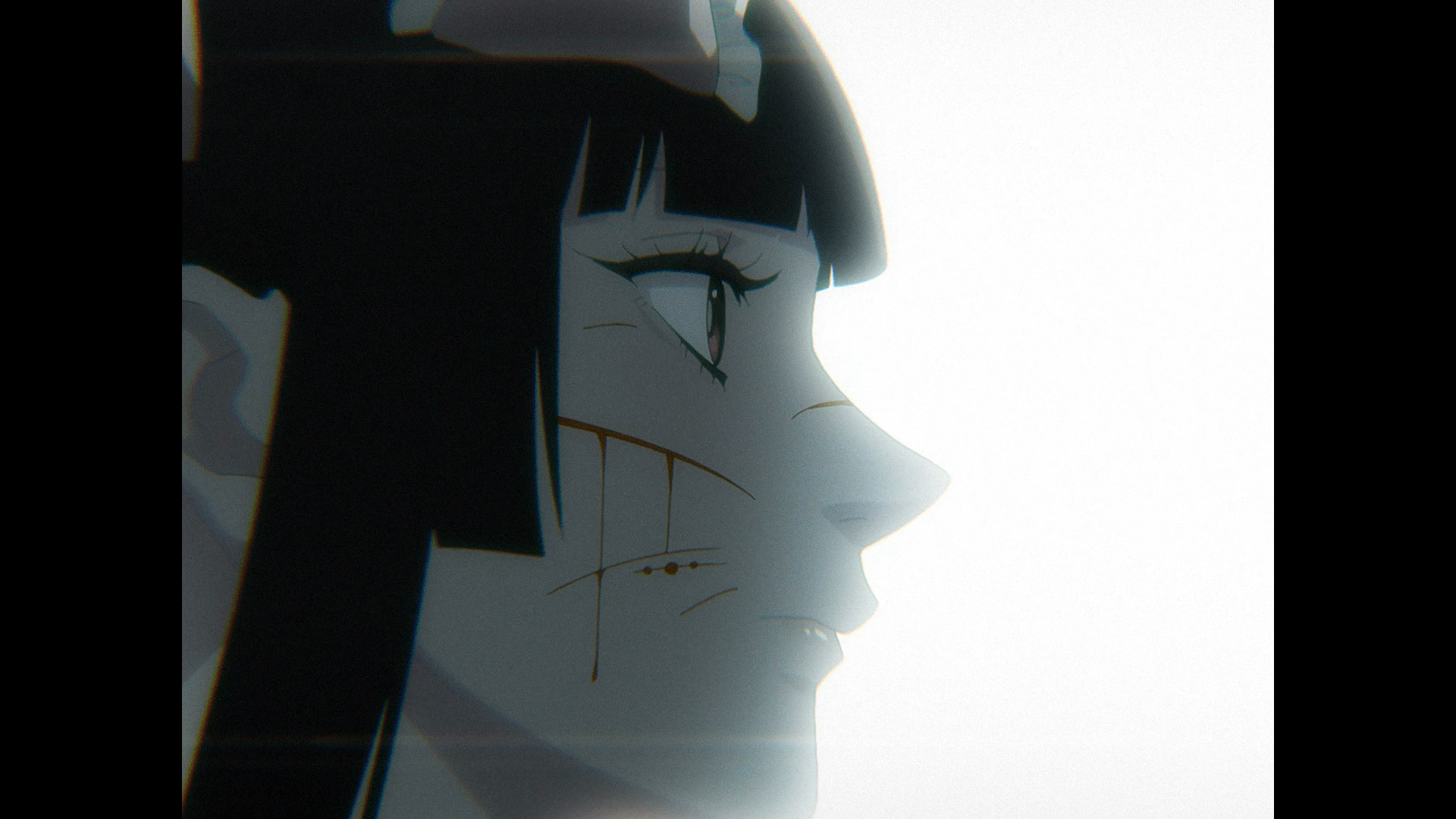
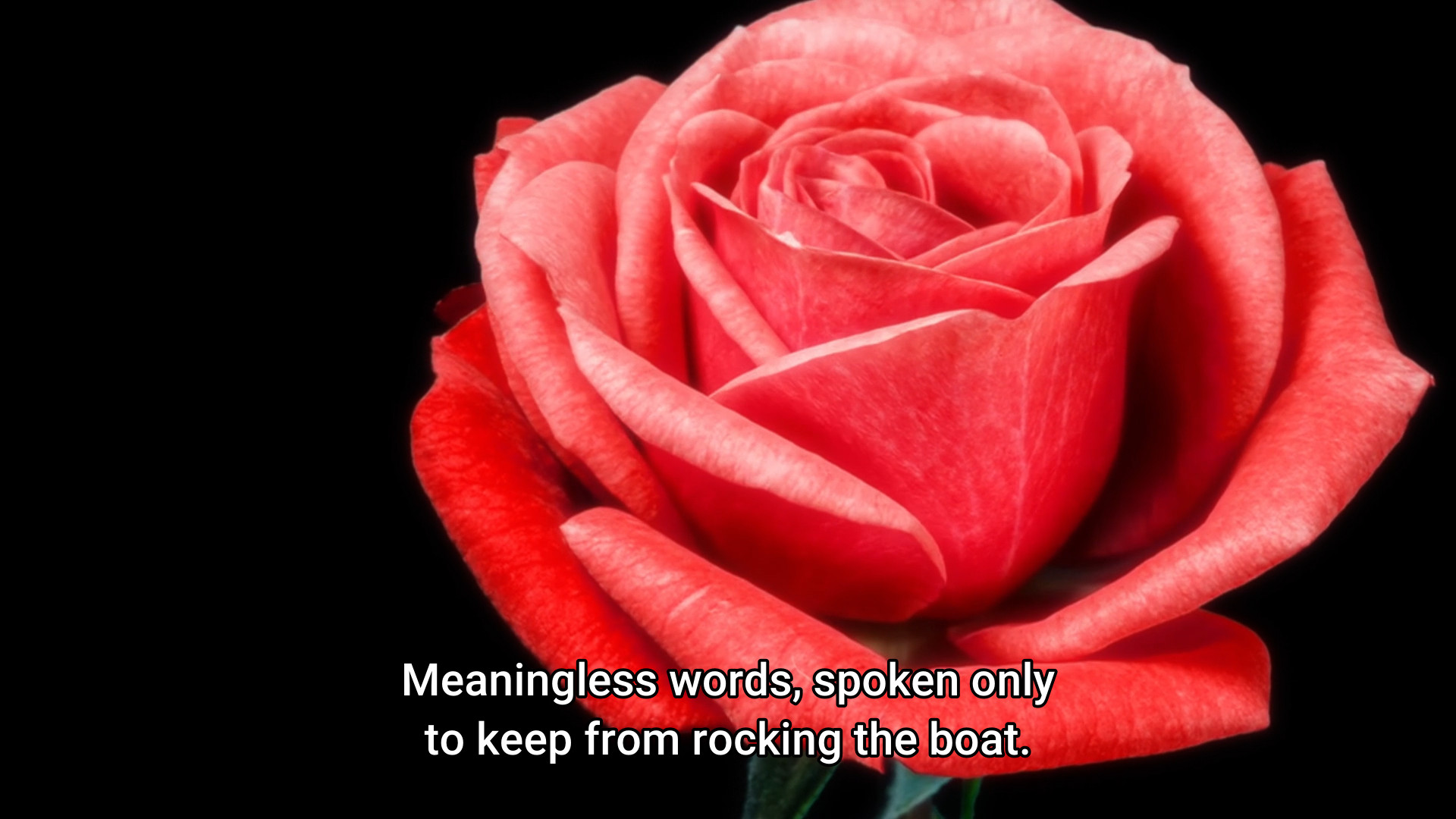
We keep seeing flowers blooming. We see flowers when Kache looks for and finally finds Michica. We see them again when she spies Nechika and Michica having a private, romantic moment. Maybe Michica meant more to Kache than just a friend. So far, everything has been about conformity versus non-conformity. Kache bemoans the fact that her classmates, school and life in general always being the same, but she’s just sitting at her desk, complaining. Even when it comes to her sexuality, she feels as though she has to deny who she is. Kache doesn’t want to garner negative attention (though she ends up seeing them anyway), so she tries to live a “normal” life. Is this why she’s still with that boyfriend who continually assaults her? ‘Cause he’s a hot guy in a band? Is this also why she works a soul-crushing job where she has to please customers she despises? On the other hand, Michica is fine with any attention. She smashes windows, gets dolled up in gothic lolita fashion, then wanders through dangerous, seedy areas of the city. She’s giving herself clout regardless of whether it’s positive or negative. People stop just to take pictures of her on the street, which then goes viral and leads to even more people looking out for her. It’s a feedback loop.




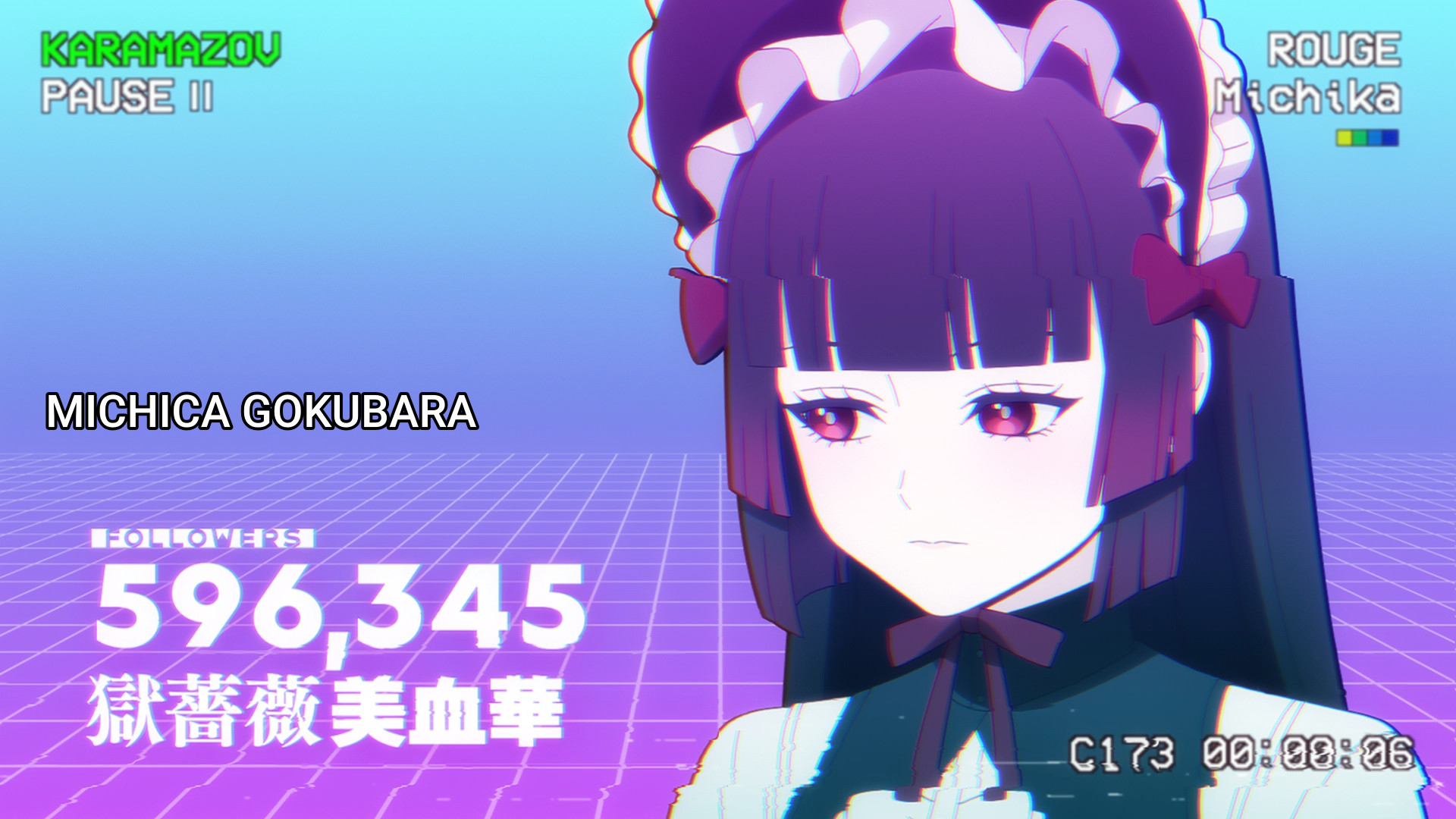
But that’s the thing about non-conformity, right? It only seems freeing and unpredictable on the surface. Oh wow, she’s totally living how she wants. She’s so cool and badass. So punk. But when you really dig deep, you’ll find that a lot of non-conformist actions are merely responses to conformity. Become an individual, they say, but what does that really mean? My point is, Michica (and the rest of Karamazov) isn’t rebelling so much as she’s creating a brand that she can market and sell. We go to school so we can prove that we have skills to ply on the marketplace of jobs. Don’t want to do that? Well, you gotta sell something. Looks, beauty, sex, whatever — even the fact that Michica is queer can become a selling point. As Disco Elysium once aptly put it, “Capital has the ability to subsume all critiques into itself. Even those who would critique capital end up reinforcing it instead.” Whenever these characters are introduced or reintroduced, they are almost always accompanied by their sub counts, i.e. their material worth. You’re still participating in the system that keeps everyone down. The real test comes when Michica’s fifteen minutes of fame are up. What will she do then?
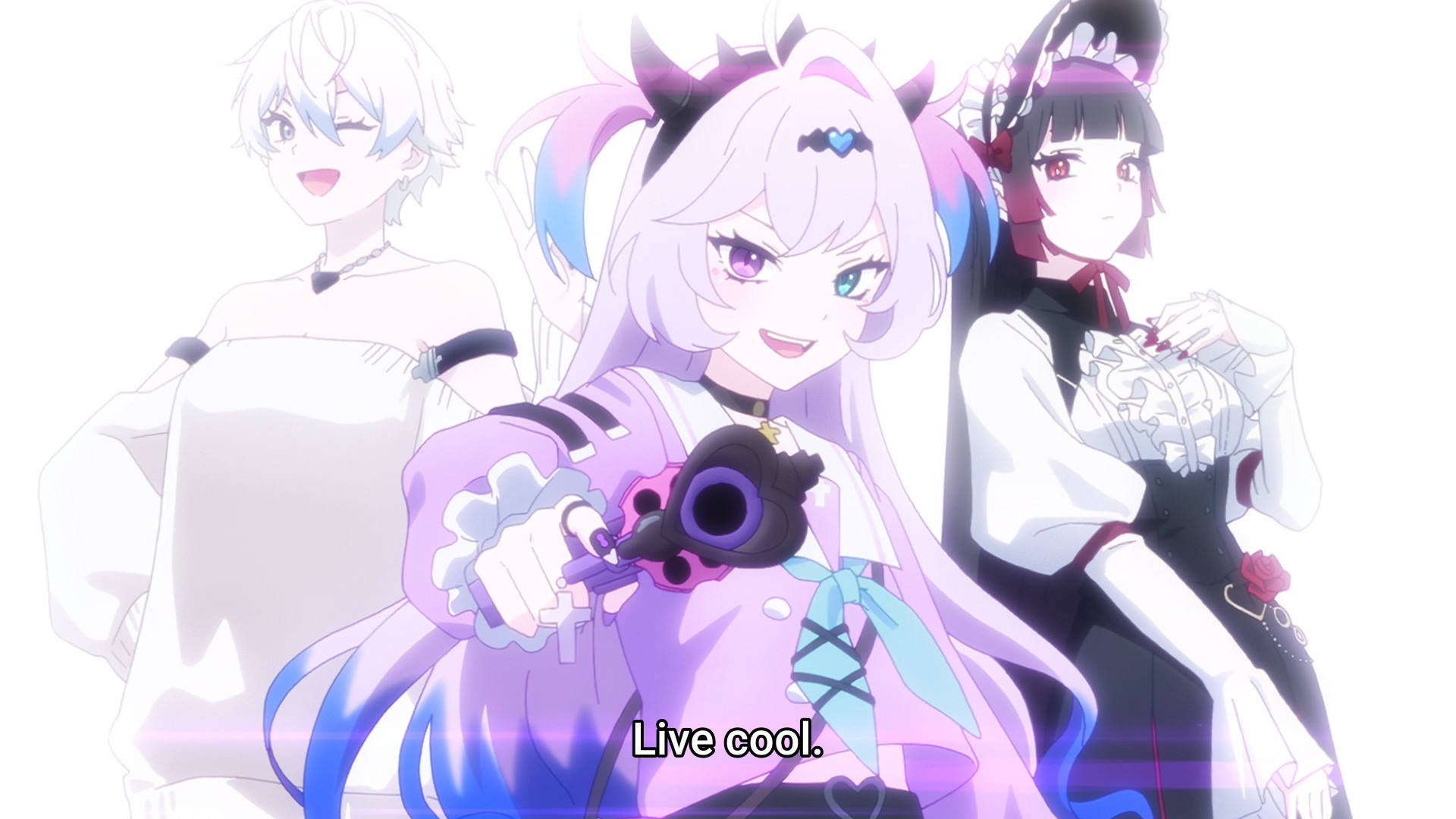
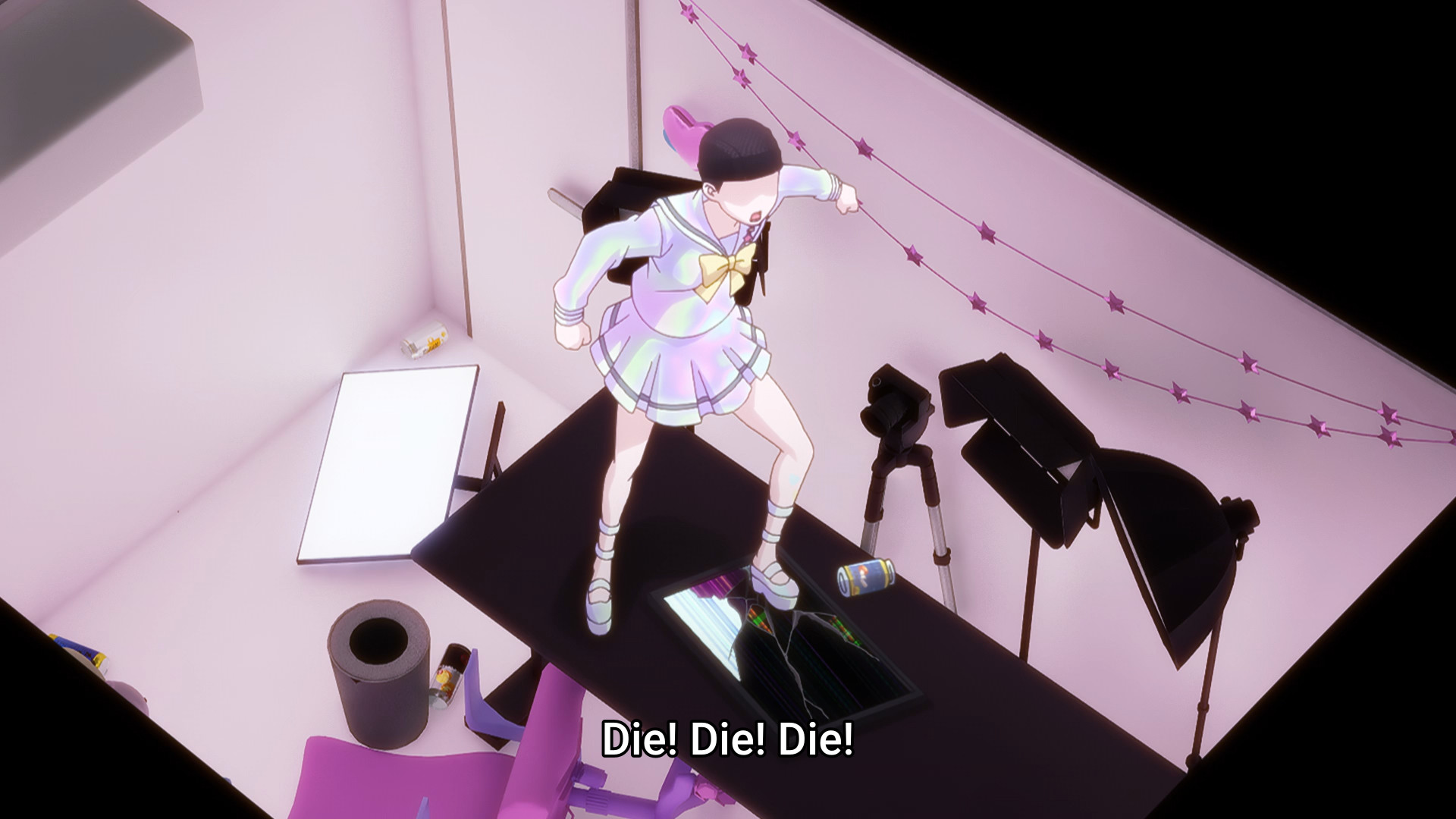
Like Karamazov, KAngel voices the same sentiments about individuality: “having your own sensibilities and way of thinking instead of going along with other people.” But I find this sort of thing rather dubious, because we live in an entangled world full of influences, big or small, visible or invisible. Almost everything about us has a causal link to the world around us. Why we speak a certain way, behave a certain way, walk a certain way, etc — these are all products of where we live, who we live with, when we live, so on and so forth. It’s hard for any individual to ever say, “These are my true beliefs completely divorced from the influences of others!” Who honestly has that kind of ability? Who can honestly reflect deep upon themselves and separate thoughts and feelings that have been influenced by others and what are truly ours? I don’t think you really can. Even when Kache goes looking for “true” individuals, she finds a subset of like-minded thinkers in Karamazov. As humans, we really like to categorize things and put them in their rightful places. X is a tree, and Y the fungal network that extends its roots. They seem like two separate things. But in reality, neither could live without the other so where does the tree end and the fungal network begins. Similarly, we, as in the individual, could not exist without others, and yet we desperately search for this coveted sense of individuality. To what extent it truly exists, I can’t really say. KAngel only has the courage put on a brave face onstream, because she is doing her best to compartmentalize herself. Once the stream ends, Ame is left to deal with the emotional baggage like chemical runoffs flowing into the ocean from a polluting factory. And like how those chemicals will eventually end up in the food we eat, Ame’s mental deterioration is going to reflect back onto KAngel someday. Why? Because none of us are truly individuals. I can’t help but think back to the metaphor with the tiny screens and the giant display at the start of the episode.
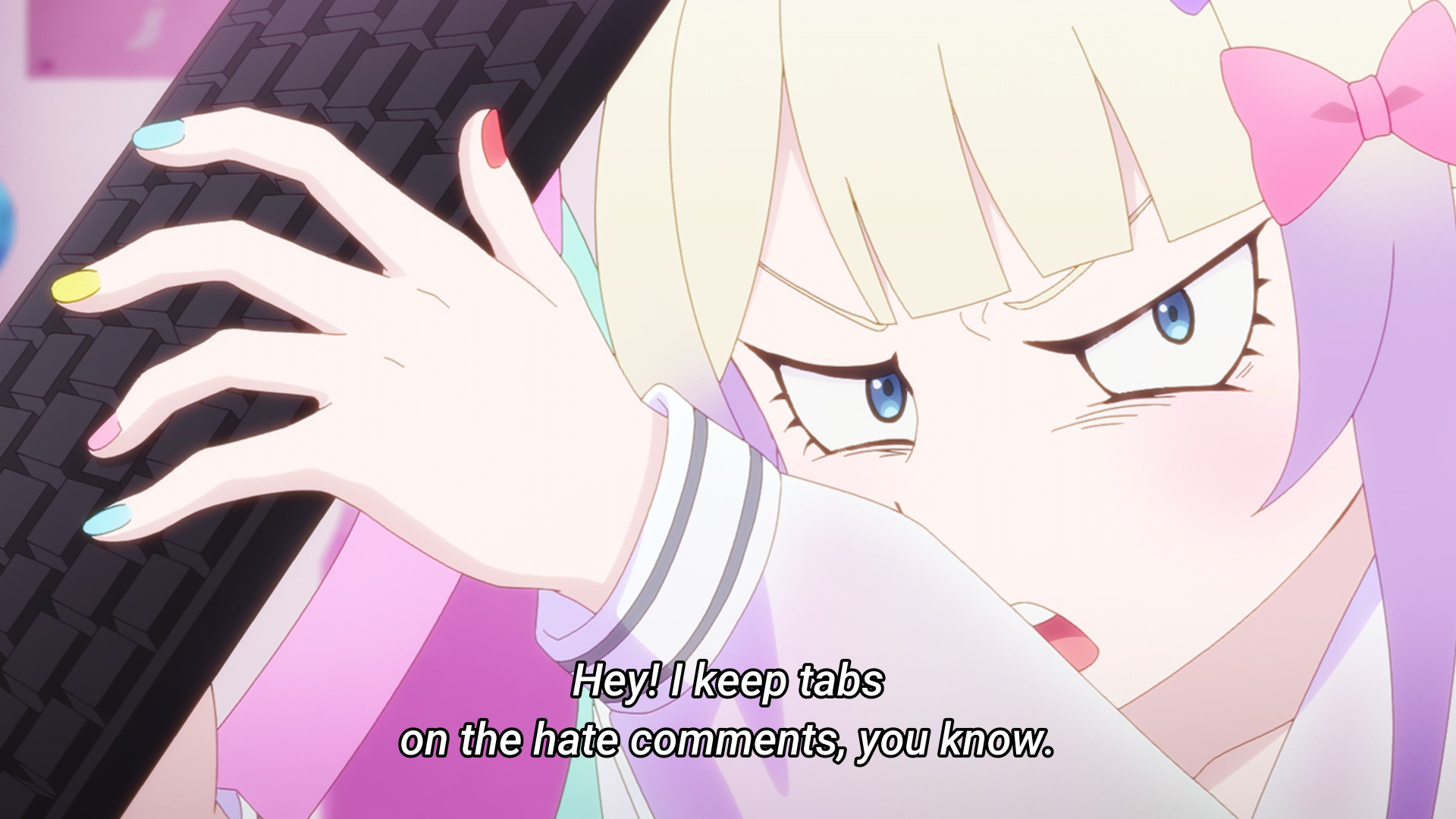
After her meeting with Karamazov, Kache changes her hair, she quits her job, she tells off her former customers, and she even dumps her boyfriend. All she has left are the bittersweet memories. Kache’s final dagger in the heart is telling her ex that at least she gets attention. On the other hand, nobody is talking about him or his band at all. I can’t say if she’s an individual now, because she’s clearly adopting Karamazov’s way of thinking. But hey, she got rid of the trash. That part looked pretty punk, at least.

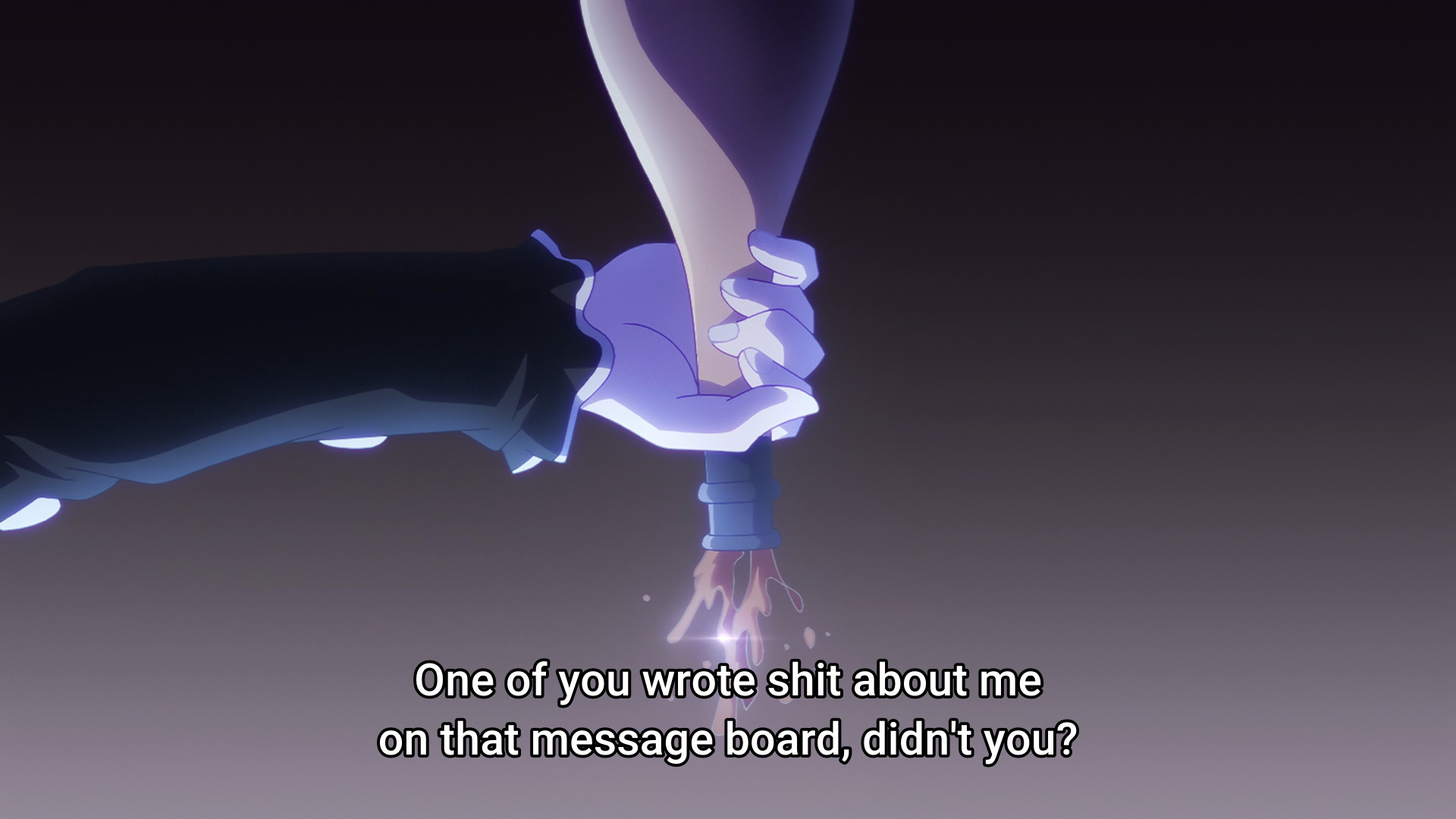

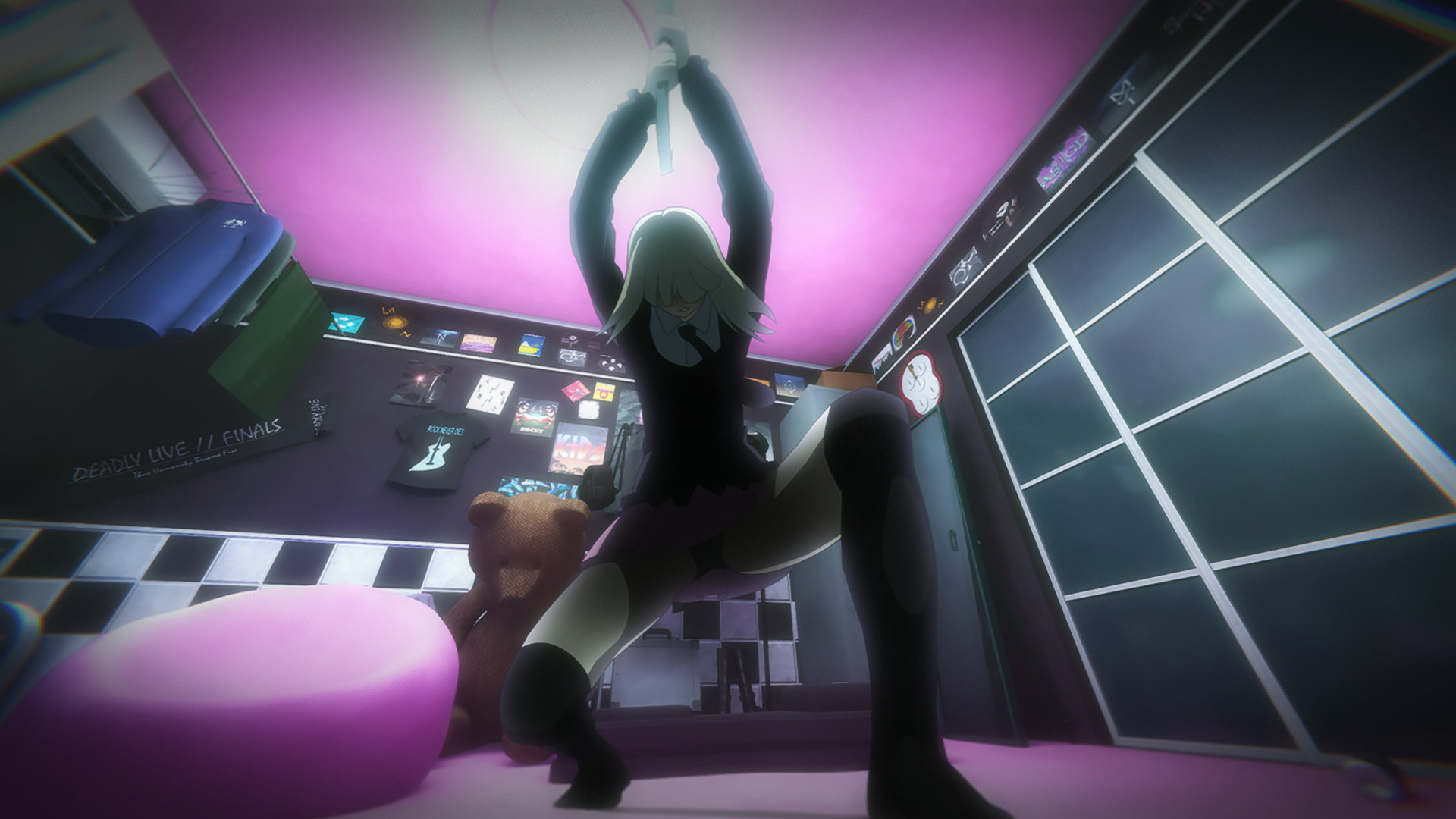
Stray thoughts & observations:
— Did someone jump? More foreshadowing?
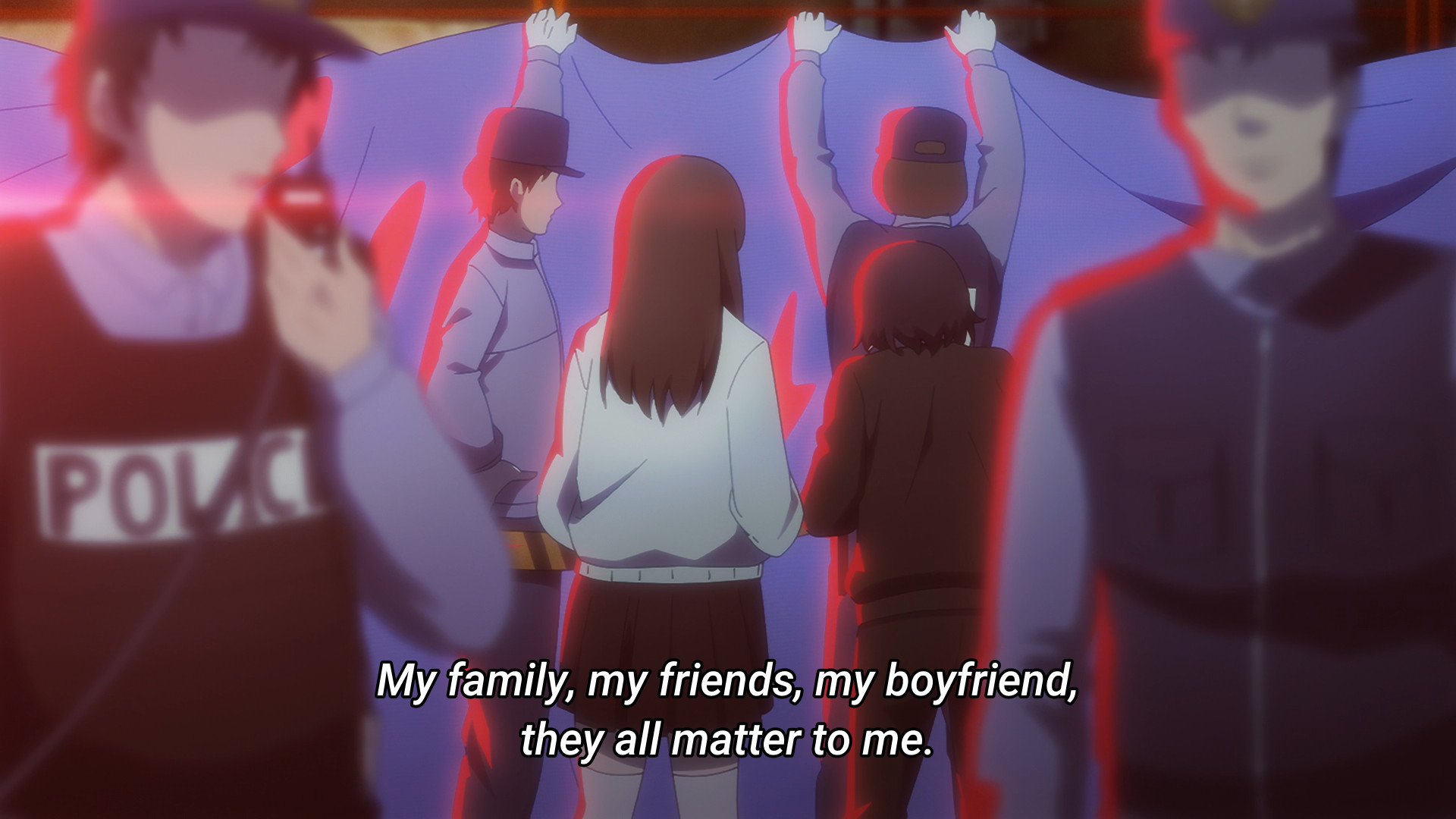
— Kache still has the same mannerisms as she did back in school — that little, nervous laughter when she tries to play something off. Having the same mundane conversations about her super famous friend, too.

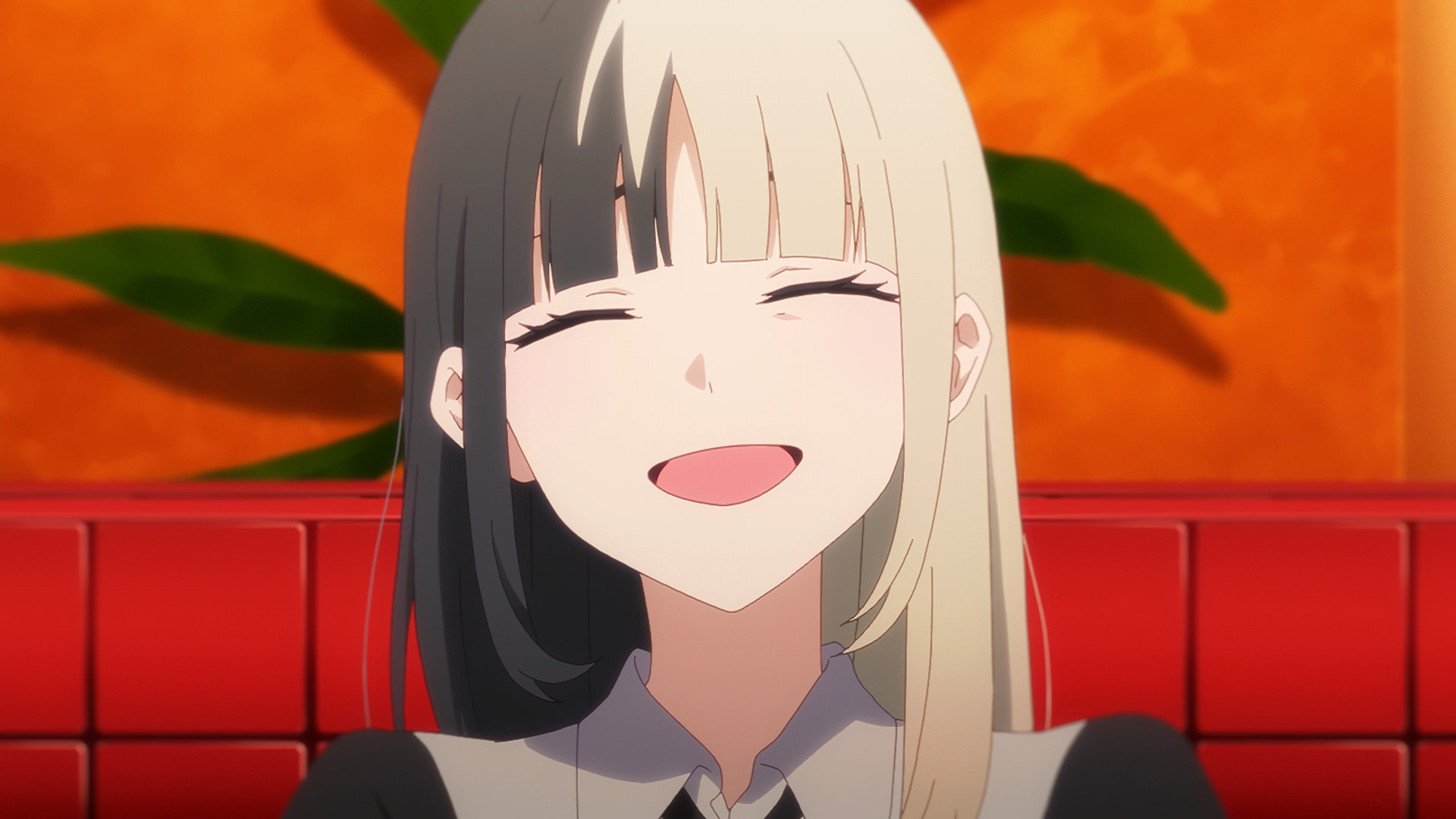
— Yeah, life is pretty boring as a conformist, but is smashing windows really that much better? I’m not sure I understand what makes it cool.
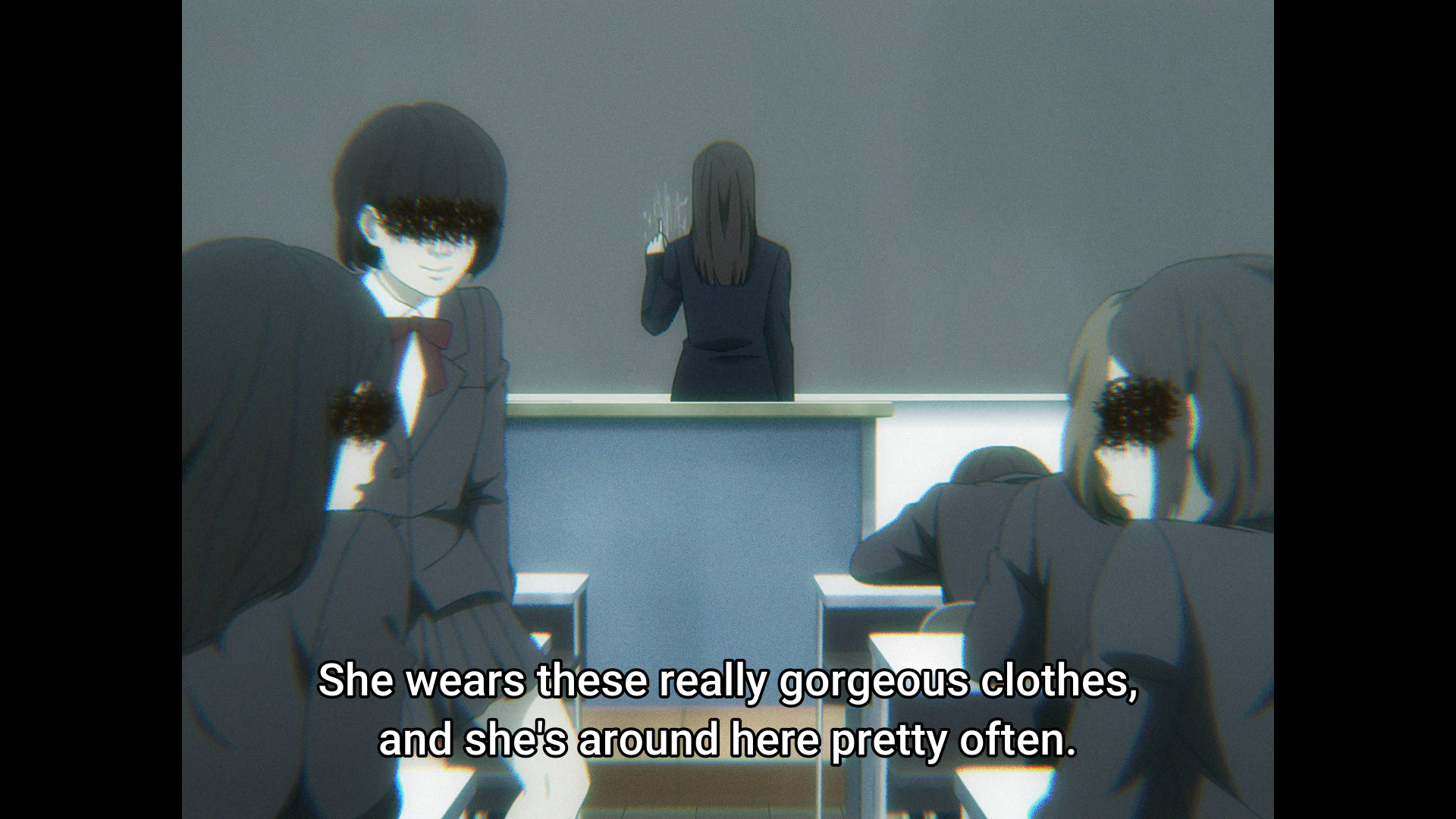
— Looks like the teacher is fed up with the inane chatter.
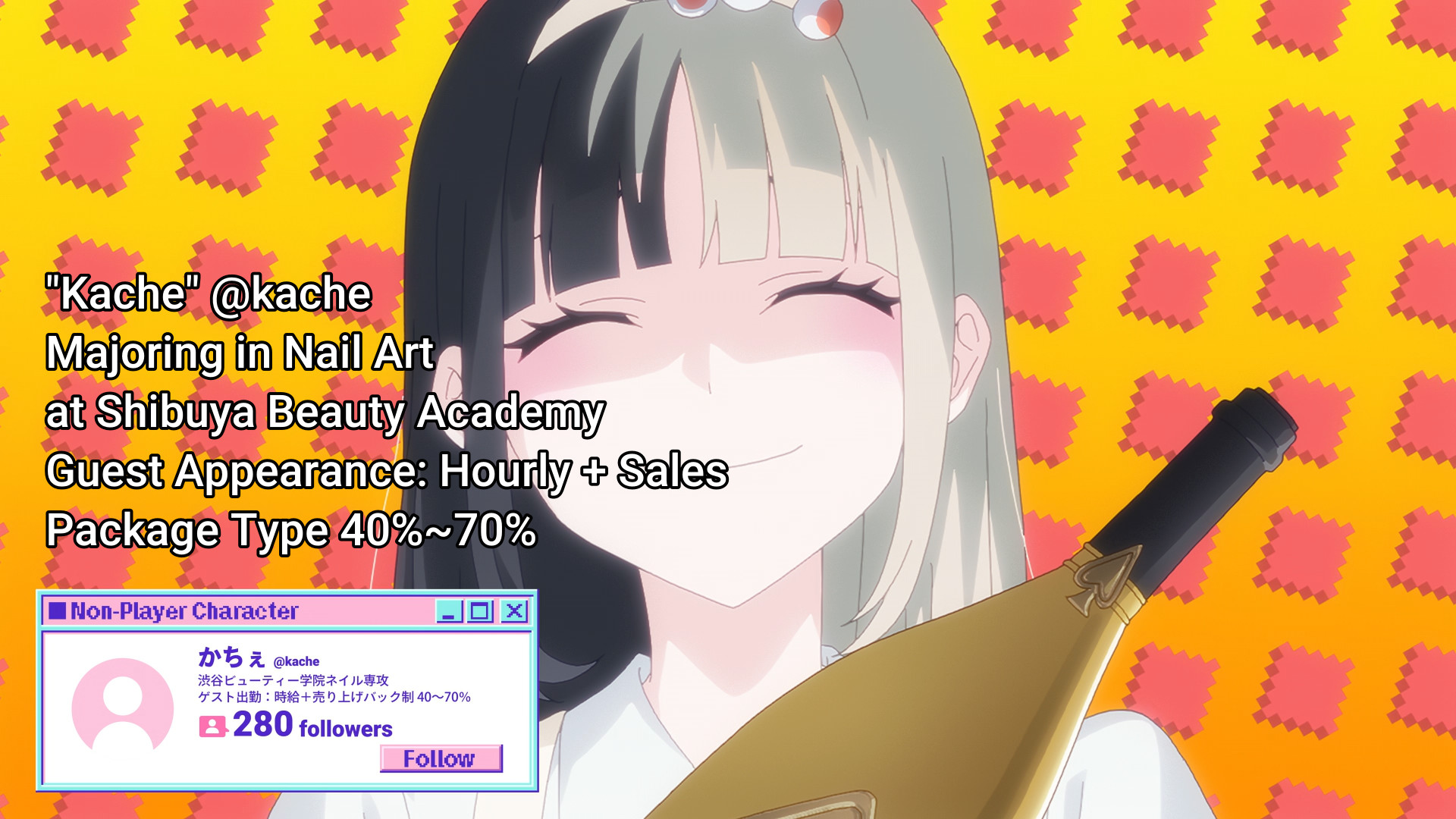
— What does “package type” even mean here?
— What is Kache even getting out of her relationship with her trash boyfriend? He just takes and takes. He looks up her reputation, because he’s too afraid to confront his own. Why does she stay in it? Because she thinks she has to? Because this is normal? I don’t think MIchica is punk or rock whatsoever, but she is right about one thing: Kache needs to be honest with herself. It’s also interesting that those same words are once again accompanied by a blooming flower.
— All of these girls claim that they can tune out negativity, but that’s easier said than done.