
With two movies coming up in November ’09 and January ’10, any analysis of Eden of the East would just be incomplete, but despite the abrupt cliffhanger at the end, I still think of the TV series can stand by itself as one whole product. I think we are able to take a good look at a few of the themes and issues introduced, even if we must wait till the very end to resolve most if not all of our questions.
I’m not gonna be shy about it–Eden was by far my favorite anime of not just the Spring ’09 season (hardly a difficult task), but for, at the very least, the last year or so. Eden came out of nowhere like a freight train. High production values for a mystery/thriller will always get my attention, especially with a decent romantic subplot (I’m a sucker for them).

Protagonists of the show, Akira and Saki.
Written and directed by Kamiyama Kenji, whose resume includes Ghost in the Shell: Stand Alone Complex and Jin-Roh: The Wolf Brigade, Eden is primarily about a young man named Takizawa Akira. Akira’s situation (i.e. lack of memory, hints of a terrorist background, the bizarre Selecao game) hooked me in from the start till the very end. To be fair, Eden was not a perfect show by any means, and I’ll touch upon the issues that bothered me at the end of the episode. For now, it is suffice to say that the negative qualities of Eden were easily dwarfed by the rest of the anime. Let’s take a look at those now.
Analysis

I want to talk first about two major concepts within the show. The first is noblesse oblige, the idea that those with power and status have a social responsibility. I’ll get into what that social responsibility entail with regards to this show later. The second is perhaps a corollary first introduced in the anime’s OP:

“The abuse of greatness is when it disjoins [remorse] from power.”
These two ideas are very relevant in our current political climate. This may sound outrageous, but consider for a second that Eden might be a subtle critique of the United States, especially its recent abuses of power. It is no mystery that the US often views itself as the enforcer of the world regardless of the wishes of other countries. It might be safe to assume that the primary discourse for US critique, however, is probably our checkered record of prison abuse and torture. So how does this all tie into Eden?

"This is... the center of the world?"
For a lot of viewers, Saki’s little dilemma in front of the White House might seem like a throwaway scene. But think about the sequence of events. The OP introduces us immediately to the idea of social responsibility of the powerful (US) and the potential abuse of power. As it ends, Saki arrives before the White House, where, underwhelmed, she remarks, “This is… the center of the world?” This is it? This is what America is all about? At this point, some of you might think I’m reaching a little too far, but in a show about the abuse of power and noblesse oblige, I don’t think, especially with the recent torture debate, a brief shot of the White House is just a plot device. Ask yourself whether or not the US has acted nobly.
Moving on, let’s get back to specifically noblesse oblige. As stated above, it is the idea that those in power have a social responsibility. The idea is vaguely socialistic in concept and while Eden may not be overtly Marxist in its ideas, Selacao #1, Mononobe, is certainly an indictment of objectivism by being one of the clear villains of the series.
I live by self-responsibility no matter the circumstance. But, in order to downsize this country and restore its power in the global marketplace, I thought eliminating both the problematic elderly who cling to their outdated interests and the slackers… may be the fastest method.
Objectivism is about rational self-interest, but as a philosophy, it is flawed due to the very fact that we must necessarily compete against one another. In such a world, it is not only morally permissible but also one’s obligation to act in accordance with self-interest, even if this means the downfall of others. As a result, those who are already in power must necessarily exploit the weak. Due to their initial advantage, the natural assumption is that the gap in power between those who have and those who have not will continue to grow. In episode five, Saki laments:
Honestly, there’s another company I wanted to work for. However, during the interview, even though they said that “society belongs to you youngsters,” I felt that they really just wanted to use us so that things would continue smoothly for them. So I refused.
To Akira, listening nearby, there was only one answer.
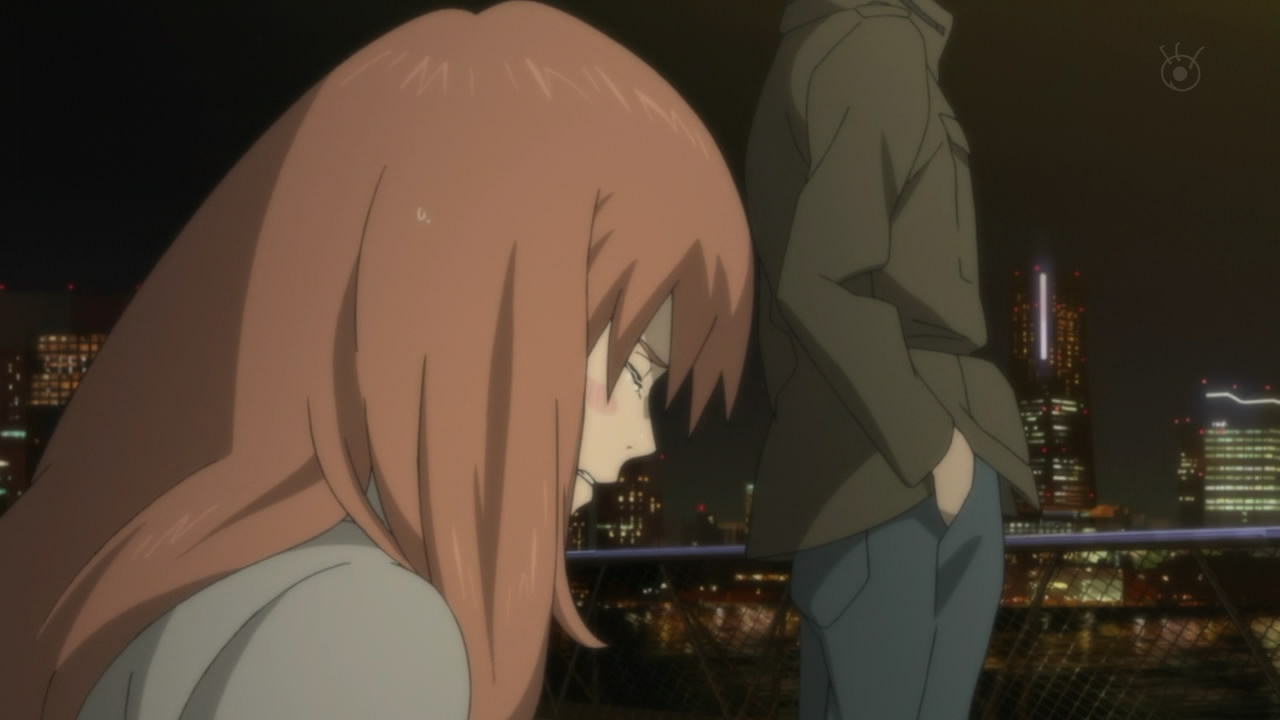
Saki, I finally know what I should do after listening to what you said. That’s why you don’t need to force yourself to work.
I interpret his response as an indictment of the corporate machinery that exists in capitalist societies like Japan. If it was up to him, Saki need not struggle endlessly in a system designed to keep a certain few not only in power but continually in profit.
So ultimately, Selacaos like #1 fail to understand what noblesse oblige means. He wants to save Japan, but his interpretation means saving Japan from its lack of political and economic power on the world stage: “…in order to… restore its power in the global marketplace.” The contemporary interpretation of noblesse oblige, in a climate where most have assumed that capitalism is the correct economic philosophy, is a social responsibility to those in need. Who’s in need? Eden centers around Japan, but I think most of the Selacaos struggle with what exactly it means to save Japan. I see three marginalized camps within Eden: the NEETs, women and the elderly. The first two, I think, overlap within the anime, but certainly not enough attention was paid to women (more on that later).
Selacao #10, Yuuki, recognizes the apparent gap between those in power in Japan and those who are weak, like he formerly was. His ideas, however, are misguided.
After, I got accustomed to being in some never ending loop of unstable employment. Even if I took out a loan so I could study and qualify for a better job, I’d only be making 10 yen more per hour. And if I complained, they’d say, “have self responsibility–your effort isn’t good enough. Hey government, your responsibility isn’t good enough.”

No. 1 and No. 10, Mononobe and Yuuki
He does, however, touch upon issues that I previously mentioned in my entry regarding the hikikomori and the state of Japanese society. It is ironic that his ally is Mononobe, who champions self-responsibility. Yuuki’s rant typifies current youth discontent and frustration. Objectivism’s claim that one need only strive and work hard in order to profit is obviously at dispute in Yuuki’s words. Even if he struggles, by being in a clearly unfair and ruthless machine, all his effort would amount to little progress: “…I’d only be making 10 yen more per hour.” Yuuki is also not alone in Eden; Saki too feels the lack of compassion by the powerful, though in her case, it is from a corporation rather than a government.
It was obvious that I’d be rejected. Since I missed the first interview, I thought that it would be fine if I sincerely apologized. I thought they’d given me another chance. Things just aren’t that simple.
Unfortunately for Yuuki, he does not use his ability to help those in need, thus fulfilling his noblesse oblige. His missile attacks only serve to wreak revenge on the powerful (the government) for having exploited and slighted him. If the socialistic subtext of Eden still doesn’t seem clear, look instead at the actions of #5, Hiura the neurosurgeon.

No. 5, Hiura
For a long time now, I’ve been feeling my limitations as a neurosurgeon. The number of people a doctor can save in his life is limited. Take a look. They can also work here. I changed the law so that patients can gather in this town, and at the same time, their families can move here to work. It’s very simple. I used the ten billion to create a private hospital, where the senior citizens who were abandoned by the country can be employed.
The sympathetic figures throughout Eden strive to empower the people, especially the marginalized. From Hiura’s private hospital to the Eden of the East program that hopes to connect NEETs countrywide, it is certain that the show feels that Japan needs to adopt socialist principles to some extent, if not become entirely socialistic. This is hardly a surprising position considering the current trend in Japanese politics. Hiura’s only downfall is that he addresses only one portion of the weak in today’s Japan. Akira’s true goal, evident by the ending of the show, is to bring salvation to everyone.
Potpourri
Here are some thoughts on the show that didn’t seem to fit into the main thrust of the article.
First, I felt the show identified women as a marginalized group, but simply didn’t give enough attention to them. Selacao #11, Kuroha, seems hellbent on punishing evil men, presumably rapists and sexual predators. Despite Japan’s low crime rates, especially for a first world nation, rape and attitudes concerning it continue to be a problem. The scope of the dilemma is hardly realized as it remains a vastly under reported crime due to society’s penchant to shame and pervasive misogynistic attitudes. As a result, although we can’t agree with Kuroha’s actions, it is hard not to be sympathetic to her cause.

Akira meets no. 11, Kuroha.
Eden, however, does Kuroha a disservice. By painting her as a crazed serial killer with a dark and painful past, Eden lessens the impact of her cause. Achieving justice for any women across Japan who have ever been prey to unwanted sexual attention should be a noble cause, perhaps a cause worthy of Kuroha’s noblesse oblige. Feelings toward her as a murderer unfortunately distract us from what’s truly important. She can’t be that crazy, after all; her dialogue is quite insightful:
After all, even if you claim to be an ally of justice, you’re just enforcing the justice that, at most, half of the world believes in. That is why, until I’ve used up this 10 billion yen, I’ll try to enforce the justice that I believe in.
What also bothers me about Kuroha somewhat overlaps with a second negative quality about Eden: Saki’s rather passive role as the show’s heroine. The show is hardly shy about referencing Akira’s manhood. When coupled with his power, the ability to do almost anything as long as he has money, Eden’s message is troubling. The only ones with true power are men in the show. Saki’s relegated to a passive observer (or listener) and does little to help Akira accomplish his goals, other than playing the offscreen role in the development of the Eden of the East program. We might argue that Kuroha is a woman who represents power, but remember that she goes through the show “stealing” the penises of men, i.e. penis envy.
My final dissatisfaction regarding Kuroha, and this relates to Saki too, is how she clearly represents the whore in the virgin-whore dichotomy that is so pervasive in attitudes regarding women across the world and time.
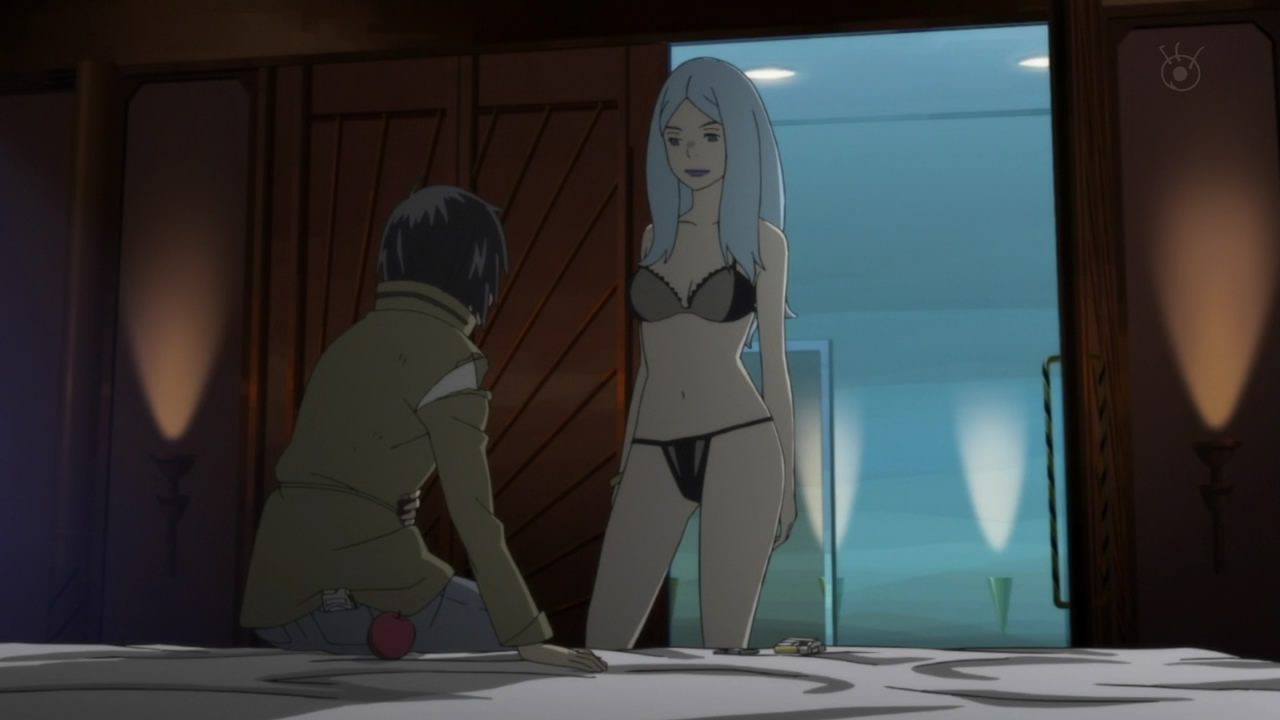
Kuroha has a dynamic character who actually does something within the show, but it comes at a cost. She must be a whore; she must be crazy. Saki must therefore represent the virgin of the show, and she is consequently passive, always watching and listening to Akira but never initiating any of the events.

Other misgivings about Eden include its inability to escape its “anime-ness,” e.g. its susceptibility to moe. Despite my disappointment with Saki’s role in the anime, or lack thereof, she exhibits few overtly moe qualities (though her character design does rub some people the wrong way). It would appear, however, that this isn’t good enough for the show’s producers and Micchon is added to fulfill some kind of loli quotient every anime must apparently meet.
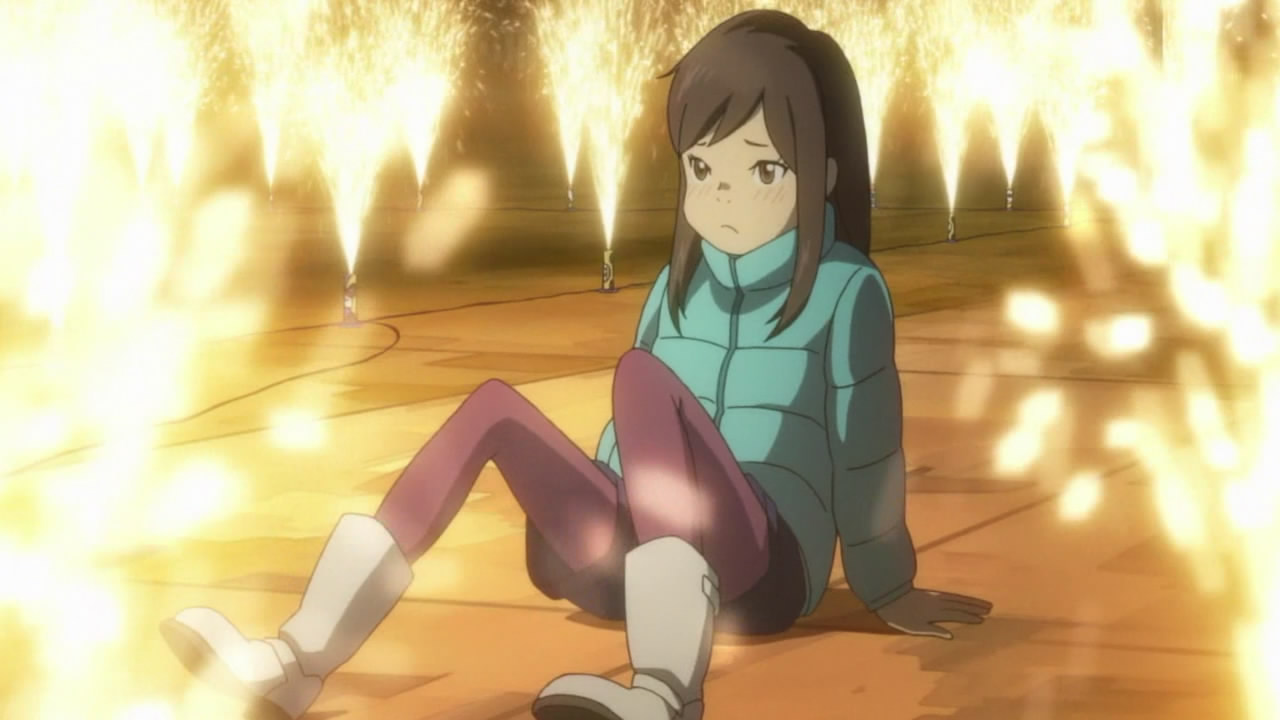
Micchon
It’s hardly surprising that she’s sort of clumsy and short of words. It might not be a big deal, but it’s just curious that the show’s female computer programmer is a thin, cute loli-ish girl while a male computer programmer is thus:

Yep, his nickname is Pants. Also known as Itazu.
Final Thoughts
At the end of the day, despite all of my complaints, Eden of the East is clearly a rare anime. It has amazingly high production values. Its animation does drop in the middle of the series, but not drastic enough for anyone but the most discerning to notice. Consistency of character animation isn’t uncommon in anime. KyoAni is quite capable of that in their own shows, but I think few studios approach Production I.G.’s ability to render cityscapes pulsating with life and energy that is truly representative of the metropolis that is Tokyo.

Even more important than its aesthetic qualities, however, Eden was full of mature and complex themes and issues that are also relevant to our current society. With two movies upcoming, numerous questions abound. There were a few topics I couldn’t really get into until we get the whole picture, especially the show’s rather cynical position that only a king, perhaps a philosopher king, can save society.
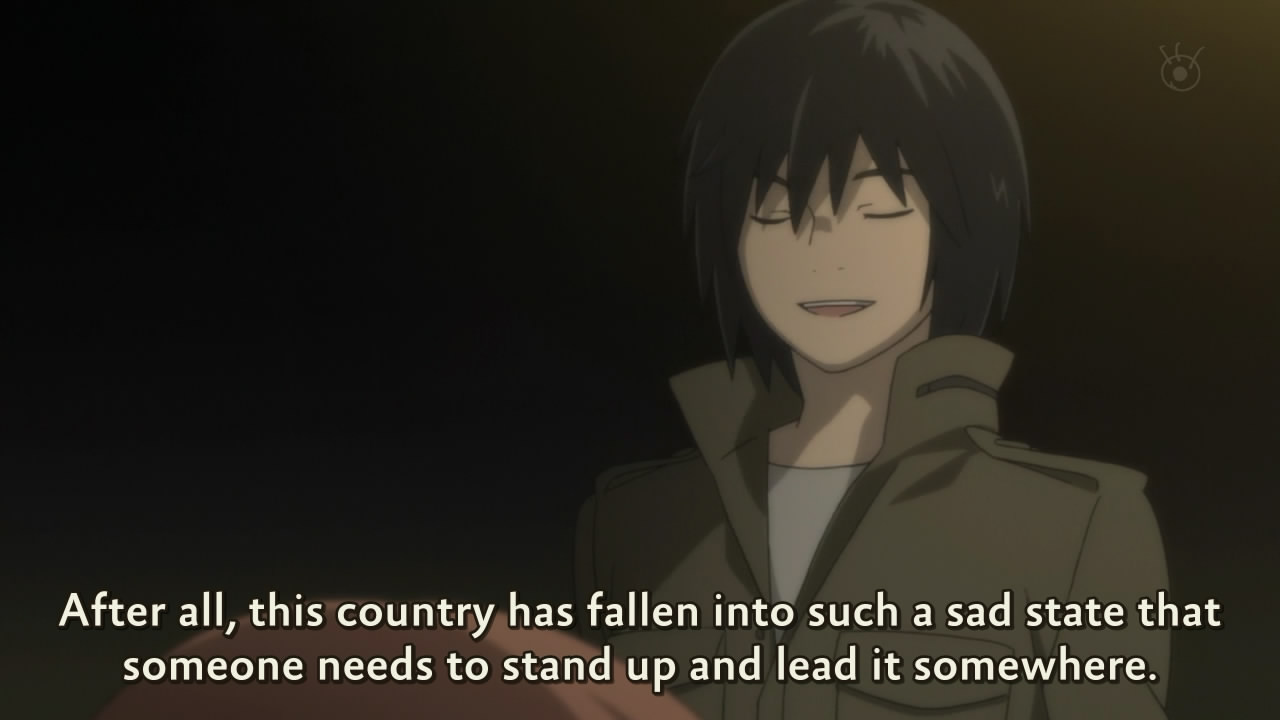
The title might be alluding to Steinbeck’s East of Eden (a work also with socialist ideas). There is also a religious subtext (the concept of Eden, obviously, but also the image of the apple constantly being used in the show’s advertising) running through most of the show. In both cases, I feel inadequate in providing a proper analysis so I’ll leave that to others here or on other blogs to examine. I will say this, however, regarding parallels between Akira and Jesus Christ. Nevermind his role as Messiah or even King to his people–those are blatantly obvious clues–Akira sacrifices himself in order to succeed in his mission just as Jesus gives up his life for our sins. It’s true that Akira isn’t literally dying like Jesus, but if you believe that one’s memory constitutes one’s identity, as many philosophers in the past certainly do (specifically John Locke), erasing one’s memory is akin to personal death. And one last point: both Akira and Jesus were betrayed by those they sought to help. Is the religious symbolism any deeper than this? I can’t really say since my knowledge in that area is limited.

For now, this entry comes to an end with my great endorsement for Eden of the East. It is not without its flaws and detractors. It isn’t as exciting as many anime fans would have hoped. It is, however, deep and thought-provoking.

Pingback: Final Thoughts on Spring 09 Anime Season « Moe Sucks
The first 2 episodes of EotE were the best anime experience I’ve ever had. The rest is murky and lacks cohesion. The NEETs, the feminist, the imperialist all felt too loosely associated and the potential wasted.
“Quick everyone send me a text message on how we should stop missiles! Um, shoot it down with another missile?”
But then again, these are NEETs so the typical response must have been: “Get a Gundam” “Use moe beams” etc.
Also the soundtrack is excellent, they really put alot of effort (and money) into it.
Man, finding this blog is for me like reaching anime enlightenment or something. I used to be totally clueless about what to watch, which animes would be to my taste, etc. So far all of your recommendations have been dead on and my amazon wishlist has grown considerably because of this. Thanks for recommending this show, I’m currently watching and enjoying it very much. Keep up the good work!