
I think comparisons to The Little Mermaid are inevitable.
I like to go into my anime blind so I wasn’t quite sure what to make of Ponyo for a while. Once it became clear that Ponyo would steal forbidden magic to become human, I realized that the movie was just another adaptation of Hans Christian Andersen’s fairy tale.

Ponyo’s danger of turning into sea foam really just sealed the deal.
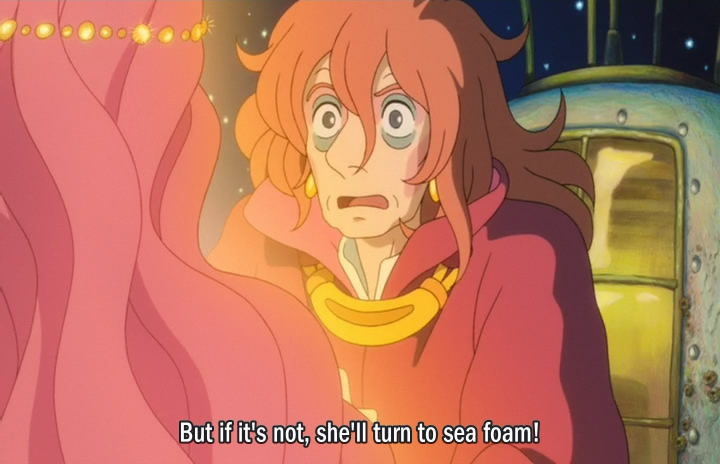
That’s not to say there’s anything wrong about Ponyo being just another version of The Little Mermaid. Studio Ghibli created a beautiful anime superior to Disney’s incarnation in every way. Let’s consider a couple reasons why.
Disney’s The Little Mermaid boiled everything down to good vs. evil. Despite having no clear villain, Ponyo is much more complex; everyone’s a shade of grey. When we check the original fairy tale, it was a simple story of a mermaid trying to become human so as to gain an eternal soul. There was no silly wicked witch Ursula to contend with and, as a result, Ponyo is more faithful to its source.
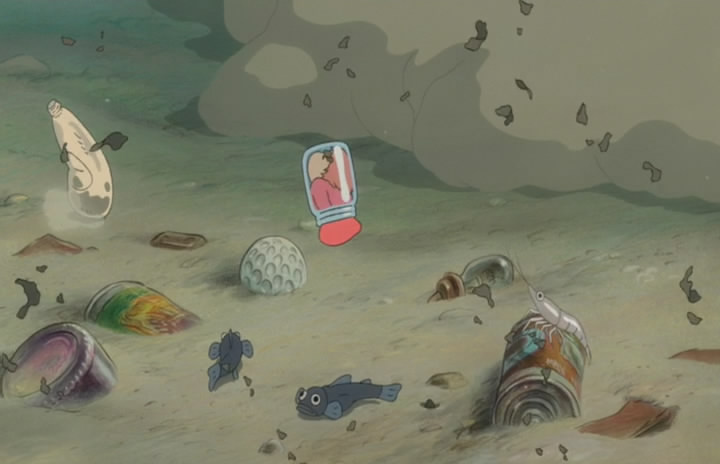
Being a Miyazaki movie, he naturally adds in his signature “man vs. nature” theme, but unlike Mononoke Hime, it’s not quite the overt statement “Man is destroying nature,” but rather “Pollution is an unfortunate consequence of man’s growth.”
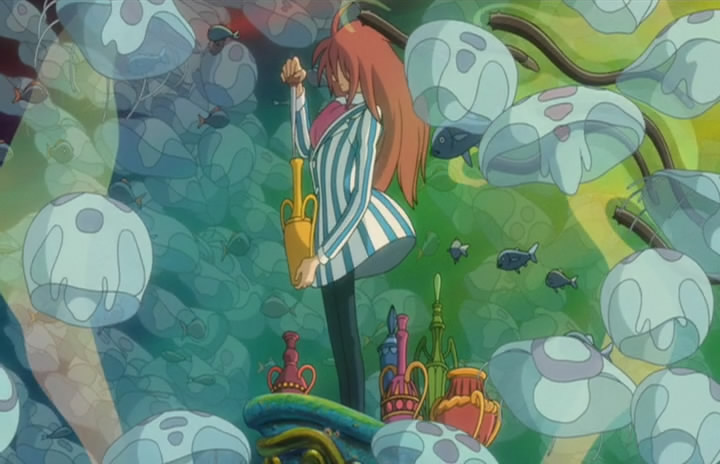
Fujimoto appeared to be a villain early on, but he’s simply an over-concerned (if somewhat overbearing) father.
This contrast between Disney and Miyazaki is interesting to me because it recalls the difficulty in localizing the first Pokemon movie.
Besides an entirely new musical score pitched to American tastes, the biggest shifts came in making the story line explicit, more black and white… over the “shades of grey” preferred by [the] Japanese in their storytelling. In the Japanese version, details and motives are left unexplained… “American kids need to be hit over the head.” This meant clarifying and pinning down what was left ambiguous in the original. — “Millenial Monsters” by Anne Allison
It’s rather insulting that American filmmakers don’t think particularly much of us. Luckily, Miyazaki has the clout to prevent his movies from undergoing such drastic changes when they arrive in the West.
Disney’s version is ultimately patriarchal and sexist. Ponyo is matriarchal but avoids sexism. The Little Mermaid was a silly movie: Ariel goes from one patriarchal figure (Triton) to another (Eric). The prince only gains the king’s approval by showing that he “loves” Ariel, i.e. proving his ability to protect her because women are obviously weak and silly creatures (sarcasm).
This brings up another issue: the virgin/whore dynamic. Ariel is obviously the clueless virgin who needs the patriarchal protection. Ursula exercises her free will without the constraints of men, but she’s the villain–the whore.
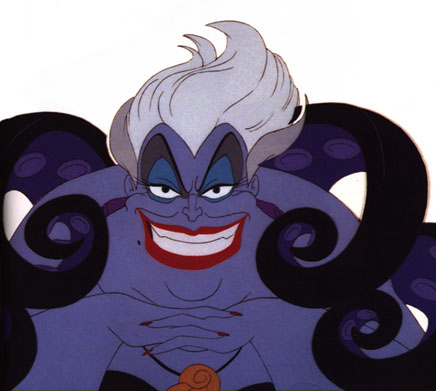
Ponyo is quite different. First, the film has strong female characters from start to finish, beginning with Ponyo; the virgin/whore binary simply doesn’t exist. The “prince” doesn’t end up saving the day here, with Sousuke merely playing a supporting but nevertheless supportive role. Lisa, Sousuke’s mother, represents another strong female role model, practically a single mom. She’s independent and headstrong but not in a foolish way one might expect in Disney portrayals. Finally, Ponyo’s mother, Gran Mamere, is a benevolent and wise spirit of the sea. One can’t help but imagine she might have been some twisted old witch in the hands of Disney.

Second, the biggest difference lies in the ending. Ponyo and Sousuke’s relationship is discussed and condoned by the two mothers with neither of the two fathers in sight.

In Western cultures, it’s a custom to ask the girl’s father for his daughter’s hand in marriage. Japanese households, however, are quite matriarchal in nature. While stereotypes of women being subservient to their husbands aren’t necessarily untrue, women do run most of the family affairs in the East. Ponyo and Sousuke’s union must naturally come from the consent of both their mothers. Ponyo doesn’t lack male role models, but in Koichi’s case, it’s the hard-working father from the distance. While he undoubtedly loves his family, work doesn’t allow him to be home as often as he would like. He therefore plays a minimal role in Sousuke’s development. A lot of Japanese fathers likewise work late into the night and thus rarely see the development of their children.
Some extra thoughts on the movie.

While Ponyo’s story didn’t really captivate me (it’s a kid’s movie), the anime was still amazing to behold. The scenes underwater are amazing, teeming with life and detail. One interesting characteristic about the film is its lack of straight edges. Ghibli didn’t utilize a ruler apparently, which might make certain scenes, like the one above, appear sloppy at first glance, but it adds to the film’s overall aesthetic. It certainly evokes a rustic feeling.

It feels as though we’re looking at color pencil sketchings come to life. Studio Ghibli has clearly gone a long way since its earlier days.

It might be odd to think a five year old could even understand true love, but this isn’t really a new concept for Miyazaki. Whisper of the Heart, an earlier Ghibli film, also ends similarly as the characters agree to marriage at the tender age of 15. Unfortunately, I can’t find the interview right now, but I recall reading that Miyazaki added the marriage proposal (it wasn’t originally in the manga) because he felt young people nowadays don’t commit as much as they used to. Ponyo perhaps reflects his beliefs in that regard.

While watching Ponyo with Nyoro~n, we started to talk about some childhood experiences during quieter moments in the film. It isn’t an exciting movie, but it has a certain charm that reminds you of childhood and bucolic days. The movie starts off slow and might have rushed the ending, but it’s a fine film overall. It’s not necessarily my type of anime nor will it be everyone else’s cup of tea, but Ponyo on the Cliff by the Sea is still amazing to look at and its a superior cartoon for kids compared to it’s distant cousin, Disney’s The Little Mermaid.

There is no moral evil in Ponyo, meaning there is no evil encapsulated in a character. There were suggestions in the beginning to lead us to view Ponyo’s father as the antagonist, but even so there is no malice in him. There is suffering and strife, and conflict does exist, but evil itself has no agent in the form of a character.
No the grumpy old lady doesn’t count.
That said, great post. I love the observations re the matriarchy in the movie. Miyazaki loves his strong women characters no?
I don’t really see your distinction of “moral evil.” What is evil if not a part of morality? I understand what you’re trying to say, but I don’t think suffering and strife without context can count as evil.
Besides, aren’t we pretty much in agreement, i.e. there is no typical sense of “good vs. evil” in Ponyo?
Thanks for the compliments, however. I agree; I can’t remember the last Miyazaki movie without a strong female character.
Pingback: Themes of Distance and Separation in Ponyo » Behind The Nihon Review
Pingback: Test Post Number Seven | Sekijitsu | せきじつ
this is the story of ponyo wow
u r a stupid shit