 Just to change things up a bit, I take a look at an anime from the 80s. We open with a young man feeling his way through a cave. He eventually stumbles upon a maiden in the darkness.
When the light of his torch hits her face, however, he realizes he’s staring straight into the face of a corpse.
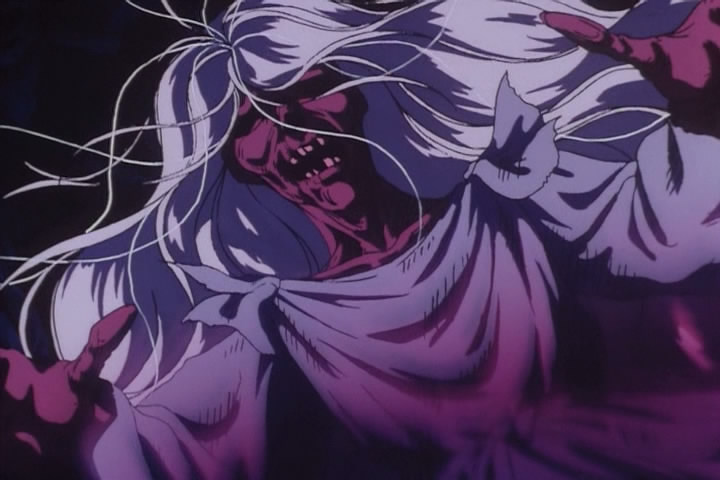
The creature immediately gives chase only for the anime to cut to our young hero awaking from a nightmare.
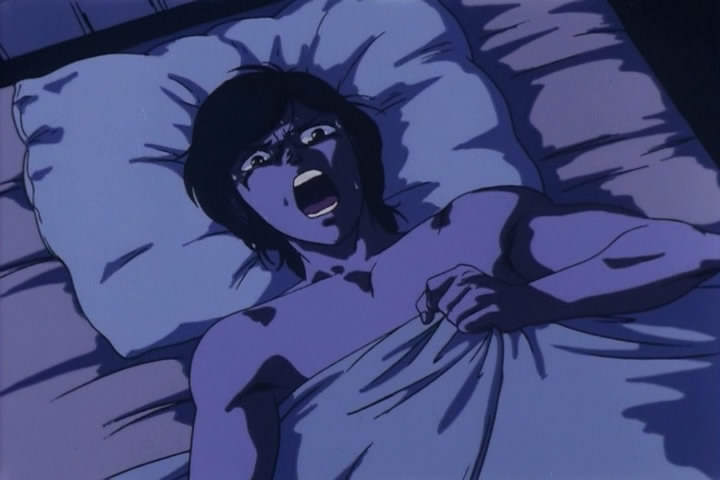
Thus begins Digital Devil Monogatari Megami Tensei (quite a mouthful so I’ll refer to it as Megami Tensei from now on). If you’re into JRPGs at all, you must have heard of the runaway success of both Shin Megami Tensei: Persona 3 and its equally popular sequel, Persona 4. Megami Tensei, the anime, is an OVA of the very first game of the original series (the series itself spawned from a sci-fi horror novel by Nishitani Aya) that began in the 80s. I won’t go into further details about the video games since it’s really unnecessary here, but if you’re interested, this link is quite comprehensive.
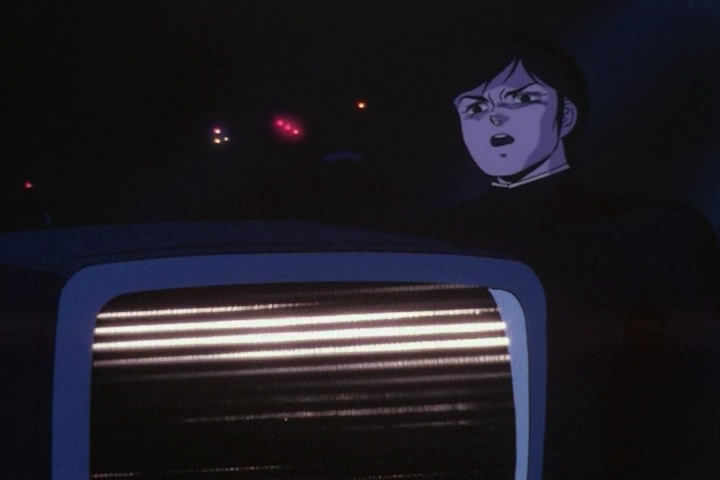
It’s hard to describe the short OVA (about 45 min.) because it’s quite lacking in both details and development, plot or character. We are seemingly thrust into the middle of a story. In the world of Megami Tensei, computers serve as an intermediate between the human and demon worlds. Our young protagonist Nakajima Akemi has been trying to summon a demon for some time for reasons quite hazy to the audience (we only know that revenge serves as possibly one of them). For equally unknown reasons, Obara-sensei and some students seem to be involved in Akemi’s shady project. Loki, a demon who has been communicating with Akemi for quite some time, wants the human to speed the process up. As a result, it tempts Akemi with some vague possibility of attaining power should our protagonist release it into the human world. Of course, summoning demons almost never goes well in any story and Akemi must set things right.
But how? How can a human fight against a demon? In the video game, you would recruit other demons (like other anime, akuma, the actual word used in the anime, come in all varieties, good or bad) to your cause. In a short OVA, the whole negotiating and recruiting deal is out the window. Luckily, however, a fellow classmate, Yumiko, is the reincarnation of Izanami and reveals to Akemi that he is likewise the reincarnation of Izanagi.
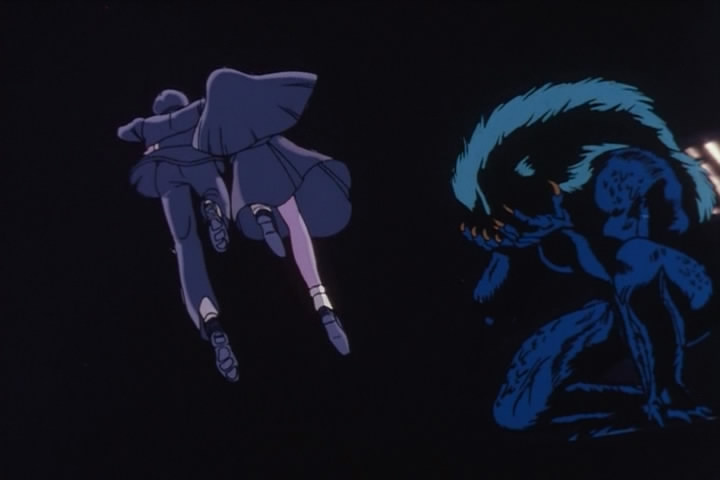
After saving Akemi from imminent death, Yumiko suffers a grave wound from one of Loki’s attacks. Akemi must then brave all odds to return Yumiko to Izanami’s burial site. As he draws closer, the world around him becomes more and more hellish. With Loki in pursuit and the exit from hell in the distance, Akemi’s true mission is revealed: Megami Tensei is really about Izanagi’s redemption. Anyone who has played Persona 4 will recall its link to Izanagi/Izanami, but the myth’s roots in the series go all the way back to Megami Tensei.
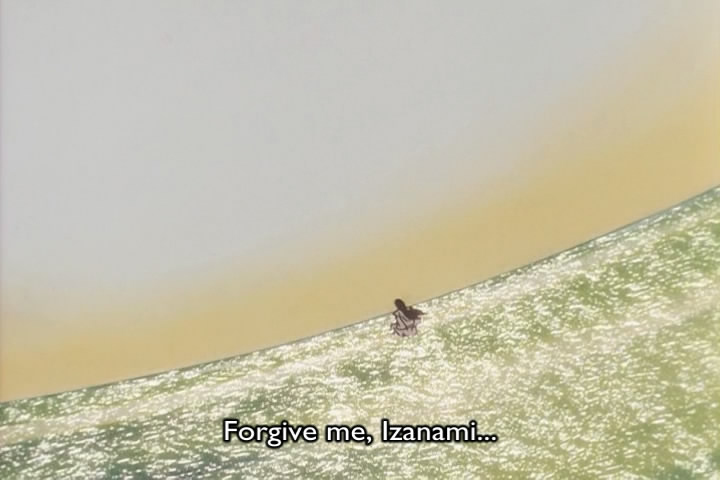
If you’re unfamiliar with the mythology, Izanagi went down into the depths of Yomi (the equivalent of hell in Japanese mythology) to retrieve the dead goddess Izanami, but when he held a flame to her face, he saw that she had become a rotting corpse full of maggots (thus explaining Akemi’s nightmares and visions). Izanagi high-tailed it out of there as fast as he could with Izanami giving chase. In the end, Izanagi would seal the entrance to Yomi with a boulder, leaving the cursing Izanami behind for good. I’m leaving much out, but I don’t think going into heavy detail about the myth is necessary. Nevertheless, if you’re interested in more, Animewriter has a post for just that purpose.
Before we move on, one quick note. In his article, Animewriter lists,
Their story is the basis for the dominance of male over female…
among other things about the Izanagi/Izanami story. What does Izanagi’s redemption and apology suggest in Megami Tensei?
Here’s an image of Izanagi and Izanami (stolen from Animewriter’s post):

Contrast this with Nakajima’s visions of his life as Izanagi:
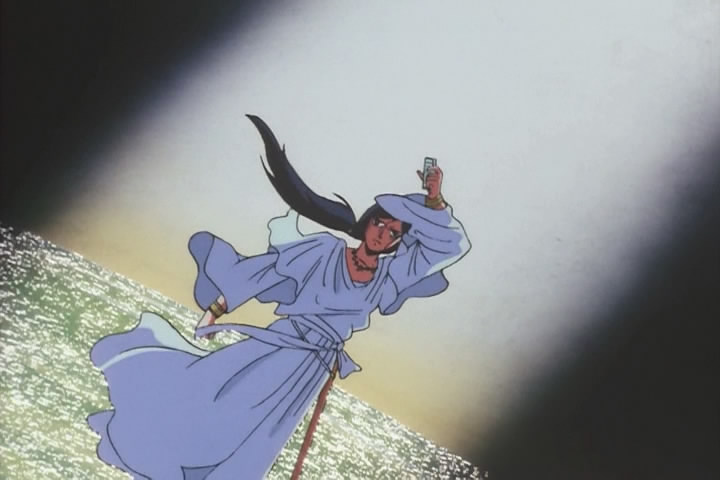
The portrayal above doesn’t quite remind me of Izanagi. It reminds me more of Orpheus:
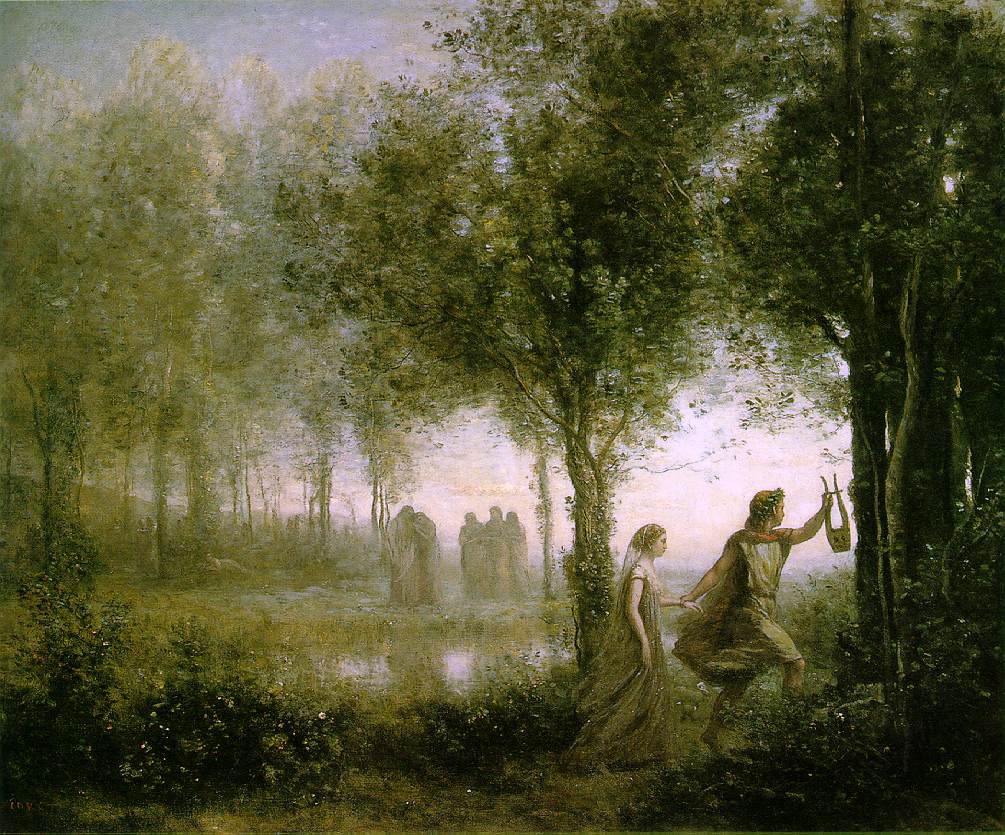
But perhaps I’m wrong and Nakajima is nevertheless wearing ancient Japanese style clothing. Cursory research online didn’t render anything significant. Continuing on, Nakajima doesn’t use a spear either in his battle against Loki. He uses a sword, but not a strikingly Japanese one:
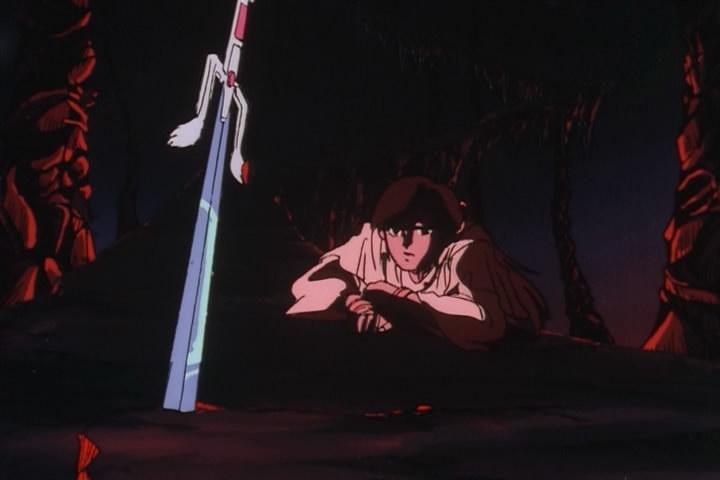
This, however, doesn’t necessarily rule out the fact that the sword above could still be a Japanese sword. I tried looking up ancient Japanese weapons to see if I could find anything familiar to what we see in the anime and I got mostly articles on katana (big shocker there). Finally, Nakajima’s companion is Cerberus, yet again something borrowed from Greek mythology.
Of course, comparing Izanagi/Izanami to the tale of Orpheus and Eurydice is nothing new. There are also many other similar instances in various mythologies like the story of Enki and Inanna. The stories are never quite the same, but familiar parallels exist nonetheless. People in every ancient culture probably wondered whether or not they could retrieve their loved ones from the underworld. I was still fascinated, however, with the anime’s decision to render Nakajima as less distinctly Japanese, opening up the possibility of comparisons to other mythologies.
There are still mysteries in the anime to me, however. What significance does Loki (or Set in the ending for that matter), a god of Norse mythology, have to do with anything? Computers leading to the demon world recalls a familiar trope (i.e. a love/hate relationship with technology) in science fiction, but what does it mean in connection to the reincarnation and redemption of the goddess and god respectively? Unfortunately, the OVA feels incomplete and rushed. Having read neither the novel nor played the game that the OVA is based on, I have no idea if the answers can be found in the source material.
Quick Asides (mostly questions):
— Being an 80s anime, it comes complete with cheesy synth soundtrack that’s not quite fitting with the action.
— I’m not sure where this scene fits in with the narrative. When did it occur? When did Nakajima finally take over the school? Why such (sexual) brutality?
— When the flies converged on Loki, Beelzebub came to mind. Satan looms somewhere in the story, but due to the OVA’s length, again, the story is woefully incomplete.


— They could have been a little more creative with Loki’s powers. Bubblegum-flesh attack isn’t exactly what I had in mind.
— Who’s the disembodied female voice that spoke to both Yumiko and Akemi?
— Why did Akemi’s sword break in his first encounter versus Loki? Where did they even get the sword for the ritual in the first place? How does the sword return in the second encounter and why does it not break there?
Loki just seems fairly popular, for whatever reason, in anime. Why? I’m really not sure. My only stab at it is that the degree of Loki’s betrayals are so great – not only is he rotten to a disabled individual, but he then goes on to side with the giants, etc. at the end of the world against all of his kith and kin. However, this Loki doesn’t always surface in the depictions of him within anime (best example: Mythical Detective Loki Ragnarok).
Its been a long time since I’ve read the either of the edda, and I’m not familiar enough with other Japanese media featuring Loki to comment any further.
Hm, I didn’t know any of that so good to know. I’ve never read Norse mythology and I personally don’t remember Loki appearing much in anime. My curiosity’s pique though: what other shows does Loki appear in aside from Mythical Detective Loki Ragnarok (the title sounds ridiculous)?
Mythical Detective Loki Ragnarok would’ve better had it been as ridiculous as its title. As it was, it was pretty boring, although the idea of Loki as a moe little boy is fairly absurd.
There are variations of Loki in Ragnarok/Sword of the Dark Ones, Kenichi: The Mightiest Disciple, Fairy Tail, and Tokyo Resurrection. I want to say that a Loki surfaces in Nurse Angel Ririka SOS at some point. But I’ll admit that, now that I think on it, I’ve encountered Loki as a character more in old, obscure OVA’s from the 80’s and early 90’s, most of which I don’t remember the names of, as they generally weren’t particularly memorable.
Oh, and I erred slightly in my original comment – Loki is half-giant, so he isn’t completely of Asgard.
Damn, every time I see “computers”, “demons”, and “mythology” in the same sentence, it makes me just shout Shin Megami Tensei; i don’t think any other metaseries combines all those elements together. I haven’t played all the games, and haven’t read the original novels they are based on – heck, didn’t even realize this OVA existed until this post, but I’ll attempt to provide what background I can.
Firstly, to address just a few of the aesthetic points, the first thing to remember is that Japan has just as long a history as anywhere else, and has gone through a great deal of evolution in clothing, weaponsmithing, and mythology – most of our common perceptions in the West on what is “Japanese” are mostly impressions formed by European traders who began visiting Japan from the 17th century onwards.
The clothing is actually not that far off from ancient Japanese clothing – it just comes from a period much, much earlier than the development of the kimono or the hakama. Compare what Izanagi is wearing with this example of Asuka period clothing (taken, of course, from Wikipedia) – it’s not terribly far off.
http://en.wikipedia.org/wiki/File:Prince_Shotoku.jpg
Straight swords were actually forged in Japan for most of it’s history. It wasn’t until the late 1300s that the distinctive curved blade of the katana began to emerge; until then, the less curved tachi was used, and before that, straight swords were commonplace in Japan. If I were to guess, the sword is meant to look like the description of the Kusanagi-no-Tsurugi (the “Grass-Cutting Sword”), which occupies a place in Japanese folklore similar to Excalibur in Arthurian folklore. Supposedly, it’s still extant today as one of the Imperial Regalia (Crown Treasures, essentially) of Japan, but the blade is not available for public display. According to the records of the sword, it’s as straight and broad as a reed and is made of bright metal, which implies it’s of very ancient design, before the development of curved blades.
As for Shin Megami Tensei itself, SMT has always been about in some sense comparative mythology; drawing connections between different religions and how they are similar (as opposed to Persona, which draws upon the works of Carl Jung in showing how mythology reflects the human psyche, SMT focuses more on direct action between the gods, kinda of like a grand crossover battle between all pantheons of all times – they’re actually very different thematically in that sense). The general premise of the games has always been a grand ideological battle between the opposing alignments of Law (which emphasizes harmony, collective good, but also can also mean stagnation and loss of freedom) versus Chaos (which emphasizes individualism and freedom, but can lead to anarchy and a “survival-of-the-fittest” mentality), with deities, demons, and demigods from all pantheons usually arraying themselves on both sides of the conflict, with our poor human protagonists often caught being the balance point between the choice of one, the other, or a third way. The Judeo-Christian YHWH is usually aligned with the side of Law, and Lucifer is aligned along Chaos, and all the other gods fall somewhere on either side of the conflict. Loki and Set are generally aligned with Chaos, and if I recall in the original Megami Tensei Lucifer sent them to Earth to bring about the pure realization of Chaos. The Megami Tensei novel itself was the original inspiration for the SMT series of games, so it’s no surprise that the thematic elements aren’t quite yet as coherent as they appear in later franchises.
The OVA really seems meant for fans of the novels – it seems like a straight adaptation of it. You can find a summary here: http://megamitensei.wikia.com/wiki/Megami_Tensei
My point wasn’t “The clothing or weaponry are definitely not Japanese,” (as I said often in the post, my research was cursory and thus inconclusive) but more “Given the chance to really nail down that this is Izanagi, they didn’t.” Why not use a spear? Why is Cerberus his companion? Considering how many other anime readily abuse certain cultural signifiers to make themselves seem blatantly Japanese, i.e. always using a katana, samurais are always honorable, wearing kimonos and hakamas, etc, why didn’t they go that route here?
But maybe you’re right — maybe the creators were going for historical accuracy. I just have slight doubts. Even so, thanks for the interesting and informative comment.
Well, Megami Tensei certainly doesn’t seem like it was aimed at an international audience – for Izanagi to be wearing a full samurai-styled hakama and o-yoroi would be as odd as say, seeing Jesus decked out in a full set of Crusader chainmail; it would somewhat hamper the suspension of disbelief.
As for the rest, I can only speculate that “rule of cool” is what wins the day, at least in the sword/spear case, and Cerberus just fits as a recognizably mythic animal companion. Sure, they could have given Izanagi an Inugami familiar, or a Shiisa guardian, but I think the whole point is to have these sort of mythic East-West crossovers happen and not have the whole thing be explicitly Japanese. It’s a straight animated adaptation of a novel written way back in the 1980s, no less, so the context is rather different. Plus, I suspect many of the mythological characters were picked mainly for means of familiarity by a general Japanese readership. But that’s unfortunately mostly speculation on my part. Hope it helps!