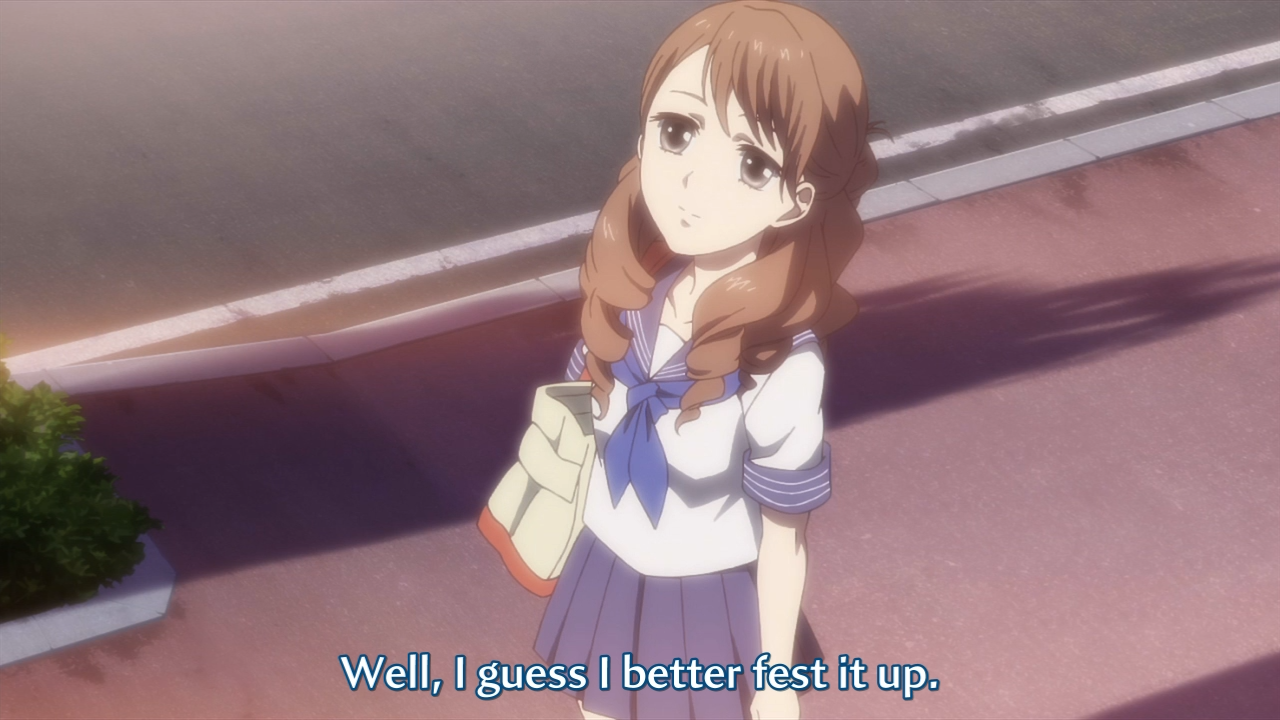
Why do something you don’t enjoy?
That’s a good question. The girls in this episode run themselves ragged and for what?

When we last left off, Yosuke’s terrible managing technique drove the staff away. His inn is now in dire straits because they simply don’t have the manpower to run the inn; dinner needs to be served and baths need to be cleaned but he’s all by his lonesome. I find it kinda odd that an inn this big could really struggle over the loss of merely four staff members, but whatever — anime’s gotta anime, right?

Ohana wants to help the inn and its management right off the bat, but management is initially too prideful to accept her assistance. Her friends also tell her to just try and enjoy her field trip, but eventually, Ohana just couldn’t stand it anymore. She rushes back to the inn and offers her assistance again. This time around, management accepts.
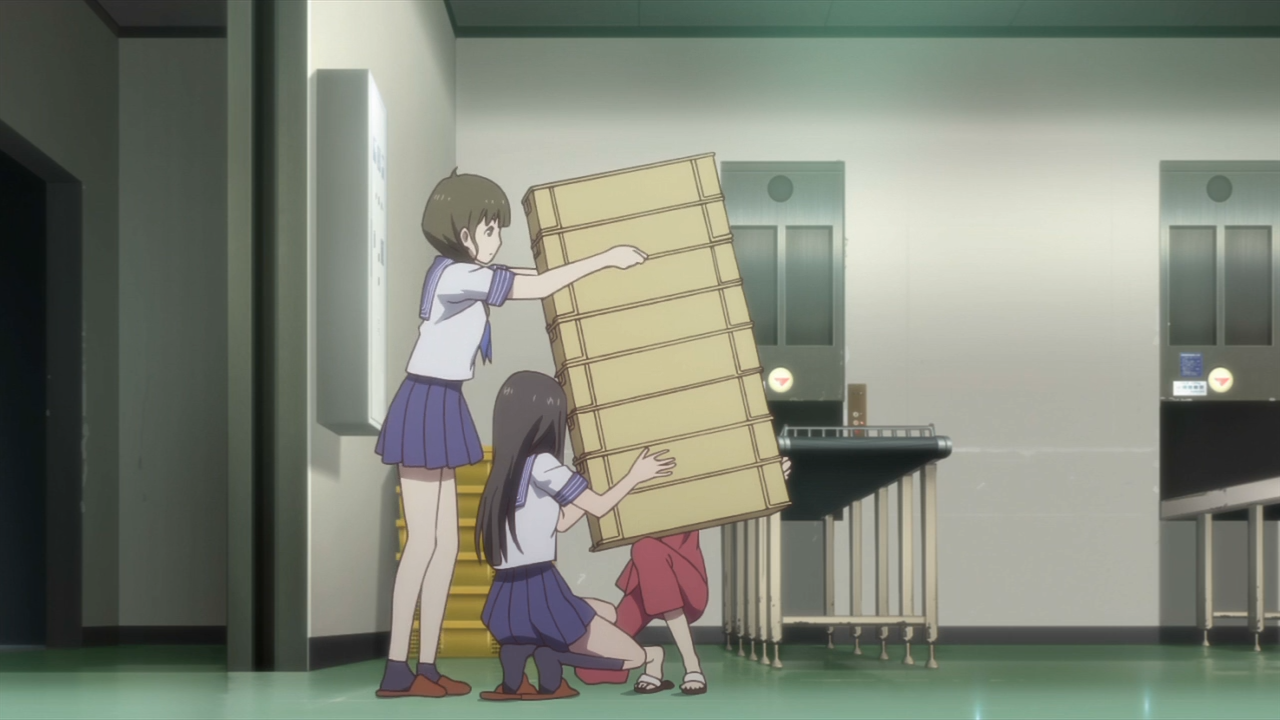
Ohana begins to work, but even she alone can’t do it all. She’s about to drop a pile of food trays when NAKAMA TO THE RESCUE! Minchi and Nako have also returned to help out their friend — isn’t that sweet? When Yuina finally returns from the field trip’s designated free period, she is shocked to see her three friends working so hard. She goes to see Yosuke while he’s cleaning a bath. This is where it gets interesting.
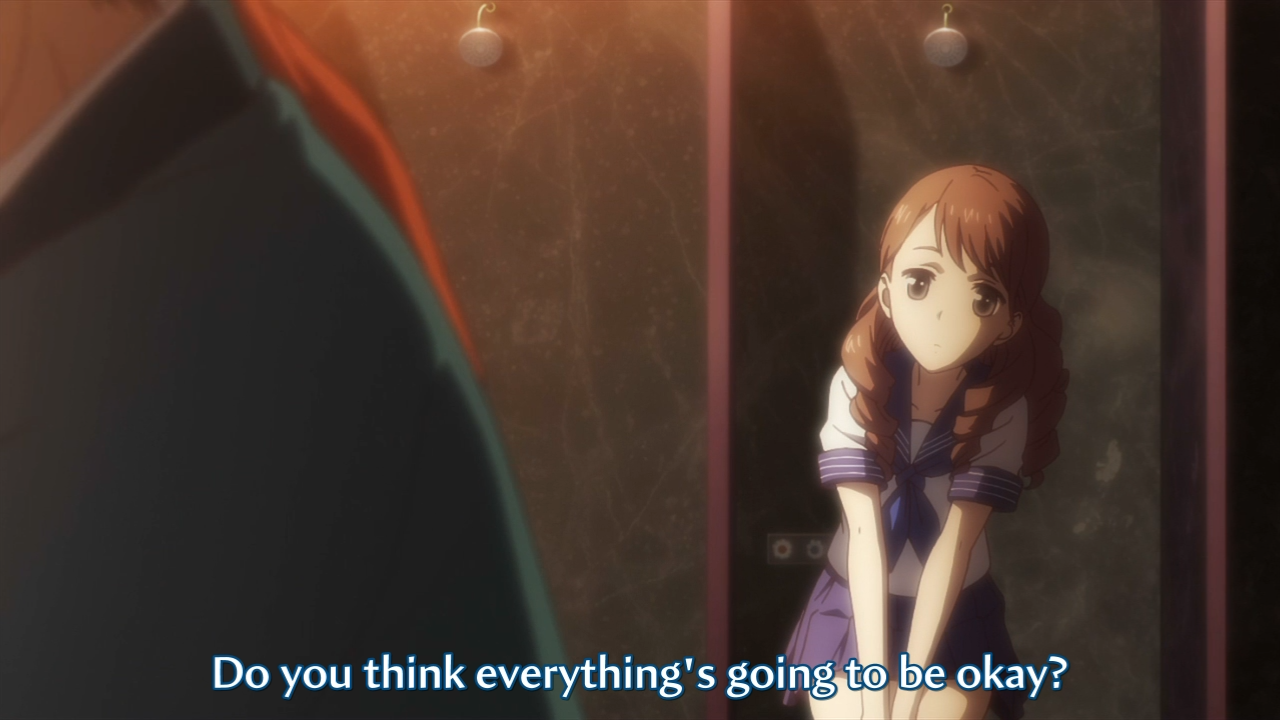
Yuina questions his dedication to the inn; after all, wouldn’t he like to do something he actually enjoys? Yosuke admits that running an inn is hard work, but he likes it anyway. Out of nowhere, he then claims that Yuina wouldn’t understand because she’s never done any hard work. He tells her to forget the promises they made as children (even though Yuina had already rejected him in the previous episode) and says he needs a woman like Ohana instead.

This triggers something in Yuina, likely jealousy, so she grabs a mop and starts cleaning the bath to prove a point. When she and Yosuke finish, her friends conveniently pop their heads in to compliment her for a job well done. Feeling all swell, she resolves by the end of the episode to learn a thing or two about the inn business.
As much as I disliked Yuina’s character in the previous episode, she did have a point. Why should she work hard at running an inn? She could be anything: a writer, a teacher, an architect — I’m just listing a bunch of professions off the top of my head. Why, then, should she run an inn instead when she could do anything else?
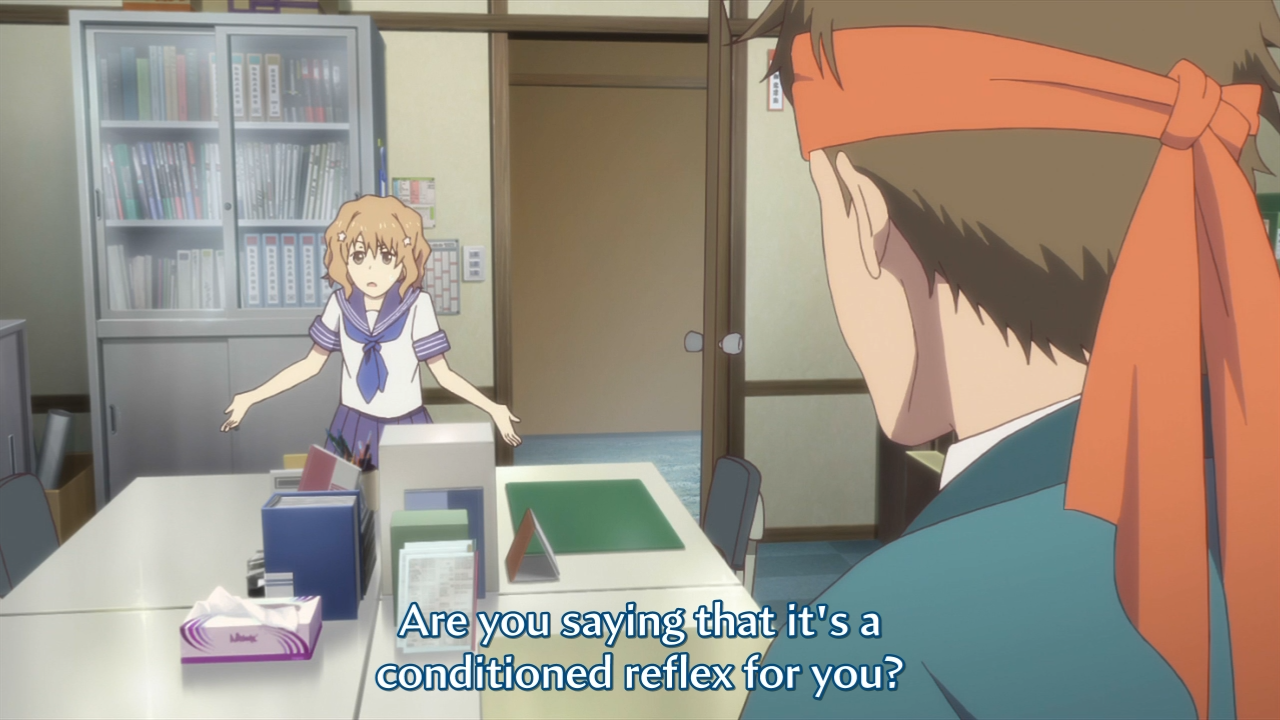
According to the anime, the answer is apparently jealousy. Yuina isn’t like Ohana; when the inn was in trouble, Ohana just jumped into action or at least she wanted to. When she couldn’t help, Ohana obsessed over it. When management finally relented, they asked her why she would sacrifice her vacation for them. All Ohana could really say was that she had been conditioned to act this way. On the other hand, Yuina doesn’t panic just because Yosuke’s inn is in trouble, but she sure as hell wasn’t losing her man to another woman.

If you ask me, the anime is implying that Ohana’s the superior marriage candidate because it’s just engrained in her nature to, well, serve. Oh, you can call it “running an inn” all you want, but all she really does is serve and clean throughout this episode and this entire series. Somehow, this makes her superior to someone like Yuina in Yosuke’s eyes. For a girl like Yuina, who isn’t programmed to jump into action when dishes need serving or baths need cleaning, her motivation is what? Jealousy.
“Just forget about our past promises. … You don’t like working at an inn, right? Then there’s no way we can get married. … I only want to marry someone who will work here with me. Someone like that curly-headed girl.” — Yosuke
And isn’t Yosuke being a bit ridiculous? That kind of inflexibility doesn’t seem particularly healthy.
In the end, Yuina resolves to fest it up even though she doesn’t enjoy running an inn — even though she might enjoy “being a designer, a creator, or even an artist” instead. Apparently, this is all secondary to the fact that she’s losing to another girl.
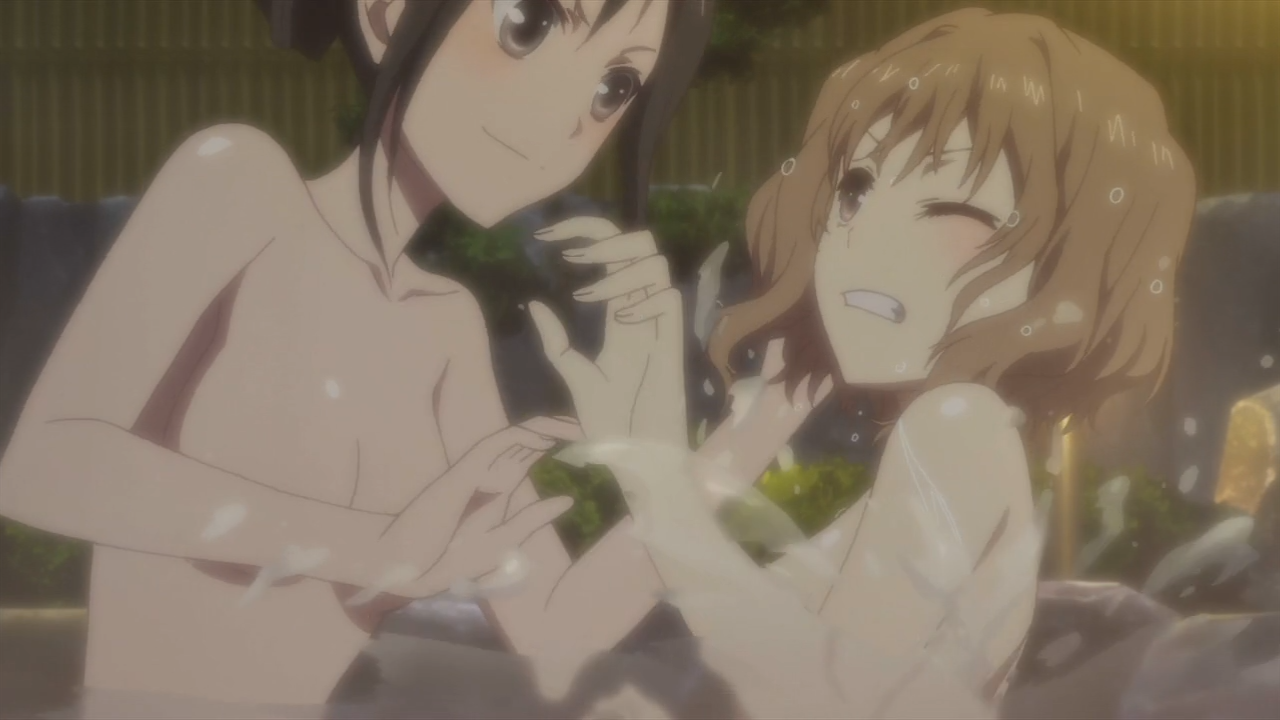
What’s even funnier on the meta level is that the reward for the girls slaving away on their free time is an open bath where they can wrestle naked with each other to the viewer’s content.
Anyway, here comes the “you’re taking the anime too seriously” or “you’re reading too much into it.”

Yeah, this show sucks.
I think what Yosuke said translates to: “You? A girl who aspires to be independent and find your true calling in life? Total turn off! Now a girl who will do anything I say whenever I say it because she loves to serve, now that is true love!!”
Just what my mind thought.
Who wouldn’t want to run an inn from when they’re in high school ’til the day they die? C’mon, this is the dream job!
Running an Innin the countryside: The Hanasaku Dream!
In Japan, working hard equals virtue. And that’s fine in itself. But in my experience, it so often means that you have to show the signs of working hard (rushing around, shuffling papers, whatever) to be judged as one of the Good Ones.
So sexism’s one thing. A secret anti-NEET program to instill systemic Japanese values on the otaku public, however… ;)
I think you’d be hard pressed to find any culture where hard work isn’t a virtue or at least given lip service so I don’t think that’s really the issue here. If this is some covert way to instill the value of hard work in NEETs, it’s a pretty half-assed attempt considering the fact that the anime’s encouraging young people to just accept the life they’re been given — aspirations be damned.
I’m of two minds on this one.
On the one hand, I definitely see 2DT’s point. There’s a lot of anime out there that glorify hikikomori and/or NEET lifestyles, and it has actually started to bother me a bit, because I think it sends a bad message to anime fans (particularly ones who actually are in hikikomori and/or NEET ruts). That message is that it’s “cool” to be a hikikomori and/or a NEET, when these lifestyles are typically unsustainable in the long-run and could easily ruin a person for life.
Take Jinta in Anohana for example. He’s really threatening his future well-being a lot by totally refusing to go to school. If Jinta doesn’t complete high school (and some sort of post-secondary education and/or training beyond) It would simply drastically limit the sort of career and job options he could have in life.
Now, in Kamisama no Memochou, you have the NEET detective, and a show that implicitly argues how cool NEETs are. Again, how many people, in real life, could be self-sufficient while living like these characters?
I see these anime shows has selling a false bill of goods to a consumerbase where a lot of folks are like this, but living off their parents for now. In other words, anime is pandering to the NEET and hikikomori parts of its fanbase by saying “You guys are cool! We think that you’re NEETly awesome! Just like our major protagonists are. So please reward us for comforting you and applauding you by buying our DVDs, Blu-Rays, and associated merchandise!” And part of me feels like all this message is doing is enabling NEETS/hikikomori to continue to live a lifestyle that can’t be healthy in the long-run, and is likely financially unsustainable.
So, with all of this in mind, I kind of like how Hanasaku is providing a counterpoint to all of that, by advocating hard work and a more practical approach to the role of employment in one’s life.
On the other hand, I do see where this counterpoint is muddled somewhat by other insinuations that are not necessarily as welcomed. Taking a practical approach to the role of employment in one’s life shouldn’t mean that you give up on your own personal dreams, passions, or aspirations. If Yuina doesn’t want to work at an Inn, and would rather a different career or profession, then she should follow her heart.
It is good to love (or at least like) one’s work, if at all possible, and sometimes that means you have to turn down some opportunities to find the ones that really speak to you.
This lengthy life discussion aside (sorry about that, E Minor ^_^;; ), there were certain things I liked about this episode. I like how Ohana and Minchi continue to grow closer together, and how Minchi has matured perhaps a little bit since Episode 1.
I just think telling NEETs to work hard because your friends (and lovers) will like you is irresponsible. For a lot of these wayward kids, that’s exactly the problem in the first place: expectations. Putting aside all the sexist implications in this episode, Yuina’s attitude toward hard work (why do we assume she didn’t work hard before?) flipped when her classmates made a big deal out of the fact that she had cleaned the bath for them. That’s all nice and dandy, but this sort of peer pressure is what got a lot of NEETs into trouble. Everyone’s constantly worrying about what their parents will think of them, what their friends will think, what the community at large to think, etc. A little “looking out no.1” isn’t exactly a bad thing; the only problem is when the pendulum swings too far to either side.
I love how every guy Ohana meets is all over her. Such an interesting character dynamic.
I hope you’re being sarcastic.
Who doesn’t love a moeblob who will turn to everything you desire? It’s the power of protagonist pandering!
I like this blog ^^ You review all these different kinds of anime, but do you watch and review shonen like fairy tail or katekyo hitman reborn?
I’m not a fan of anime series where the episodes number in the hundreds. They take the definition of filler to the umpteenth degree and I’m not gonna bother myself with that.
I love how Ohana’s hard work ethic and selflessness is offensive to the mindset of Americans and other subjects of the “British Empire”. If that’s truly their tendency, remind me to never hire any who grew up in an English-language-dominant society.
What a pathetic strawman.