
Alice was beginning to get very tired of sitting by her sister on the bank, and of having nothing to do…

…when suddenly a White Rabbit with pink eyes ran close by her.

Alice started to her feet, and burning with curiosity, she ran after it, and fortunately was just in time to see it pop down a large rabbit-hole under the hedge.

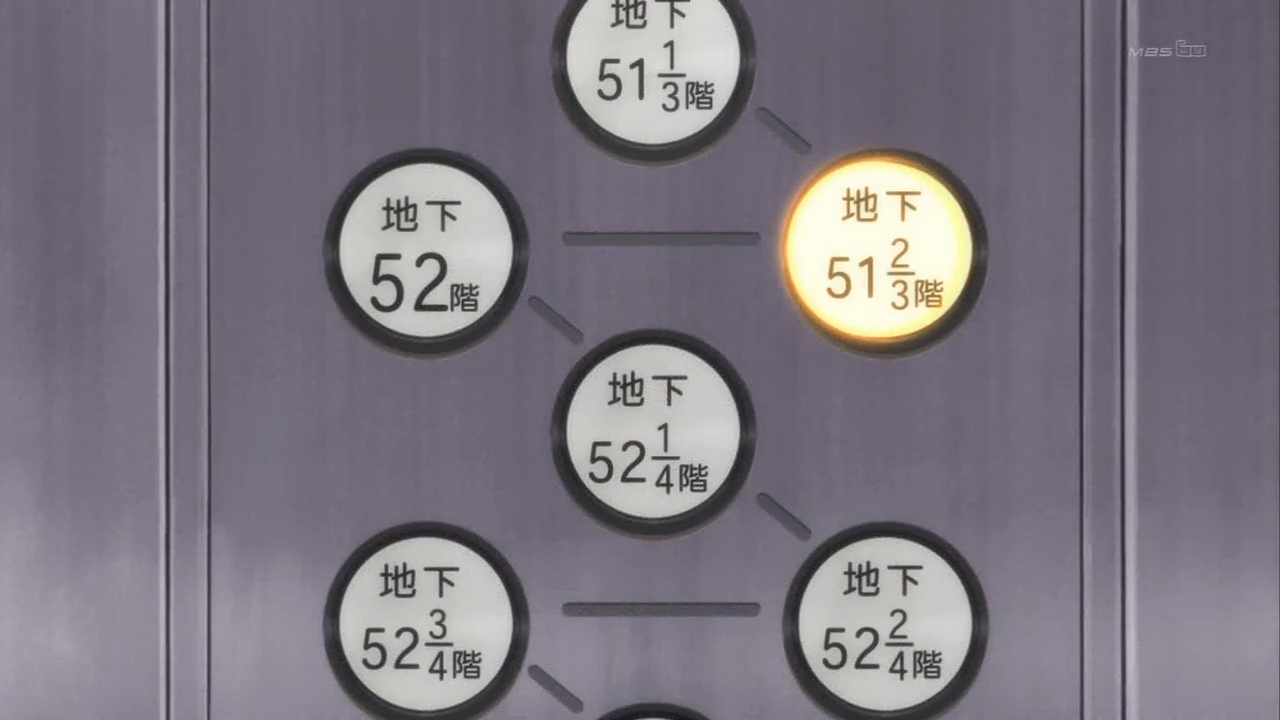
The rabbit-hole went straight on like a tunnel for some way, and then dipped suddenly down, so suddenly that Alice had not a moment to think about stopping herself before she found herself falling down a very deep well.

At the end of the tunnel, Alice encounters a beautiful garden.
Reality versus fantasy
The story of Alice is really the story of a young girl with an overactive imagination. Divorced from the adult world, she thus descends into her own psyche, i.e. the rabbit hole, where she can indulge in a world of fantasy and play. Himari, on the other hand, is a sickly girl who doesn’t have much of a social life. She hasn’t gone to school in a long time nor does she currently have any friends (unless you count Ringo… but who would?). Although her brothers love her, as Kanba and Shouma continue to ascend toward adulthood, it is inevitable that the distance between the siblings would increase. Often times, Himari finds herself all by her lonesome in her very own home, wondering where her brothers could be. As a result, it isn’t hard to imagine what strange fantasies a girl like Himari might conjure up to keep her mind occupied.
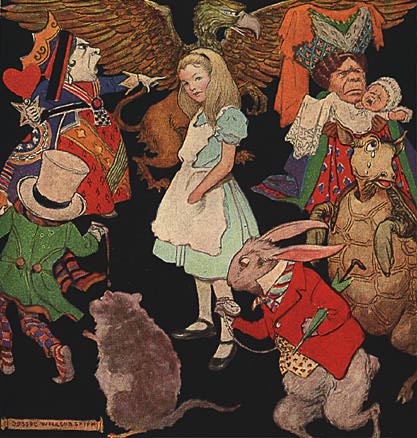
Doesn’t Himari’s attire in this week’s episode remind you of Alice?
With such a striking similarity between the start of Alice’s Adventures in Wonderland and Himari’s day at the aquarium, is it possible that Himari may have also descended into her own psyche when she went chasing after a mysterious penguin? If she did, Himari wasn’t there for long. Unlike Alice, Himari only spends a brief moment in her fantasy world before she is whisked back to reality with no memories whatsoever of her bizarre experience. She then returns to her mundane life albeit with a companion penguin to call her own, i.e. #3. If anything, it is her brothers who are now mired in a world where reality and fantasy collide.
After all, it was Himari and only Himari who could see #3 at the aquarium that day. Also, notice the subtle differences between the siblings’ visit to the park in episode one versus the same event in this week’s episode. The events appear similar but they are not quite the same. In the ninth episode, Himari calls out to Shouma shortly after Kanba leaves the pair. In the first episode, we hear no such utterance from Himari. Since the previous eight episodes have dealt largely with Shouma (and Ringo) as opposed to the other two siblings, it is reasonable to assume that, in the first episode, the story had primarily adopted Shouma’s POV. The ninth episode thus adopts Himari’s POV. There are other minor differences as well, but I won’t bother to list them all as doing so would just belabor the point. Basically, as close as the siblings are, they are also worlds apart.

So how come the brothers can suddenly see the penguins now? Is it possible that Himari’s dreams and fantasies have escaped from her psyche, and is now intruding upon the brothers’ reality? If this is a case, however, Himari is cruelly left out. So while the brothers are running themselves ragged on the streets, attempting to please some malevolent alter-ego of Himari’s, their sister is completely oblivious to what’s going on in the strange, new world around her.
“Wait a minute — a girl’s psyche is intruding upon reality?”
Yeah, it sounds weird and something doesn’t quite add up. Mainly, Masako is the wrench in this entire theory. Her existence implies that the fantastical elements such as the invisible penguins and looming conspiracies might exist independently of Himari’s psyche. Then again, Masako didn’t enter the picture until the siblings started to embrace a strange and crazy world where invisible penguins could exist. So who knows if Masako herself isn’t yet just another example of the unreal exerting itself upon the real. But in any case, let’s assume that the penguins and all the other strange occurrences are independent of Himari’s mind. We don’t have to imagine that Himari’s psyche is literally intruding upon the fabric of reality. We can simply see her Alice-like story as a metaphor.
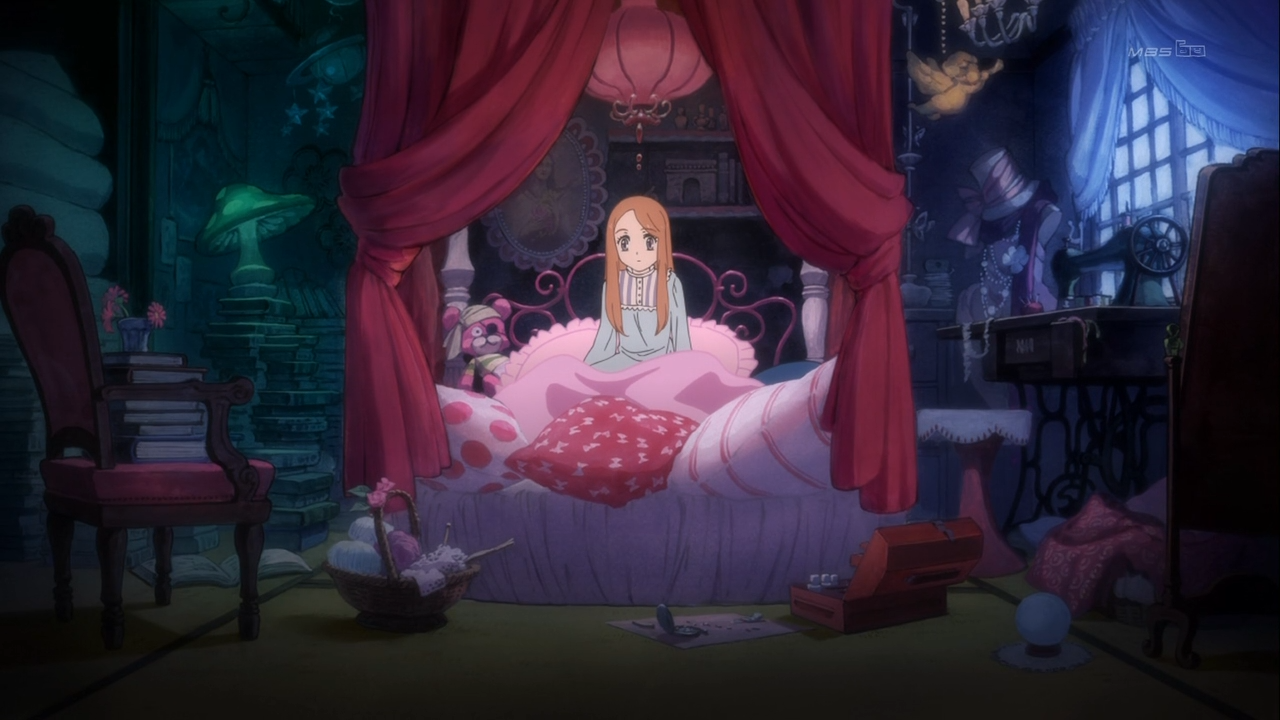
But a metaphor for what? Let’s imagine the same anime without the elements of the fantastic. Such a story begins with a girl who doesn’t have long to live. The girl’s parents are missing and her brothers are all she has left. Recall a passage I quoted last week:
“We humans are not naturally born into reality. In order for us to act as normal people who interact with other people — who live in a space of social reality — many things should happen like we should be properly installed within the symbolic order and so on. When our appropriate space within the symbolic order is disturbed, reality disintegrates.” — The Pervert’s Guide to Cinema
For the siblings, the family represents their symbolic order. With the parents missing, however, the family situation is tenuous at best and Himari’s illness threatens to compound the problem. When Himari briefly died at the start of the series, it is as if reality could no longer suffice. After all, reality, i.e. modern medicine, cannot and could not save Himari’s life. The brothers will turn instead to dangerous, life-threatening games full of fantasy and conspiracies. Yes, invisible penguins, an evil penguin spirit, a future-telling diary and some slingslot-toting femme fatale may very well be real and tangible, but these fantastic elements can also be seen as a metaphor of just how far the brothers are willing to go in order to maintain the facade of a functional, loving family. Most of us would just accept a doctor’s word eventually and await our loved ones’ deaths.

But what is Himari after? The mysterious librarian in her psyche tells her that there’s a deeper story, i.e. memory, that she is looking for. From the episode, we can discern that this well-buried memory involves Himari’s soul mate. This episode also gives us a glimpse into Himari deepest kept secrets and it is quite evident that the young girl’s life has been full of regrets. We could then imagine that when Himari came face-to-face with death herself, she suddenly realized that she still had a life full of unfinished business. After all, wouldn’t we each want to unite with our respective soul mate before we kick the proverbial bucket? This might then explain the purpose behind “Survival Strategy.” Yes, as I’ve said above, the fantasy in Himari’s reality may very well be tangible, but it can also be seen as a metaphor of her overactive psyche trying to allay her life’s many regrets before she passes away.
Why can’t Himari remember anything?
Let’s think of the library and its annex as a repository for Himari’s dreams and subconscious memories:
Ariadne: “Limbo?”
Arthur: “Unconstructed dream space.”
Ariadne: “Well, what the hell is down there?”
Arthur: “Just raw, infinite subconscious.”
I’m not quoting Inception, however, to suggest that Himari descends into a realm analogous to limbo at any point in this week’s episode. I selected these lines from the movie to instead suggest that Mawaru Penguindrum‘s dreamworld might also be similarly constructed, i.e. in a tiered fashion. If you’ve seen the blockbuster flick, you’ll also recall that an elevator is used as a metaphor for the characters’ descent into the subconscious.

We can thus imagine that the books in the library represent past experiences in Himari’s life. The library’s annex may then represent an even deeper, darker region of her subconsciousness:
Main librarian: “That book doesn’t appear to be in our database.”
Himari: “I’ve seen it before. I’m sure it’s here.”
There, she might encounter memories full of regret and various other negative emotions. For example, in the annex, Himari relives the tragic incident where she nearly killed her mother. Of course, since we are operating within the realm of the subconscious, when Himari does wake up, she naturally remembers nothing but perhaps faint, dream-like visions.
Collective unconscious
There’s a sense that while the library and its annex contains Himari’s dreams and memories, it isn’t a realm that exists solely for her. In other words, you and I could also follow a penguin down an elevator shaft into this strange world. After all, the main library is full of people. Plus, the plaque on the outside contains multiple languages as if to imply that the library is universal. So assuming that everything Himari encounters in this week’s episode isn’t some sickness-induced delirium, we might conclude that the universe of Mawaru Penguindrum contains some sort of collective unconscious where all of our memories are intertwined in some fantastical inner library.
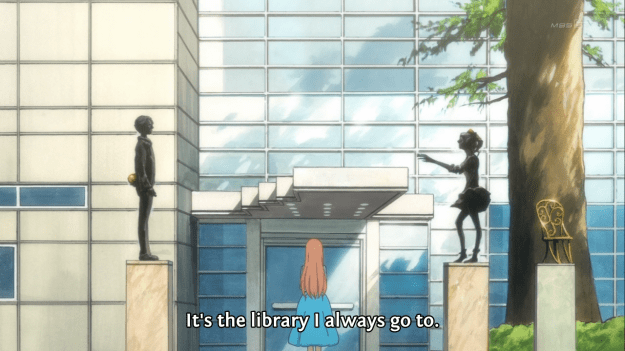
Could it also be the library we all go to when we fall asleep?

The idea of the collective unconscious is just naturally fascinating. How do we explain people having vivid memories of their past lives? How is it possible that two completely unrelated people from all across the world can suddenly stumble upon a unique idea at roughly the same time? Most of us realists would chalk all of these incidences up to coincidence, delirium, confirmation bias, etc. A lot of people, however, would like to believe that these puzzling occurrences are not make-believe. The human mind is constantly searching for cause-and-effect, and if visions of a past life, for instance, isn’t fantasy or evidence of reincarnation, then what is it? Perhaps, then, a collective unconscious.
The mysterious door
I love this door:

It’s like something out of a David Lynch film, which isn’t all that surprising when you consider that Ikuhara has once voiced his desire to collaborate with the avant garde film director.
To me, the imagery here evokes a sense of death. Tucked away in a dark recess of mankind’s collective unconscious sits a door that ticks like a clock. And as Himari stares at the puzzle unraveling before her eyes, her head suddenly knocks backward and she briefly enters a trance-like state. She begins to see visions of what looks like birds (doves?) flying in the distance. Of course, she doesn’t exactly see birds. She seems to only see silhouettes of birds. Once the door solves its own puzzle — its internal contradiction — #3 opens it and allows Himari to descend further into her subconscious. You’ll notice however that the door immediately opens to black nothingness.
Everything else
• Himari’s initial reaction to the pink-haired man isn’t a favorable one:

As with everything else in the anime, there’s probably a double meaning to Himari’s words. After all, here’s a man with access to all of her innermost memories. He’s essentially a peeping Tom.
• The pink-haired man tells Himari that she is the annex’s first guest in a long time.

If the collective unconscious idea makes sense, his words here would also imply that few people are ever willing to dig this far deep into their painful memories. Or rather, fate doesn’t compel them to dig this far.
• At one point, during Himari’s trip through her memories, the background fades away and is replaced by a sea of white dots upon black nothingness.
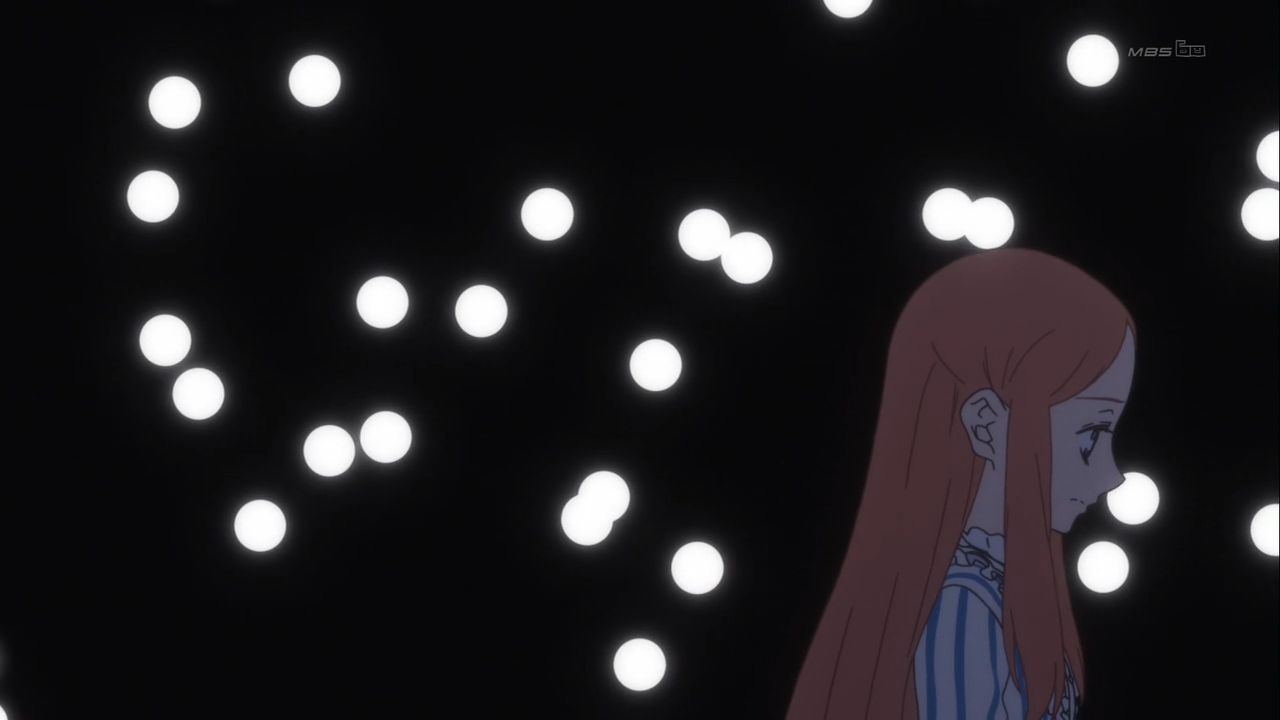
The imagery here reminds me of a very recent scene in another anime currently airing. In the 23rd episode of Steins;Gate, the hero boards a time machine and as the vehicle begins to operate, strange white sparkles appear around him that none of the anime’s characters can explain. Back to Mawaru Penguindrum, reliving one’s old memories is, in a way, similar to time traveling. As a result, the two anime appear to share a similar motif with regards to time and memory. Mawaru Penguindrum simply takes a even more abstract, minimalist approach.
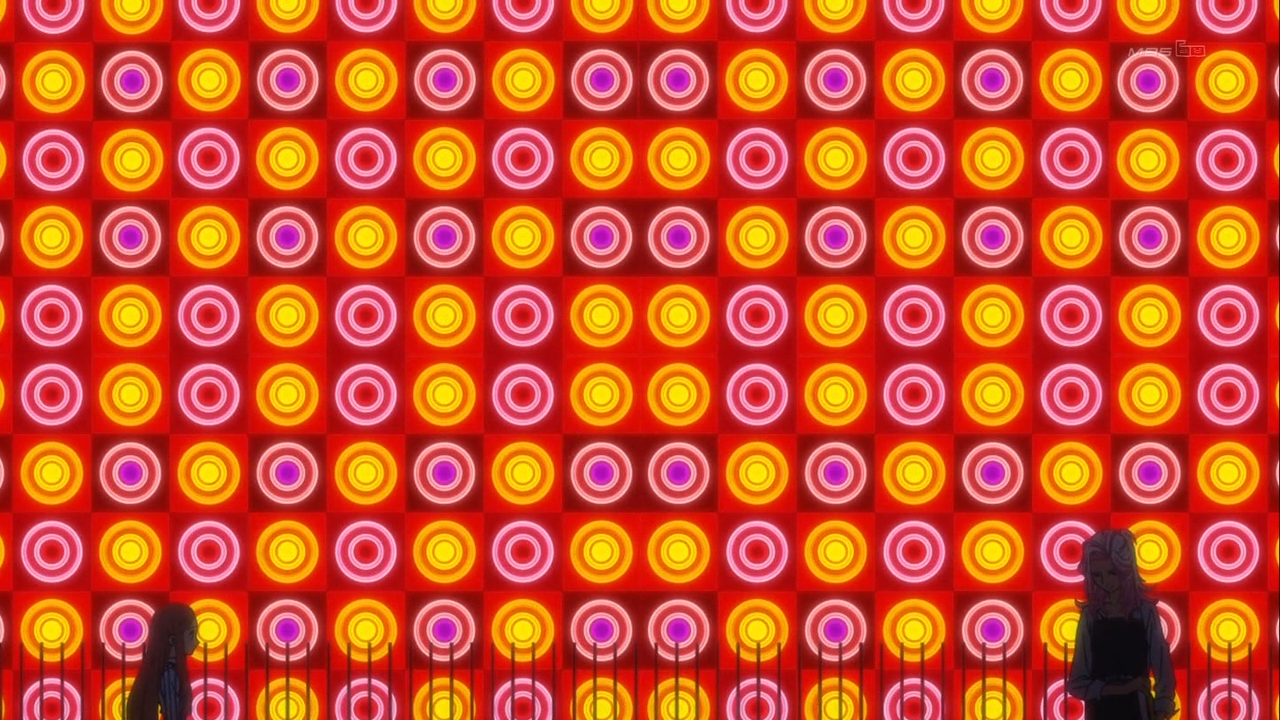
• I don’t suppose anyone can discern any sort of pattern in this shot. Or what about this strange marking on the floor? I initally thought “‘Ka’ line” might refer to palmistry, the art of fortune-telling simply by examining a person’s open palm, but I wasn’t able to really find anything interesting in a quick Google search.
• There’s a striking contrast in the scene where Himari leaves her school for the final time:
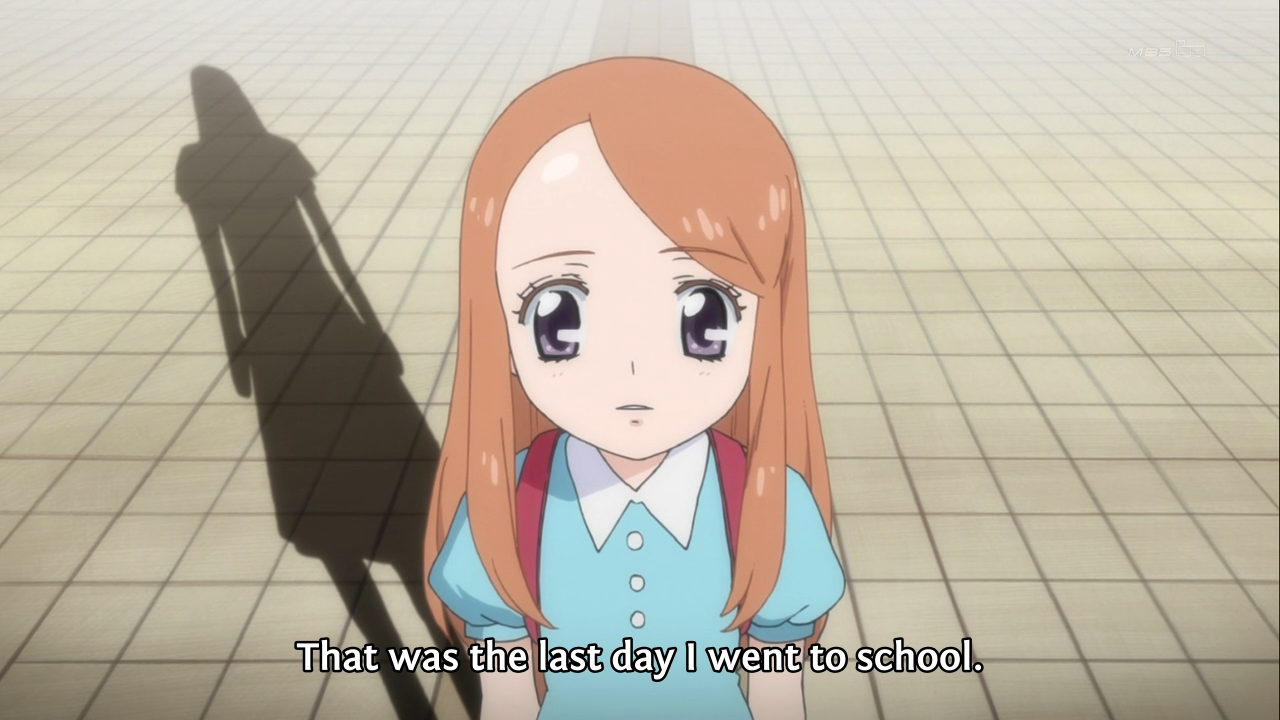
The way the light source has been angled in this particular shot gives Himari a shadow that looks as if it belongs to an adult. In a sense, Himari is leaving her childhood behind. Both her mother’s accident and her illness has perhaps forced Himari to grow up sooner than she would have liked. Plus, although most of us dislike school, for Himari, it was the site for fun and play; it was where she could spend her carefree days with the rest of Triple H, i.e. Hibari and Hikari.
• This particular shot is practically telling us to pay close attention to the characters’ eyes:
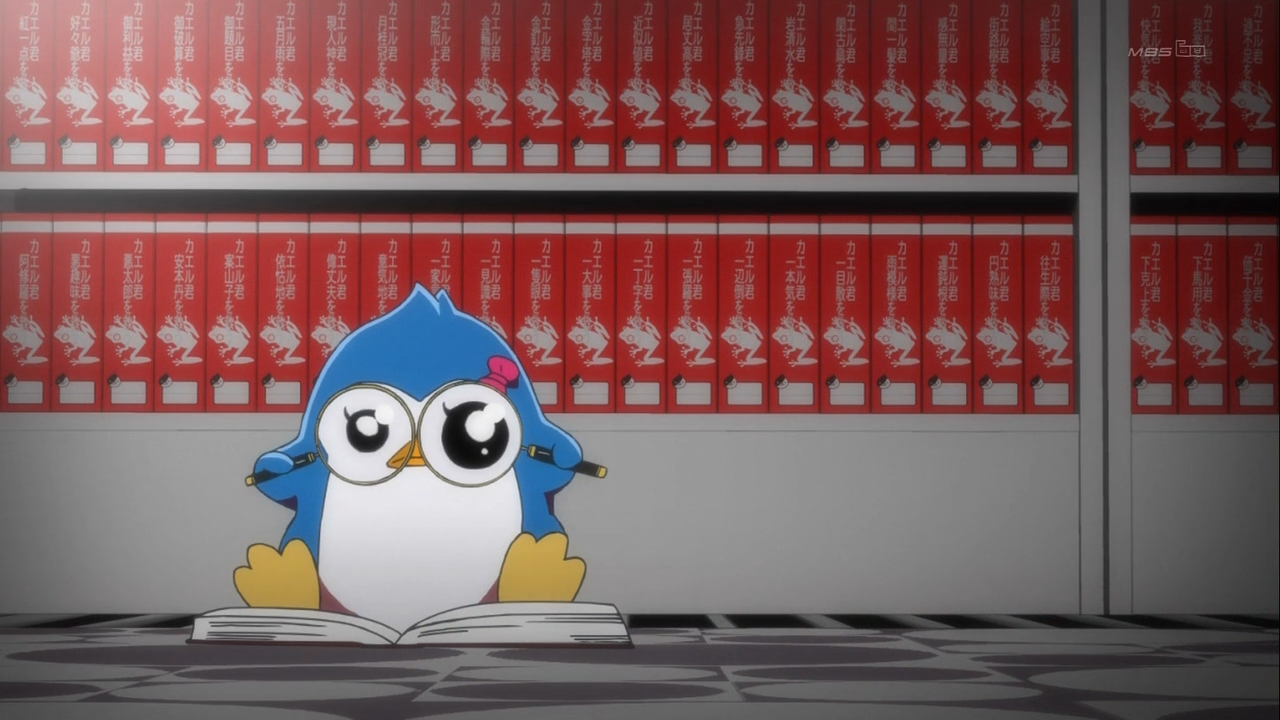
Sure enough, Himari’s eyes take on a different character:
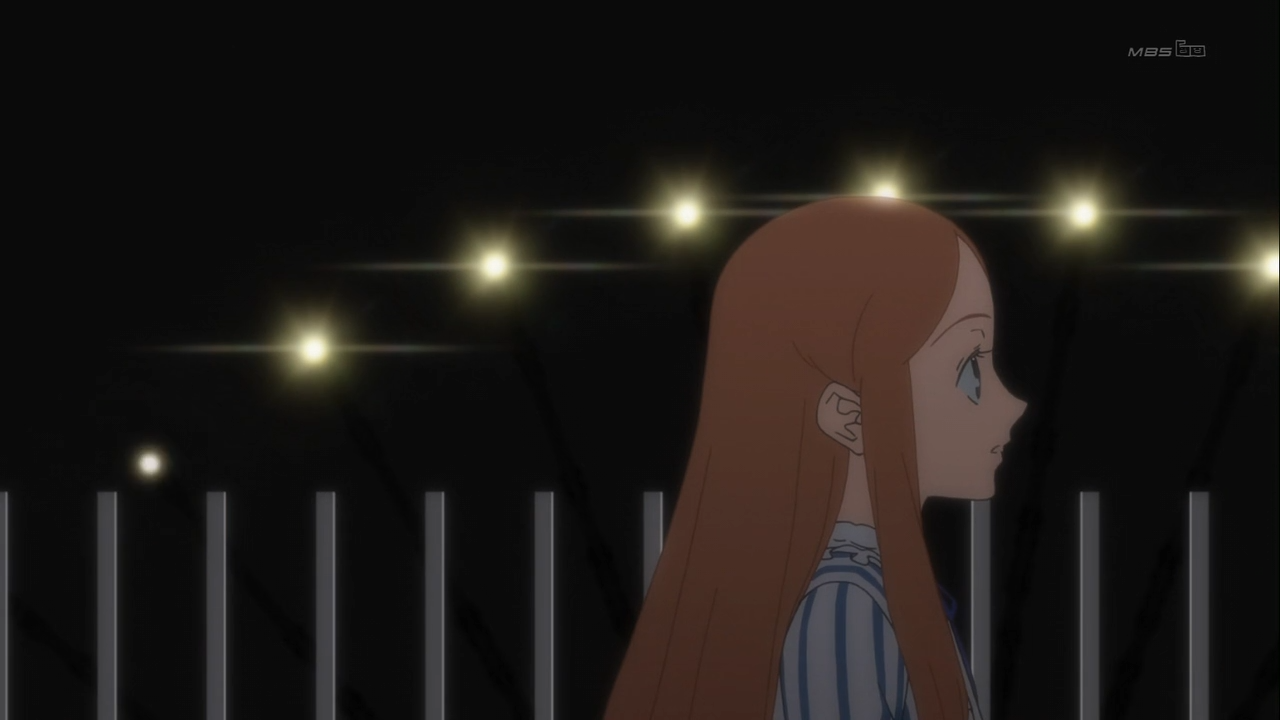
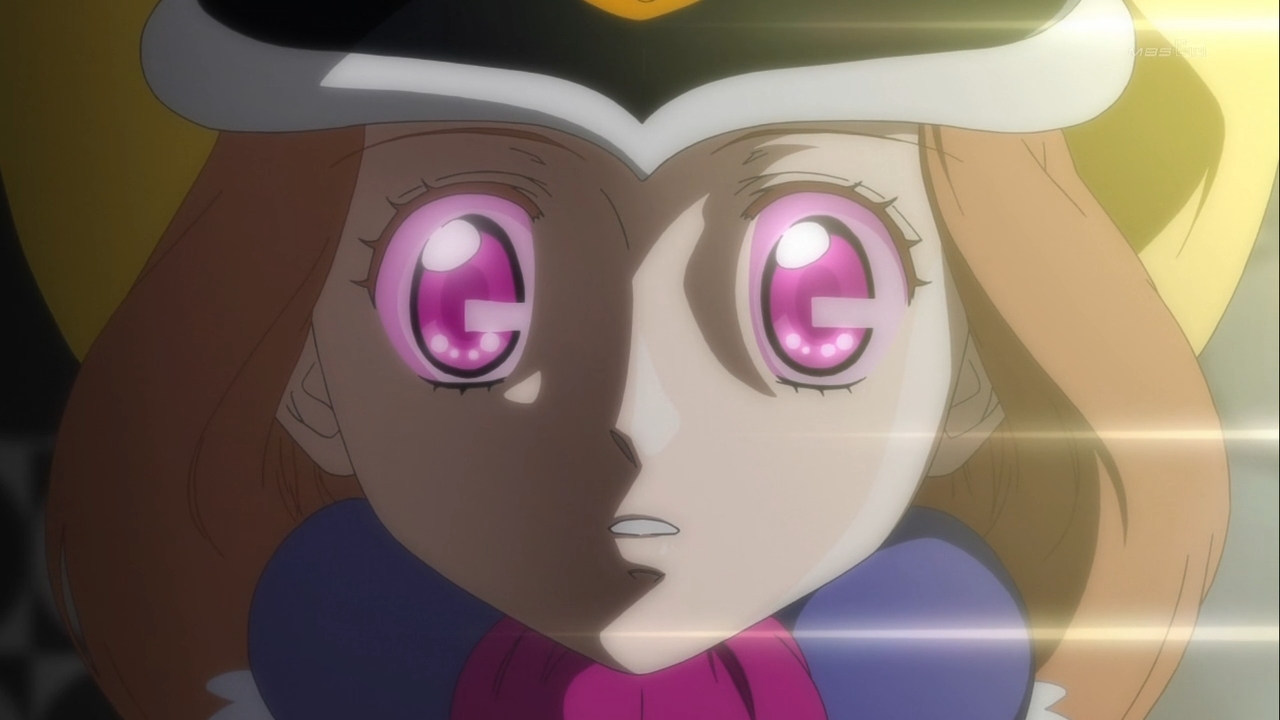
But did Himari’s personality change as soon as the hat touched her head? Plus, as she fell from a great height later in the same scene, it would appear as if she had already returned to her normal self:

I wonder if this might then suggest that Himari and the strange penguin spirit assuming her guise aren’t really two distinct entities after all. Himari’s alter-ego might very well just be a more goal-oriented Himari, one in search of her soul mate. And maybe she has no idea what the penguindrum could possibly be, but she might initially think that a young girl’s diary will contain the answers she’s looking for.
• What’s with the huddled masses in a room with two giant exhaust fans and a “Child Broiler” sign on the wall?

Shrug, your guess is as good as mine.
• Himari’s soul mate, whose face we cannot see, gives her an apple and calls it the fruit of fate. Yes, the forbidden fruit was never originally identified, but let’s assume for a moment that Mawaru Penguindrum is invoking Christian imagery. How might an apple be the fruit of fate? Adam and Eve’s unfortunate (or, depending on your point of view, fortunate) consumption of the forbidden fruit led to mankind’s fall from grace. Otherwise, we’d all be sitting in paradise… with nothing to do — sounds fun. So in an anime where fate and determinism plays such big roles in the narrative, the forbidden fruit can be seen as the very object that has determined the course of mankind’s rich and complex history.
• When Ringo calls Himari to deliver the bad news about Shouma, the camera briefly centers on the siblings’ parents:

I don’t know if this will amount to much of anything, but I figure I’d include this minor observation anyway.



“Yes, the forbidden fruit was never originally identified, but let’s assume for a moment that Mawaru Penguindrum is invoking Christian imagery”
I don’t think it’s invoking Christian imagery really. After all, the library is called “Hole in the Sky Annex”. “Hole in the Sky” is a reference to Miyazawa’s Night on the Galactic Railroad, and the apple is a recurring motif in Mayazawa’s works. Here’s literary commentary on the subject:
“Apples were a favorite food of author Miyazawa Kenji, and they appear in many of his works… To Kenji, apples were connected to his image of the universe. This was because the universe that includes our galaxy is also round like an apple. So when you hold an apple in your hand, you’re holding the entire universe in the palm of your hand. According to the author, the seeds of an apple were comparable to the worlds we live in from day to day. The fruit of the apple reflects the hugeness of the universe outside ourselves. Just like there’s a world outside the apple’s skin, the universe doesn’t end at its own edge either. Outside of our own universe, there’s something even bigger surrounding it. No doubt, there’s another dimension of a higher order expanding outside our universe, that can’t be contained by our three-dimensional rules.”
Basically, as that unnamed boy said in the first episode of penguidrum, the apple symbolizes the connection between this world (the world of the living) with the other world (the world of the dead). It’s a symbol of passage and, unlike the Christian take on the apple, it doesn’t really have any inherent negative connotation.
Yeah, I’ve read similar analysis. Really, though, I think things can have more than one singular interpretation. To anyone who may have read Night on the Galactic Railroad, the apple may represent what you’re saying. To someone else, the apple can symbolize something else. The joy of textual analysis is the subjective nature of interpretation.
I just mentioned that in light of the library’s name, which IMO already gives us the necessary context as to how what happens inside the library is meant to be understood. Besides, the boy in episode 1 goes as far as to explicitly mention Miyazawa’s name:
“What KENJI was trying to say [with the apple] is that [death] is actually were everything begins”.
Don’t you think that fits what happens in episode 9 perfectly. For Himari, her death is when her story begins (or continue, if you will, since it stopped the day she had to abandon her dream of becoming an idol).
I’m not disagreeing with the interpretation you’re putting forth. I wrote this months ago for the first episode:
I simply chose to interpret the apple in this episode from a different angle. Christian imagery isn’t exactly unknown to the Japanese so why not try to see things in a different context? Just as I’ve said in my previous reply to you, symbolism isn’t limited to finding the one right answer. As such, I disagree with you on this:
I don’t believe there is only one way to interpret any work of art.
Fantastic post. My blogging partner and I read it together and really enjoyed what you had to say, especially in regards to the family hierarchy.
You also touch upon a possible answer to a question that I was wondering myself: in light of recent developments with Himari, if she has a stronger hand in what the penguinhat wants, then why does it immediately fixate on Ringo’s diary? How are Ringo and the Takakuras related (beyond Ringo’s developing friendships with Shouma and Himari)? It will certainly be interesting to find out. Thank you!
What ^she^ said.
Ah, thanks. I do read yours and Vuc’s posts as well since I haven’t read Night on the Galactic Railroad and you guys seem to have the finger on that particular topic. I should leave comments, but it always feel as though I’m jumping into the middle of a conversation! But I’ve made an effort just now…
There are almost too many episodes left to really say. If the diary contains any clue to finding Himari’s soul mate, why does Masako want it so bad (assuming it was even her who tore the book apart at the end of the eighth episode)?
So many theories, so many speculations, so wonderful. Unfortunately, I am still bewildered by this episode and tired, so I won’t get into making such a long winded comment for this time.
Again, nice reference with Alice and Wonderland. And her clothes look similar to the picture as well…
The apple and Himari’s soulmate, all locked up in the library that is the inner mind. Psychology might refer to Freud and the subconscious, conscious, the ego and all that, but I digress.
Vuc and AJTheFourth provide a nice analysis at their blog. The “Child Broiler” sign on the wall might just as well be a symbol of purgatory, relating to Catholism. “Unbaptized children go to purgatory, correct?” Then the apple, sharing it with a male, start to tie altogether.
Of course, Rou references the apple to Miyazawa’s Night on the Galactic Railroad, but I haven’t watched it yet. However,
“…you’re holding the entire universe in the palm of your hand. Outside of our own universe, there’s something even bigger surrounding it. No doubt, there’s another dimension of a higher order expanding outside our universe, that can’t be contained by our three-dimensional rules.”
Perhaps referring to fatalism, or as Ringo loves to exclaim, DESTINYYY! There might be an external force acting on all these events. The Penguindrum? The hat? The enemy? They aren’t confined by rules at all.
Of course, now that we’ve seen that Himari-Hat happened before everything started to occur, I wonder if it is another personality or part of Himari altogether. Split personalities! Dissociative identity disorder!
“This disorder is theoretically linked with the interaction of overwhelming stress, traumatic antecedents, insufficient childhood nurturing, and an innate ability to dissociate memories or experiences from consciousness.”
Hmm…she was traumatized from her mother and the mirror, but she lacks the “innate ability to dissociate memories or experiences from consciousness”, I think.
Scratch the first comment, I did it again.
Hm, I can see how that might work. But purgatory is only a temporary dwelling. I’m not a Christian, but I do believe souls aren’t meant to stay there forever. The huddled masses in the shot, however, seem to have no avenue for redemption. What can they possibly do in that room that will prepare their souls for heaven?
Yeah, I’m rather fixated on this particular theory at the moment. I do believe that Himari is unhappy at home and is seeking her escape. At first, death seemed to be the answer, but after reliving her old memories, she may have now decided she has unfinished business to attend to.
You think so? — well, you just said “I think” at the end, but you know what I mean! I dunno, the new Himari just seems so oblivious and detached from everything that’s happening around her that, well, I wouldn’t put it past the anime to give Himari a split personality.
You can interpret it either as Purgatory or Hell, as I perceive broiler as heating, fire, burning, or suffering as people go through in Purgatory, to prepare themselves for Heaven, or Hell. If it were Hell, then I would relate it to the Original Sin, the apple, the temptation, etc.
But she may not necessarily want to confront them. She says she doesn’t hate her friends, but maybe like the person in the library says, she’s just keeping them down deep inside. Since she can’t express this (that person gave her), she manifested another personality within her, the Hat-Himari, or impure (language, actions, etc).
Sometimes, it’s instinct! Gah.
Hell’s possible, but it would also seem particularly harsh considering that the sign refers to a child broiler. We don’t normally send children to hell. Ah, well, I’m sure we’ll find out in due time what everything means–
Oh.
Yeah, this is what I am trying to allude to. If she does succeed in finding her soul mate, would this mean a rejection of her dear brothers? I’m not sure normal Himari would have the heart for this, but that’s not necessarily the case for alter-ego Himari. Alter-ego Himari also has no problems insulting her brothers over and over…
Pent up hate and frustration perhaps? I’m still wondering who her soul mate is…perhaps a first love -> bride veil -> pureness?
Well, I’ve been digging around about the term “broiler” and this is what I found:
broiler: flesh of a small young chicken not over 2 1/2 lb, suitable for broiling. It could be either alive or dead. But if it is alive, then it probably won’t be for long. It is probably in the slaughterhouse or will soon be sent there. All chickens begin at less than 2 1/2 lbs but they are not all called broilers. It is only when the decision has been made to process them at that size that the term would be applied.
So, if the chicken is alive, the term broiler means “chicken fated to die”. If that’s the case, “child broiler” could mean “child fated to die”. It kinda fits when it comes to Himari….
Broiling a live chicken sounds cruel and disgusting, what with all of its guts intact. But who knows, maybe you’re onto something.
The marking on the floor simply reflects how things are indexed in Japan. Whereas in English-speaking countries you’d arrange words/books/etc alphabetically – so things starting with A, B, C – in Japan you’d arrange them by A (I U E O), KA (KI, KU, KE, KO) and so on, in a specific order.
Why this index takes the shape it does in the episode, of course, is a different question.
Ah, okay. That makes sense, but it also leads me to wonder: does [gg] ever accompany their releases with .txt files to explain things like this where cultural familiarity makes all the difference?
Look at the statues in from of the library:
https://moesucks.files.wordpress.com/2011/09/mawaru-penguindrum-0909.png?w=640&h=360
Isn’t if foreshadowing Himari’s meeting with the pink-haired man later in the episode? Or is it with the mysterious person at the end holding the apple?
I’d say the latter, the boy a.k.a. soul mate.
Very cool, I would not have thought of the Alice and Wonderland link but it seems to fit perfectly. The fun part about this show is that there are so many ways to interpret it.
As for what’s real and what’s in the imagination, I haven’t been bashing my head too hard over it due to the references to Murakami. In his stories, the distinction between reality and the imagination isn’t all that clear. Often the world of the imagination is more “real” and reality is a cover-up of layers and layers of fakery. Events that seem to take place in the imagination can have very real effects. Perhaps the world of the imagination is more “real” here as well: Himari’s demure little sister personality is “fake”, and the Himari in the library and the survival strategies is her true self.
I’d agree with this for the moment as well. Imouto Himari just seems too… clueless. I mean, I’m sure there are people out there who are just as clueless, but I’m more inclined to think that the girl reacting to all those painful memories is the genuine personality.
No need to reach to Inception for the elevator metaphor. The Black Rose arc of Utena did much the same thing.
Fukaku. Motto fukaku.
Also, did you notice that San-chan had the number 3 already written on her back, even though we saw that Kanba had to write the numbers on after the penguins were delivered?
And the most important question of all… does anyone know a place that sells those penguin hats? Mysterious possessing spirit from the destination of fate optional.
It doesn’t have to be a reach. Drawing from different medium is fun.
Hm, that’s interesting. We almost also remember, however, that this is a dream that Himari is having — a dream far after the fact. Who knows how much of what we saw is honestly reliable?
The whole scene with the boy and Himari in the ‘child broiler’ and him giving her the apple also reminded me of the forbidden fruit idea, though I’m not sure whether or not that implies the boy is the snake in this occasion (with Himari being Eve). He doesn’t appear evil, but we don’t actually know him enough as a character to make the correct assumption. What I also found particularly interesting was that the scene in the broiler room directly paralleled the scene portrayed by the two statues standing outside the library. Instead of offering the fruit like the boy did, the man is hiding the apple, while the woman is actively seeking it.
I liked your idea of how Himari and hat-Himari are actually the same person. It makes a lot of sense when you take into account that her actions were basically the same as her regular self even when Sanetoshi placed the penguin hat on her head. Perhaps that hat is somewhat of an outlet for Himari’s pent up feelings and emotions. Spending day after day in the same house doing nothing would certainly do that to a person.
Lastly, that boy Himari sees with the penguin hat at the beginning of the episode may be the boy she’s looking for. Actually his hat is a little different from Himari’s in that it’s topped with a crown. Could he be some type of emperor penguin or something? Why else would they pour so much into the visual aspect of his character if we’ll never see him again?
He could still be ‘Adam’ and the scene would represent reprisal. Then again, this is getting quite ahead of ourselves.
I saw it as the woman running towards her lover and the man had something to give her.
I wasn’t quite sure of the kid’s sexual orientation myself. You can never really tell with kids at that age. I’d agree with you that there’s no way the kid is a throwaway visual, but I think the hat is also a wedding veil? It would seem strange for a boy to wear one of these, no?
I’m thinking it might not be a wedding veil but more of a companion to Himari’s, like the two hats are a part of a set. If you think of it that way, that would make the kid (I would’t put it past Ikuhara to have the kid be a girl, just look at Utena) the groom of fate. The crown that sits atop the kid’s hat just makes me think its not just another wedding viel, after all why would there be more than one bride of fate? Unless this is some type of promotion for polygamy…
A penguin couple with matching hats, huh?
The silhouetted figure handing the apple to the girl did seem and sound rather boyish, but I suppose that doesn’t definitively rule out the idea that it could nevertheless be a girl or some androgynous character.
It’s hard to answer such a question without first even understanding what a “bride of fate” even entails. What do those three words even mean when we put them together? It will be interesting to see if Ikuhara can make something of this idea.
The child broiler could refer to growing up. After all every must stop being a child at some point. So the child fated to die is the self you get rid of to become an adult. So this picture is the place where people throw away their childish selves.
As for the pattern in the shot, I really think it’s just a style. But it reminds me of those lights you place behind a band or a pop group. It has a disco light feel.
When do we enter such a place though? It seems like those people in the shot have been there an awfully long time. What’s the connection between growing up and Himari falling through the air, thinking of her soul mate from childhood?
Nobody becomes a adult immediately. The child broiler seems to have a waiting line. And as for the connection between growing up and Himari’s soul mate….that is a bit obvious. When Himari was a girl she encountered a boy who gave her an apple. As stated before, an apple is the end and the beginning. So when she met him something ended and something began. This boy could be the reason why her friends hate her and why she had to quit school. Ultimately something happened that forced Himari to grow up. Fall from grace. Fall in love. Fall apart….
My point is that while we’re awaiting our turns to be an adult, we’re presumably running around as children. Those children, while waiting to be adults, are just sitting in one place.
This might sound a tad out of left field, but concerning the Child Broiler room, I think it might actually be an allusion to a sort of primordial womb. Im my view, the whole purgatory thing seems a tad too simple. I have yet to read anything concerning people being broiled in purgatory. Likewise if you imagine purgatory as just a cosmic waiting room, a waiting room that is known as the child broiler, then perhaps everyone waiting there are merely children as of yet to be born. As for how this relates to the current plot, perhaps Himari and her soul-mate met in the primordial womb and thus she needs to find him again. As for the apple imagery, and here is where i might lose some people, i think it ties in with the implied incestuous tension between Himari and Kanba. Maybe they wanted to be soul-mates before they were given life and just ended up being born as siblings? O.o
The boy who gives the apple to Himari in the Child Broiler isn’t Kanba since the VA is different. 2ch said they recognize the voice as Aranami Kazusa, who appears in the credits as the VA for a character named Mario Natsume. So that would be the name of Himari’s elusive “soulmate”. Not Kanba!!
Yeah, Kanba being the soul mate would be a little… icky. Not that I’d put it past anime.
That poor mother’s gonna be sore giving birth to all those children.
You’ll have to explain to me how an apple says incest to you!
Yeah. sorry about incoherent that post was. Ill try again. First-off, lets assume that the apple given to Himari is a sort of key or rite of passage into the next stages of the story. In the library, the apple represents her passage into death and gives her a brief glimpse of the knowledge she had before her life began (hense my allusion to the waiting room as a stage before life). Therefore, while waiting to be broiled, i.e given life, Himari exchanged apples with her soul-mate in the cosmic space between nothingness and first life. At this point that apple represents more of a promise or consummation if you will of their love or connection to “share the fruit of fate together”. What is the fruit of fate? well it is the fate of every living thing to be born, live, procreate to the best of its abilities and then die. Here is where i bring in that whole incest thing. The director is the same man who made Revolutionary Girl Utena, which focused HEAVILY on incestual relationships. My theory is that Himari’s fated person might accidentally be Kanba. After all, if the child broiler room was a cosmic waiting room then they were merely two separate souls without any biological connection. And whoops, Kanba became related to Himari. fate can be cruel at times XD. Anyways, this whole thing hinges on if Himari pulled an apple out of Kanba during the initiation of the first survival strategy in episode one.
At this point, it’s hard to agree or disagree with any theory since it’s so early in the season and we still have so much story left to cover. But just to foster discussion, I’ll ask you some questions anyway.
Yeah, but how do we know this will have any effect whatsoever on Mawaru Penguindrum? Don’t you think it would be rather odd to do yet another story about incest fifteen years later? I mean, yeah, there’s some incestuous vibes with Ringo’s story, but I just think it’s strange for Ikuhara to focus heavily on incest yet again.
Not sure about the bolded part. Considering how Ikuhara has also focused on homosexual relationships, neither that nor incest are particularly conducive to procreation.
How do we know what she sees at the end of the episode is not just another memory of hers as she’s returning to life? Plus, we saw Himari’s dreams in the ninth episode. While we’ve instantly assumed that her dream is a perfect recreation of her day at the aquarium, there’s nothing to suggest that everything in Himari’s dream is reliable.
I’m still hesitant to conclude that the child broiler has anything to do with birth, but we’ll see.
I feel overwhelmed. This is one of the most massive and interesting blog posts I have read in… well, forever? I… I don’t know what to say. I can just sit here and watch.
No need to stop now! Plenty of analyses out there. Here’s a couple other posts to chew on if you’re not ready to stop reading:
Link #1
Link #2
Knowing Ikuhara, the child broiler might be used to serve as freudian imagery, with the fans being testicles and the faceless masses being sperm. And maybe he’s confusing broiling with “igniting”, (i.e. starting).
What I’m confused about is…weren’t the numbers on the penguins drawn on by Kanba? Why is there a 3 on Himari’s penguin before then?
The ending also reveals that this is a dream. It’s possible that Himari’s memories are temporally unclear at best.
Pingback: Notes of Mawaru Penguindrum Episode 9 | Organization Anti Social Geniuses
Like the others have already mentioned, the Alice in Wonderland reference fits the episode perfectly *_* And the “dream” being related to Inception made more sense to me xD
Great observations, even the last one. Shouma might be the key (or has somethign to do) to their parents’ disappearance.
I’m just not sure what the last observation means. Shouma might be dead = cut to missing parents? Did they also go on some strange quest like their sons are doing now?
Whoa, lot of responses on this.
The sign in multiple languages does not seem to actually be any indication that many people go there; it is a listing of Mahatma Ghandi’s seven sins, so it only makes sense that it would appear in the language of the land (i.e. Japanese) and in the native written language of India. Given that Himari identifies the building as the library she always goes to after a shot of said sign, I think it is safe to say that this is a detail she’s carried over from reality.
As for the big room with the sign about broiling, I got Holocaust vibes. But I already wrote about it in my own post, so I’m sure you’ll see all of what I had to say there.
Why would the sign be in Indian for a Japanese library even if it was from Ghandi? I mean, we don’t normally have signs of the ten commandments in their original language.
Pingback: The door to Himari’s psyche | ganbatte.