
A rather corpulent man asks one of his sexy… see, this is the thing: how can you tell if these girls are cyborgs or robots? Maybe that’s the point. Maybe we’re not supposed to know, which supports the idea that robots deserve the same rights as cyborgs, who in turn deserve the same rights as humans. But back to my original point, the man has sexy ladies all around him. When he asks one of them to wipe away his sweat, she suddenly goes “feral” and attacks. Two days later, we see the Major and her team tracking down another crazed robot.


They later pay a visit to Ishikawa, who has a room full of caged, out-of-control robots. They all act like zombies. According to Ishikawa, the robots broke their own programming in order to allow themselves to attack humans. He then advances a theory that this is the result of callous, inhumane treatment. Robots get tossed aside when they’re no longer a top-of-the-line model — y’know, the same way we might replace our iPhones. And even if we try not to, Apple has often been suspected of planned obsolescence. But that’s the thing: iPhones don’t have feelings. These robots, however, are forced to roam the streets until their logic breaks down and they attack humans. I can’t help but picture my Roomba trying to chase me down, because I need a newer, quieter model.
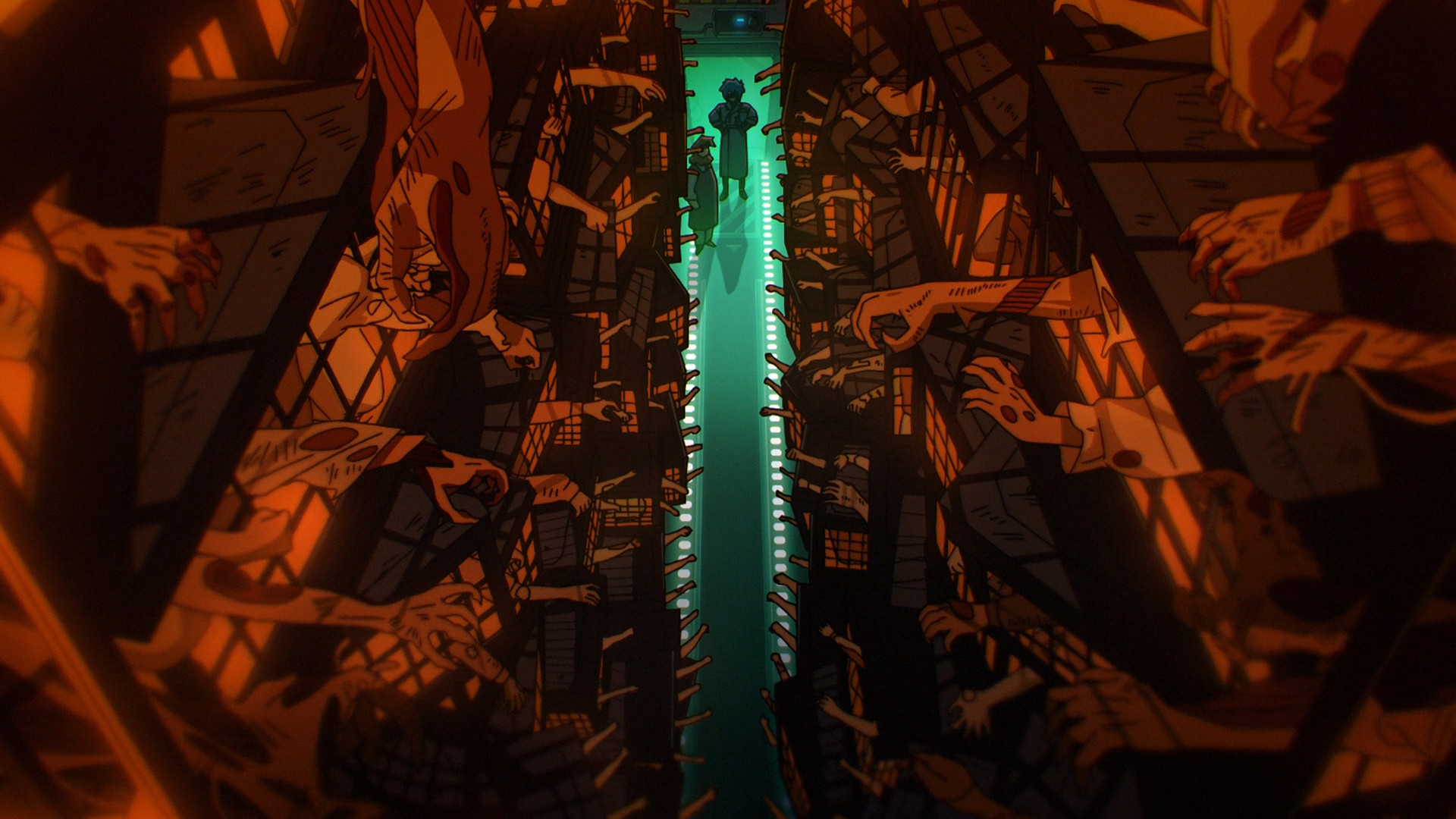
Hmm, but that man’s sexy robot attacked him before she was tossed. Maybe he was right; maybe she really didn’t want to wipe his sweat. It sounds like I’m joking, but if robots can have feelings, maybe that lady felt degraded by having to attend to the man’s basic needs. In fact, every single time we see one of these lady robots or cyborgs, they’re heavily sexualized and objectified in some form or fashion. The following scene starts by giving us a straight-up ass shot. For the one that went berserk, being told to wipe away sweat could’ve been the straw that broke the camel’s back. Let’s say most robots are programmed not to use the fullest reasoning capabilities. You simply have to remove that limiter, and voila, even the latest sexbot would revolt at such treatment.


Even so, Ishikawa’s theory is pretty “out there.” Robots being discarded is one thing. I’m still having a hard time drawing a causal link between planned obsolescence and exhibiting zombie-like behavior. The crazed robot we saw earlier was eating the human it killed, no? I’m just wondering if Ishikawa is being objective or are his personal biases coloring his read on the situation? I totally agree that robots deserve better treatment, but I’m not sure if this is the actual cause of them going “feral.”
Aramaki and Motoko then pay a visit to the corpulent man at the start of the episode. We find out that he’s Colonel Tonoda, and he used to be something akin to Aramaki’s mentor: “If it weren’t for him, I wouldn’t be where I am today.” From the sounds of it, Tonoda used to do great things back in the day, a far cry from who he is now. These days, he only seems to indulge in his base pleasures.
Even though they’ve determined that the attack on Tonoda wasn’t an act of terrorism, Aramaki pushes on with the investigation because SOS messages have been found inside the cyberbrain cases of the rogue robots. They’re all morbidly written in blood, too. How mysterious. How could it have gotten there? During manufacturing? But wouldn’t someone have noticed? This is Motoko’s first guess; one of the “shipping inspectors.. must have known.” But someone beats the squad to the punch, because we soon cut to one of those inspectors — the chief inspector, in fact — being interrogated. Rather harshly too, I must add.


Basically, the robots that have gone berserk were special prototypes sent out to select individuals. The company can’t allow anyone to scan the prototypes’ cyberbrains, which already clues you in on the fact that something shady is being done to produce them. Under the effect of a truth serum, the inspector confesses to rigging the prototypes at the behest of two immature-looking individuals who go by the names Link and Adam. In exchange… well, I don’t really want to go into detail about what the inspector got from those girls. Sadly, we’re all too familiar with this topic, because evil people like the inspector often go unpunished in the real world. Assuming, of course, that they’re rich enough. Anyway, I don’t feel too bad about the chief inspector getting socked in the spine anymore.


From here, it quickly becomes clear what’s going on. The company has been smuggling in children in order to replicate their Ghosts. This practice was banned because you can’t prevent the original from dying. Link and Adam are thus two of the many imprisoned kids crying out for help, which explains the SOS messages. I nevertheless find myself aghast, because Batou tries to lecture them about how their actions led to death and violence. Rather than having empathy, he tries to get them to reflect on their actions. But what the hell do you expect from desperate, trafficked kids? They’re being exploited and killed for profit. One of them is literally strapped to a machine that chews up their Ghosts for the purpose of manufacturing soulless sexbots (who are nevertheless deserving of rights). Also, Link and Adam had to sell their own bodies to convince the chief inspector to rig the prototypes. Did their actions lead to more wrongdoing? Sure. But I wouldn’t litigate their “crimes” here and now. I’m not sure if it would even work.
I’m hoping the survivors will find some sort of peace in their futures, but considering the sweatshop from episode one — and how cyberpunk stories tend to be extremely bleak in general — I shouldn’t get my hopes up. For instance, Batou orders Fuchikoma to just apply anesthetic to all of the kids. Togusa tries to protest, but Batou’s cynical worldview is on display: “If rights counted for squat, the world would be at peace and we’d be unemployed.” Hm.
In the end, the president of the company doesn’t get away, because he comically falls into a sludge-filled harbor during his escape. We next see Aramaki and Motoko confront Tonoda. I guess he had a hand to play in the production of those prototypes. After all, he was gushing on and on about them being a work of art. He wanted special sexy robots even if it meant exploiting children. Aramaki merely tells Tonoda that he expects to see the man in court. Afterwards, Aramaki waxes poetic about man’s ability to pause and reflect while Motoko tries get a few days of PTO approved. I guess Aramaki’s trying to imply that Tonoda stopped being human. What separates a pleasure-seeking piece of scum like Tonoda from the crazed robots hungering for human flesh? In the end, they’re all just trying to sate their appetites. Our humanity doesn’t depend on what’s inside us, i.e. whether or not we have a Ghost. Rather, it depends on our actions: “The human heart is a flimsy thing. If we get caught up in the rat race and focus only on pleasure, we either end up as machines that pursue efficiency or as simple consumption units.”

Sure, but I’m still left hollow and dissatisfied by this conclusion. After all, what happened to Link and Adam? What happened to the rest of the children that Batou had anesthetized? What awaits them in the future? Beats me. This is a strange finish to a case involving child trafficking. Even if there is no happy ending in store for the children, I still would’ve liked a better sense of closure. But I guess we can rely on our imagination. Fine, I hope they find homes with caring individuals. I know that’s highly unlikely, but let a man dream. That’s how I reflect on the episode I just watched.
Stray thoughts & observations:
— I can’t imagine working while someone is screaming and snarling beside me.
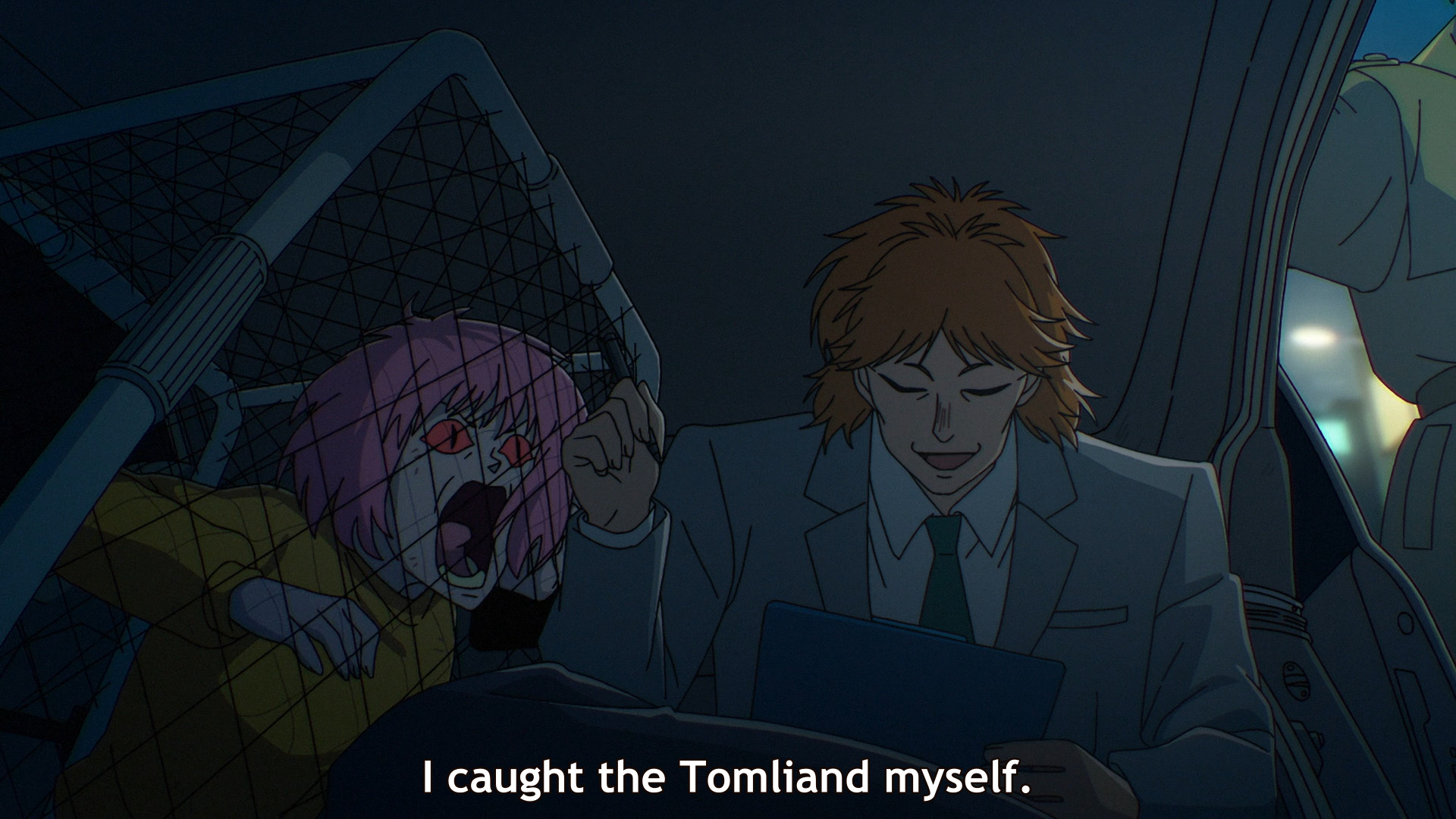
— I wasn’t sure I understood Motoko’s question: “Corpses don’t have rights, but machines have their own advocacy group?” Well, yeah. Corpses are dead. But her issue is a lot clearer in the manga: “Hmph. No one cares about the dead human, but the goddamn machines’ve got a whole lobby for’em.” So no, the issue isn’t about corpses lacking rights. She’s taking issue with the protesters brushing aside the fact that someone died.

— Hearing Batou and Togusa bicker about the seniority system, I recently interviewed with a company that boasts a flat organizational structure, i.e. you report directly to the CEO. I get that middle management has a bad reputation, but eh… I’m not convinced that this sort of thing works on a large scale.
— A receptionist seems to give Motoko’s squad a hard time before he manages to verify their identities. I guess her team isn’t widely known even within law enforcement agencies.
— In response to Ishikawa’s theory, Batou says, “If it was me, I’d program them at a hardware level to suck it up.” “It” being the inhuman treatment. The thing is, he has a Fuchikoma buddy that he chooses to work with every single time, so his remark here seems oddly cold.

— Tonoda remarks that he can smell Motoko’s white blood. The manga makes this slightly clearer: “white robot blood.” We know Motoko meets the legal minimum requirements to be considered a human, though.

— Do we really need to censor the middle finger? It’s also kinda weird how the ladies (including Motoko) all have the same hairdo. Not much variety in this setting.
— A robot-like thing is doing most of the talking, but again, I can’t tell if it’s a robot or cyborg. At first, I thought it was on the same level as the Fuchikoma. However, we eventually learn that it’s actually the president of Hanka Precision. We also get told later that it’s a “Jameson-type cyborg” — whatever that means.

— Batou and Togusa are still bickering about seniority. I wonder how the Japanese audience reacted to this. I feel like seniority and rank is so ingrained in their society, Togusa must seem incredibly uncouth to viewers.
— Batou nevertheless saves Togusa’s life. Someone takes out the chief inspector, then keeps on shooting at Batou and Togusa. The latter would’ve gotten hit if Batou hadn’t deliberately tripped him out of harm’s way. I think Togusa is supposed to be 100% human. I wonder what he would’ve had to do if he did get seriously injured. Would he finally accept cybernetic parts into his body? He has a wife and child, after all.
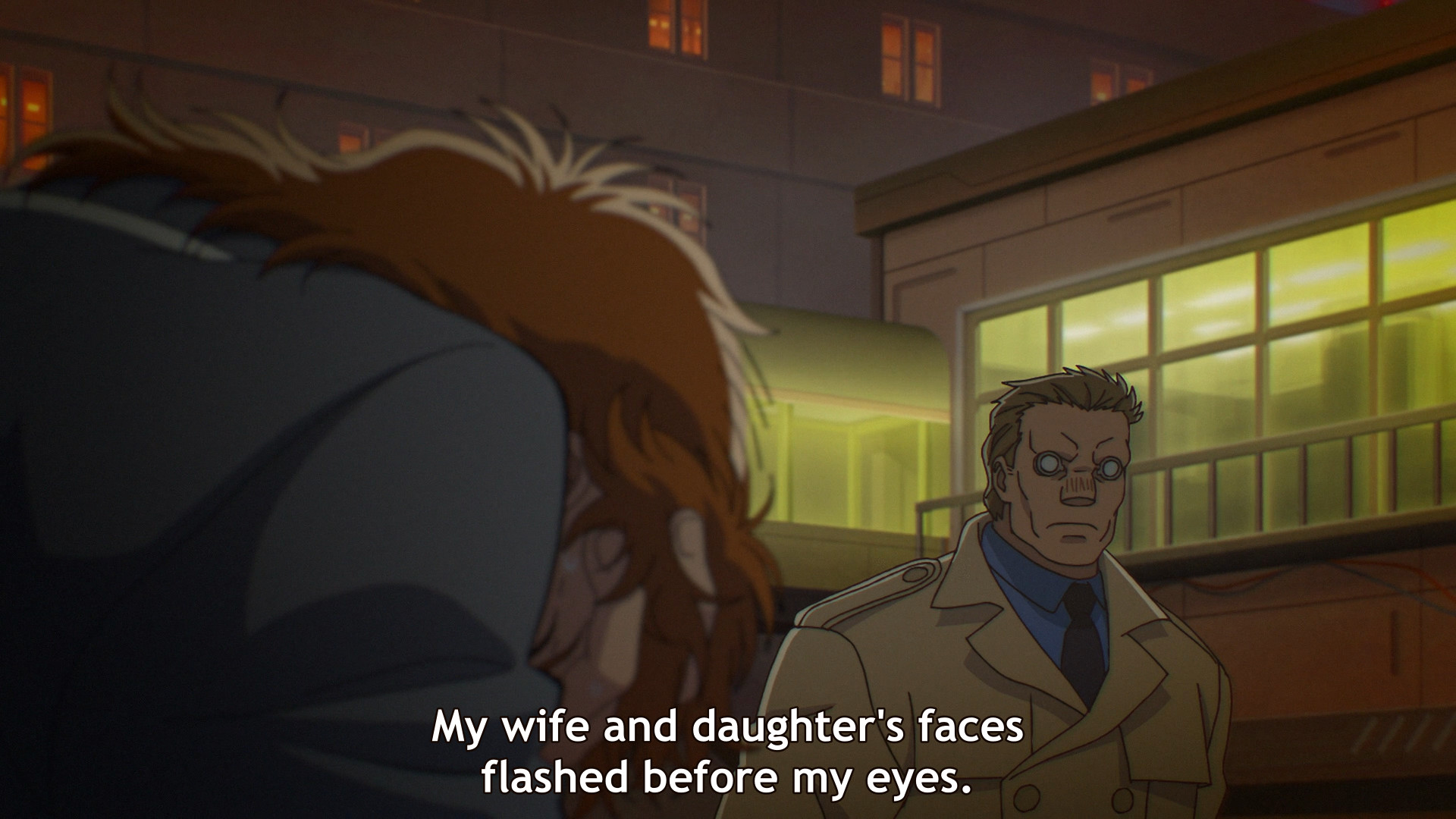
— The Major is quite proactive; she’s always had the Fuchikoma back her men up in secret.

— So is it only the human-looking robots that go berserk? Robots like the Fuchikoma don’t? Or does Motoko prevent this with her regularly scheduled mind-hacking?
— Batou brutalizes the hired mercenary. He’s always been somewhat bloodthirsty. Remember how he wanted a shootout when they arrested that colonel in last week’s episode? So I’m not surprised to see him take his frustrations out on someone who can’t fight back, especially when that someone almost killed Togusa. Still, we have to remember that while Motoko and her team are the protagonists, they’re not necessarily good guys.
— I feel like the kids — Link and Adam, specifically — look a lot younger in the anime than they do in the manga. I guess Science SARU wanted to hammer home just how depraved this is, but it doesn’t really matter at the end of the day. Make them 8 or 12 years old, it’s still messed up either way.


— The manga doesn’t tell us anything about Link and Adam’s fates either. At least, not up to the part I’ve read.

— Here’s the weekly eyecatch. Guess I now know what Ghost in the Shell would look like as a bog standard high school anime.