
There’s a pivotal moment in this week’s episode, and it takes place within a courtroom. When asked by the prosecutor why she had executed the suspect, Motoko delivers a speech that surprises even her own boss:
“Because death is the only reality, and I am a realist at heart. More than any individual life, it is the software that is life, its potential, that has meaning. The thing that has value. Was he really him? Was he even a person? There’s no way of knowing. But it’s clear that he snapped out of the nightmare of his programming. If his program was to be human sewage, that makes me a sewage treatment unit that’s covered in the stuff. His real killers are the programmers who made him. What I did, albeit inadvertently, was save him.”
Yes, her victim was a kid, but he was also a terrorist. Her argument is that his “programming” was “sewage” from the start. The Major isn’t claiming self-defense. Rather, she did her job in eliminating the malignant code altogether. Are you convinced? I don’t think that matters. As the audience, we are not really here to determine whether or not to take the Major to task. After all, this is cyberpunk, so there is no justice. This whole situation was a setup from the beginning; schemers wanted to make Section 9 look bad and also impede the team’s future operations. They just didn’t expect their “asset” to get killed. Even if you do convict Motoko and throw her in jail, it would just leave her defenseless. Their enemies would then use this golden opportunity to take her out once and for all. This is why Aramaki refuses to “throw her to the wolves.”
Aramaki is that classic hardboiled character who is supposed to be incorruptible; he’s the one guy in the whole shebang who can’t be bought. Motoko and her team are rather amoral; they’re good at their jobs, but they don’t really seem to care about the outcomes of their missions all that much. It’s really up to Aramaki to point them in the right direction and the right targets. As a result, it might seem a bit strange for him to overlook the Major’s extrajudicial execution of a minor — again, he was a terrorist, but still a minor nonetheless. But that’s because even the most morally stalwart among us have no choice but to become realists when they inhabit a cyberpunk setting. Justice is great when it works. In an ideal society, you can keep arresting the bad guys until there’s none left. Then you give yourself a pat on the back and go home to your family. But Aramaki knows he isn’t in an ideal world. If he gives her up, they’re just going to assassinate her anyway, so what’s the point? Better to keep her around because “[her] talents are even rarer than a psychic.”

But can Section 9 keep her around? Oh, we see Motoko on the run. We see her take a hostage, ask for a getaway helicopter, and take advantage of the media circus to prevent snipers from taking her out right there and then. In fact, judging by the way Batou responded immediately and eagerly when she and Aramaki first put this plan in motion, the entire team was in on this from the start. But it’s cyberpunk, so you can’t expect a happy, “the team eventually gets back together” ending.

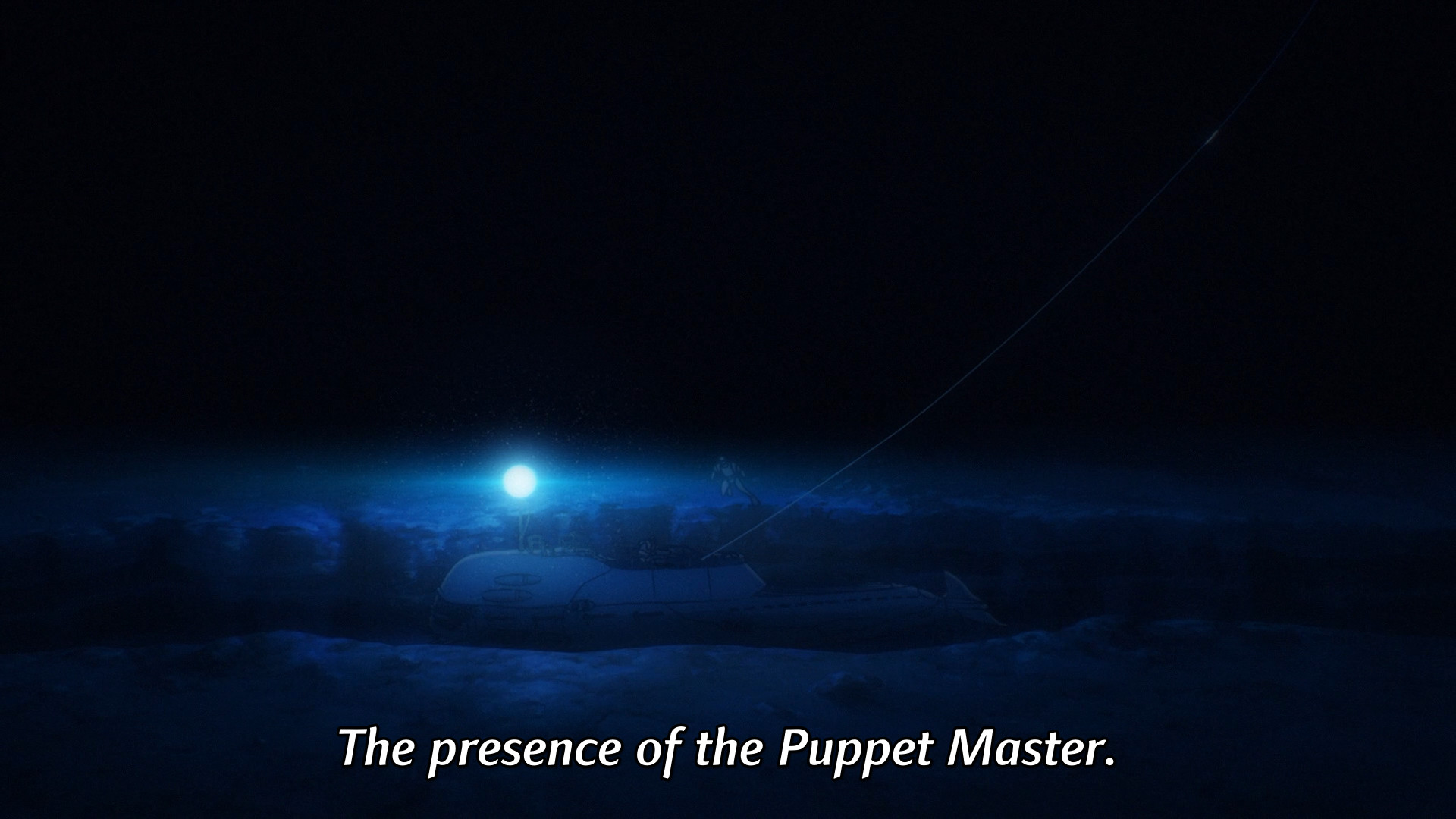
During Motoko’s existential speech, we get a close-up of her face. The Major’s eyes are empty. She has a vacant stare as her words completely disarm everyone in the courtroom. So is this really Motoko doing the talking? Or is it someone or something else altogether? I don’t think the Motoko we met at the start of the series would’ve pulled the trigger; she would’ve been able to take the kid in for questioning. But lately, Motoko has been distracted. Not only does she feel an unsettling sense of ennui — an emptiness that has only grown ever since her encounter with the Puppet Master — she keeps sensing their lingering presence. So maybe it is coming from within. In trying to save the Puppet Master, she tried to house its Ghost within herself. It still “died” only to transcend to the “sea of electrons,” but perhaps there are lingering traces of the Puppet Master imprinted onto her Ghost.
But it might be simpler to simply say that Motoko’s mask has finally fallen off. For people who only know Motoko from Mamoru Oshii’s landmark adaptation, it must have been jarring to see the silly, goofy Motoko at the start of this series. But the Motoko that we see now is a far cry from that woman. She’s dropping cynical lines left and right: “A lifestyle that prioritizes consumerism is the real act of violence against impoverished countries.” Maybe this is who she’s always been. Maybe she has always felt the emptiness of her existence. I’m rehashing my words from last week a bit, but I think it’s necessary to get the full picture. Motoko tried to fill the void with money (always angling for a bigger payout from Aramaki), sexual pleasure (like that one quasi-orgy scene), a traditional (and almost seemingly comhet) relationship with the captain from Section 1, et cetera, but Motoko was still left unfulfilled. Then the Puppet Master came along and gave her a glimpse of a new existence — a potentially higher existence.

Now, Motoko’s camaraderie with Section 9 isn’t worthless; obviously, there’s a certain level of kinship there. When Aramaki takes his leave during a recess in the court case, there’s a melancholy air to the scene. It’s as if a father knows he probably won’t see his daughter again. Even so, her closest companion Batou couldn’t understand her or her emptiness when she opened up a little to him. She tried to talk about how astounding it was that an AI could gain sentience from just information alone. But Batou dismissed this entirely. And now, the public is calling for her head, and politicians are all too happy to take advantage of this situation. When you testify in court, they make you swear an oath to tell the truth before they start bombarding you with questions. I like to think Motoko seized that opportunity to ditch her mask entirely. She no longer has to play the silly, goofy girl in order to deal with the harsh reality of both her job and the world around her. After all, her mission was a Sisyphean task. Root out one corrupt official, then another one replaces them. As always in cyberpunk, the fundamental problem with society cannot be solved. At that moment, in front of the judge and the prosecutor, Motoko knew that she would soon be on the run. So it’s time to tell the truth and become who she has always been: a deeply cynical realist of a woman who knows she has one final decision to make. After all, what’s the alternative? Escape, get a new face, and live out this empty existence? No, I think Motoko was preparing to “die” from the start.
Stray thoughts & observations:
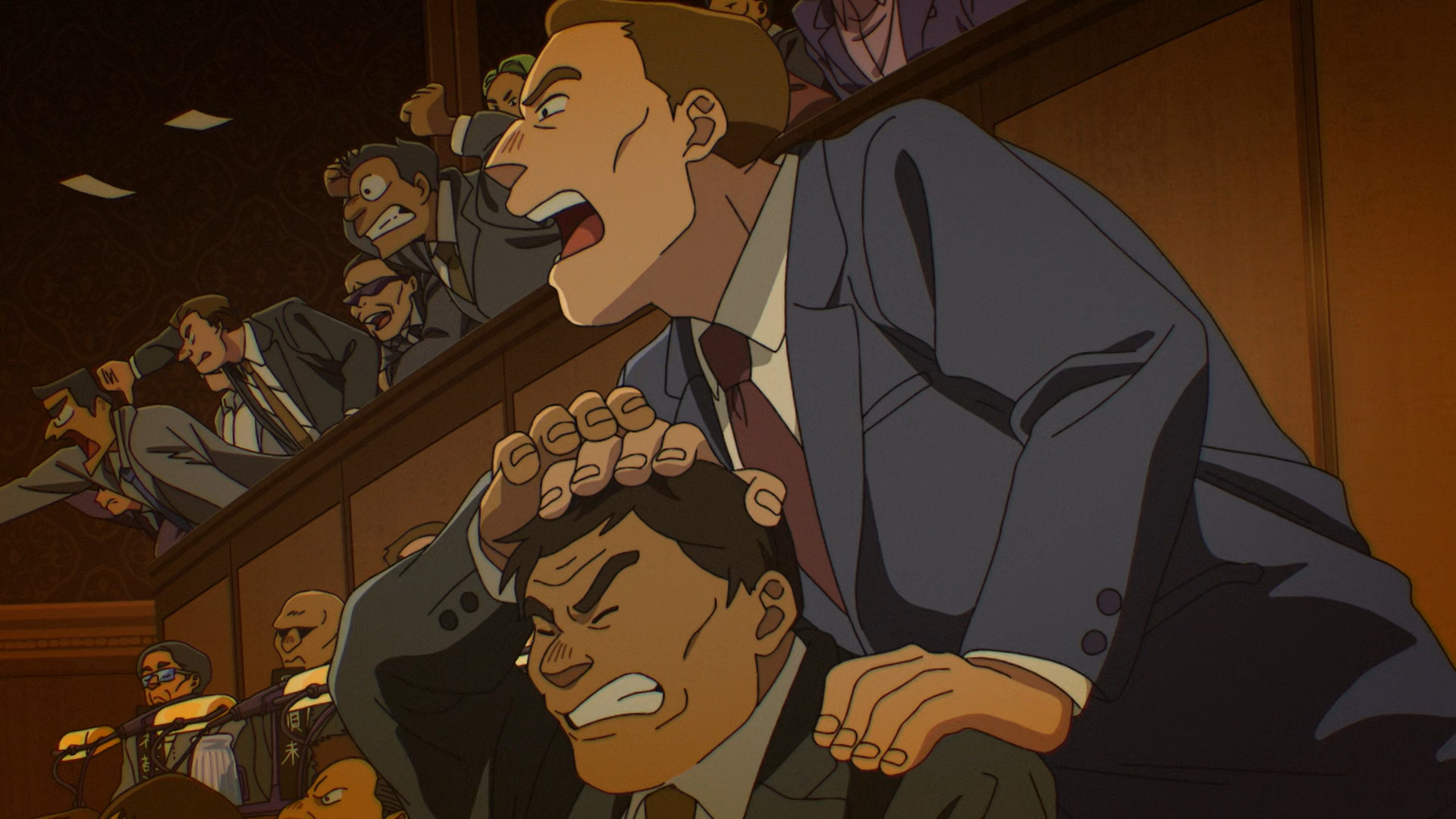
— You can see a few women hidden in this crowd, but the government is still predominantly comprised of men. I guess the future isn’t very progressive either.
— What is the emptiness that Motoko feels? I have a hunch, but I think I’ll leave it for the final episode.
— The eyecatch this week comes from Kazuchika Kise, who was the director for Ghost in the Shell: Arise. I haven’t seen it, though. I hear it’s decent, but Motoko’s new look in that series is a bit of a turn-off. Not in the sense that I don’t find her attractive, but she just doesn’t look right to me.
