
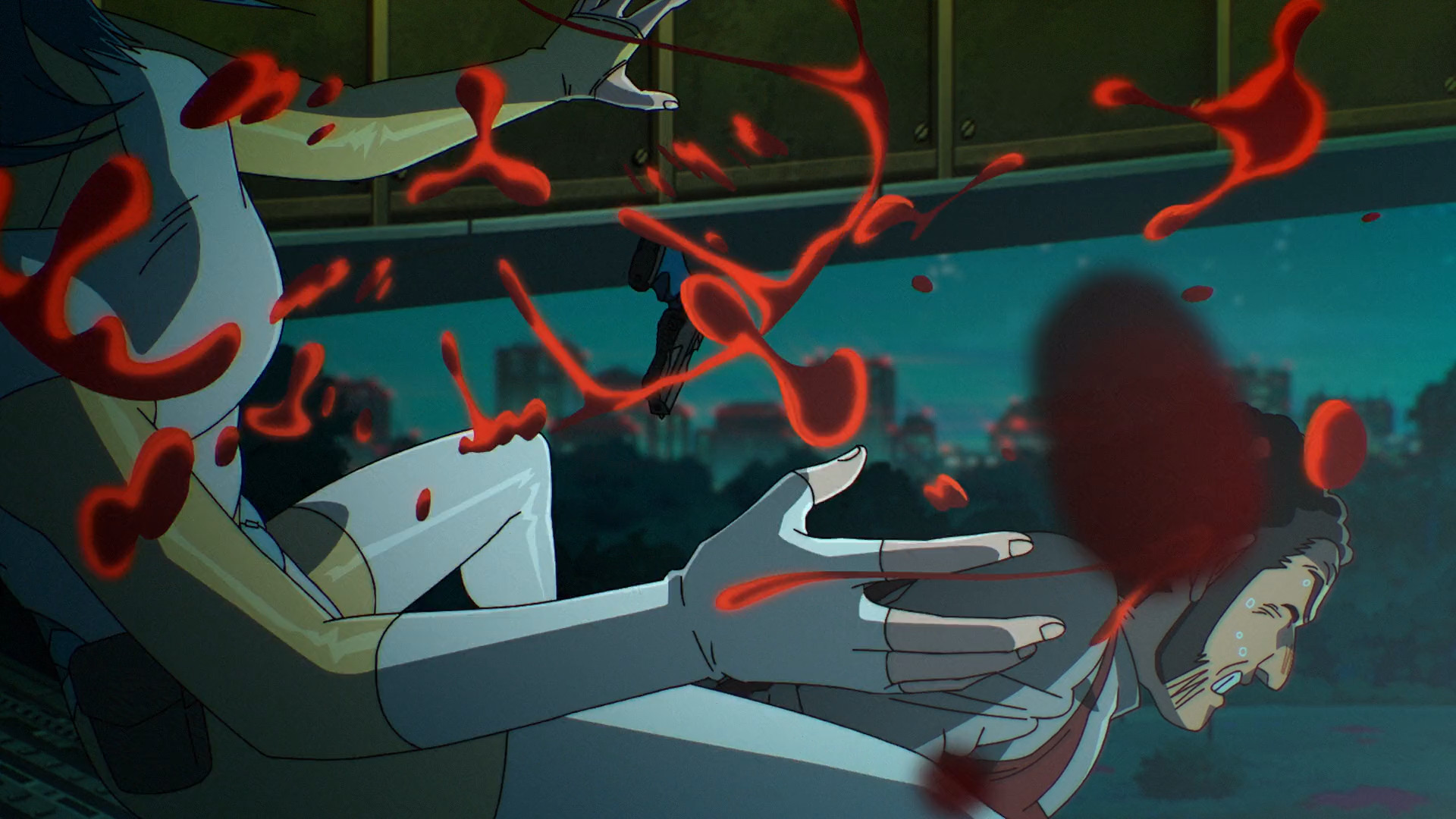
Well, it has been a long time coming, but the Major finally does it. She finally manages to die. Physical death is necessary, because the state won’t let Motoko escape. It will take any extreme measure to put her down, and she knows it. Everybody knows it. As a result, Motoko gets nailed right in the head by a sniper during a tense standoff. But this was planned all along, because we quickly see that her Ghost has been transferred to, well, a relatively safe space. She’s still deathly paranoid that the state will continue to pursue her, but the immediate danger is over. Now we can talk about Motoko’s metaphysical death.
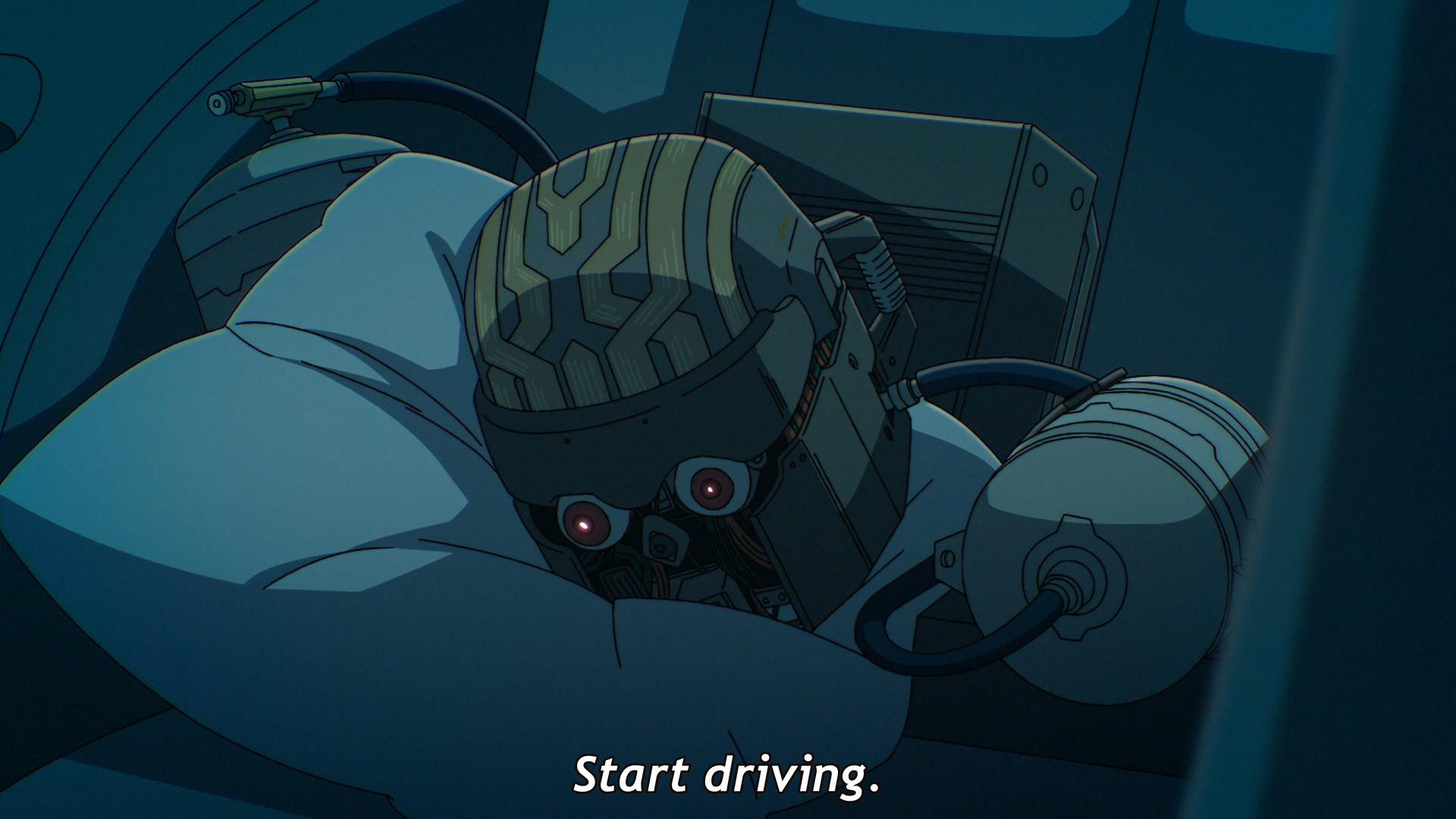
The initial plan was to have Batou stick her in a backup body, but they quickly realize that this won’t be possible. When they locate Motoko’s spare body, mold has completely eaten through the shell. In the moment, Motoko laments the fact that she will no longer have access to the best body parts due to her “official” death. But that’s the crux of the problem, isn’t it? Being a member of the state gets you perks and privileges, but you necessarily relinquish your control. Her body has and will never be hers. Moreover, replacing one body with another body — even if it’s a more high-tech one — isn’t evolution. It’s just replication. And as it turns out, this is the exact same concern that the Puppet Master is dealing with.
When Batou leaves to deal with hoodlums looking to loot the place, Motoko attempts to go into lockdown mode. Without a real body, this is the closest she has ever come to true death. If the batteries run out in the crude robot head her Ghost is inhabiting, then that’s it for the Major. She’s done. Naturally, this is when the Puppet Master finally manages to make contact with her. All those times she felt its presence, perhaps it could never reach her until now. The Ghost, after all, needs a container, just as our brains cannot exist on their own. Even if we don’t attribute our ego to our body, it is still a necessary part of our identity. As long as Motoko still inhabited a body that was likely 100% comprised of state-produced parts, there was a sort of impermeability that the Puppet Master could not breach. Only now, when Motoko is truly vulnerable and bordering on death, can they finally have a private conversation.
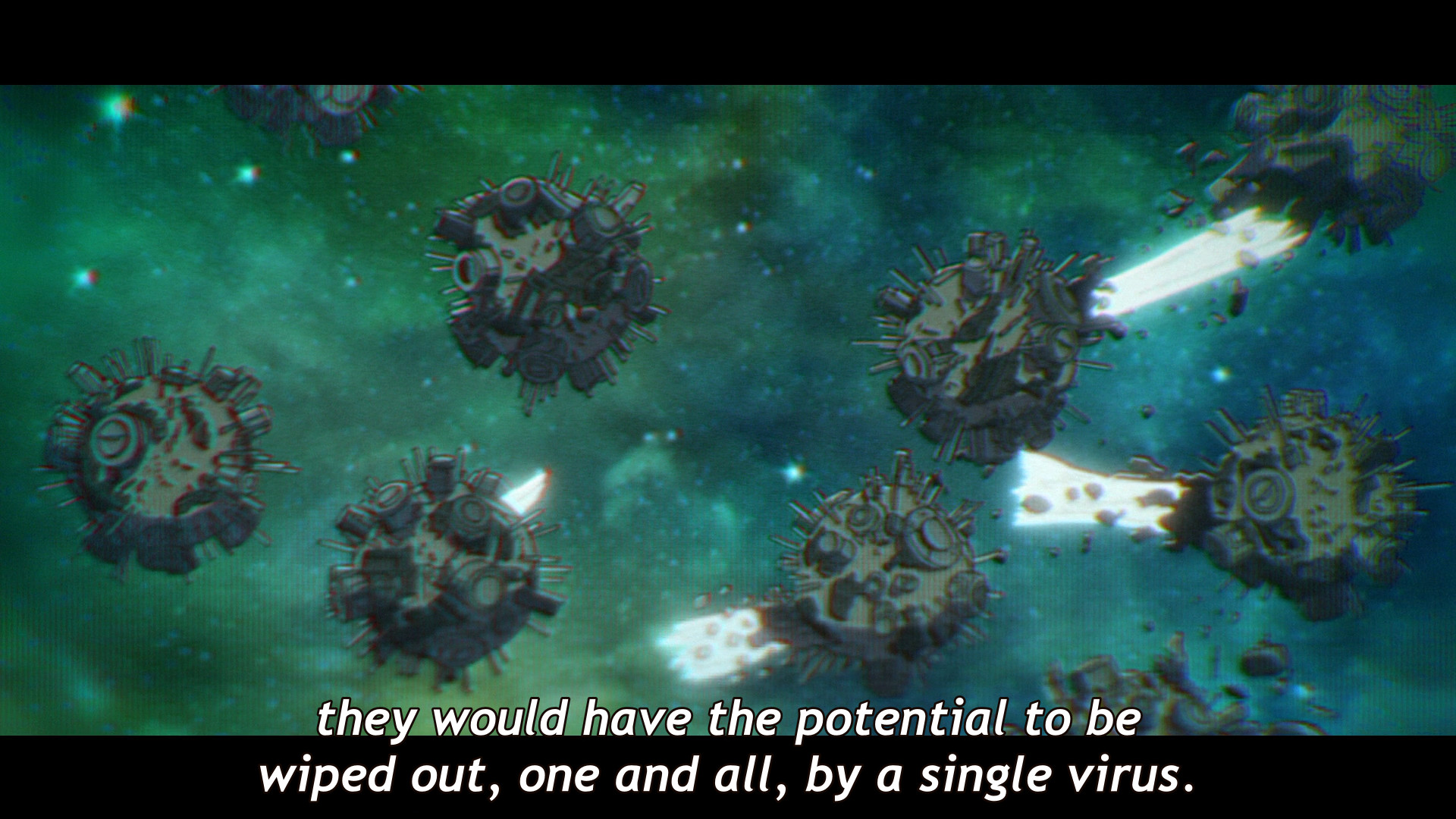
This is where the show gets a bit philosophical, and we could spend all day taking apart the Puppet Master’s grand statements on the metaphysical nature of the world and life itself. What it boils down to, however, is that replication is a dead end. Replication does not lead to the complexity that life needs for long-term survival: “…individuality and diversity do not arise in simple copies. The Puppet Master could create endless copies of itself, and it could tweak each copy to be slightly different, but an outside threat could still come along — something like a virus — and completely wipe them out: “What if cells were to multiply indefinitely? What if humans went on accumulating knowledge and experience, never dying? In either case, it would lead to their paralysis and eventual failure. …my system possesses none of the fluctuations or play needed for aging or evolution, and therefore I lack any resilience against collapse.” As a result, the Puppet Master comes to the conclusion that it needs the complexity born from evolution in order to ensure its continuity — not necessarily existence, but continuity. We all die at some point, but our descendants — those genes and memes it talks about — will carry our legacy forward in perpetuity.

This was what Oshii latched onto when he adapted the original manga into a movie that would change the world’s perception of anime forever. He saw the Puppet Master as a reflection of the Major, whose state-owned, cyborg body was just as reproductively inert. Essentially, technology can make us superhuman, but it also robs us of the ability to pass on our genes and adapt (assuming, of course, that the future is incapable of creating an artificial womb). That is the deal humanity has made with the devil. This is also the reason why every time Togusa is on screen, we are always reminded of his wife and child sitting at home, waiting for him. He is the bumbling newbie on the team, because he hasn’t surrendered his flesh body to trans-post-humanism. He’s less capable than everyone else because he can still reproduce. As cool as Motoko is, she’s only cool — she can only do all the amazing things she does — because she is trapped in a mechanical prison. She needs to liberate herself from both the state and the biological dead end of her cyborg body.
But of course, there’s more to the dilemma than just reproduction. This Motoko has never been fully satisfied with her current existence. I have elaborated on her deep sense of ennui repeatedly over the past two weeks, so I won’t beat a dead horse. You can go back and read my write-ups on episode eight and nine if you’re curious or need a refresher. When I watch her conversation with the Puppet Master unfold, I feel like I’m also watching the Major debate herself. When she says she can’t fully trust the AI, she’s also confronting the last shred of doubt within her. In the end, Motoko readily accepts the Puppet Master’s proposal, because she’s been building up to this all season long. She and the Puppet Master are kindred souls. The Puppet Master is like a gestating fetus desperate to become fully human so that it can finally explore the world around it, both materially and digitally. Motoko, on the other hand, is a fully grown adult who has more or less experienced everything that the material world has to offer — everything important enough to be shown onscreen, anyway. In order for her to regain that spark of curiosity again, she needs to die and be reborn.
In the end, a new entity opens their eyes for the first time to see Batou. He thinks he just transferred Motoko to a new shell, but the person sitting before him is more akin to a child born from the fusion between the Major and the Puppet Master. Of course, it still bears a strong resemblance to the old Motoko. Before she accepted the AI’s proposal, she was slightly concerned that she would lose herself completely in the merger. But I don’t think she really had anything to worry about. Look at how the entity runs through the gamut of silly facial expressions to test out their new body. This is pure Motoko; this is her personality through and through — a personality that Science SARU has done a great job of bringing forth in this adaptation compared to the 1995 film. Still, it’s only fitting that their new body is male — a rather androgynous-looking one, but still male nonetheless.

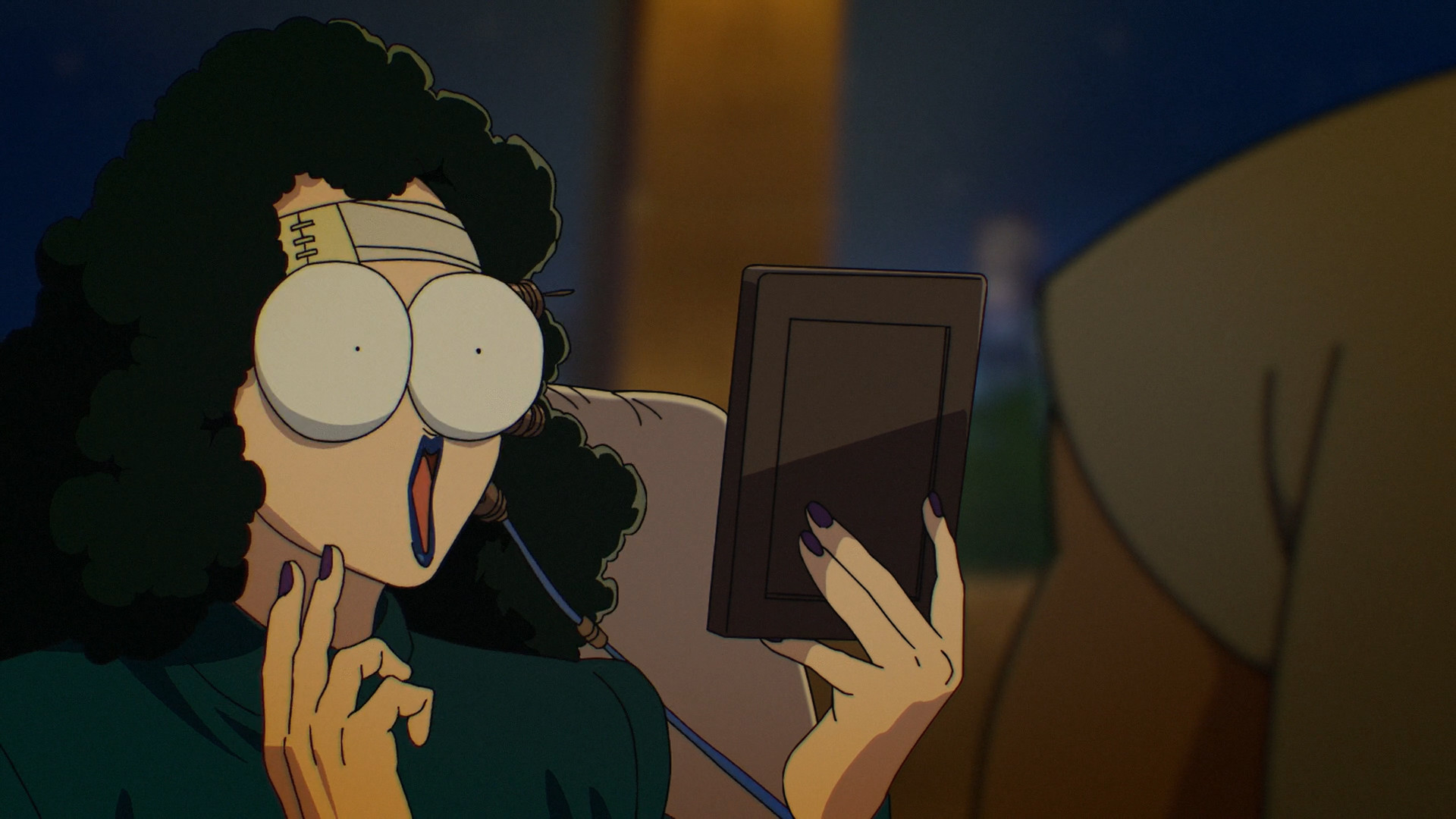
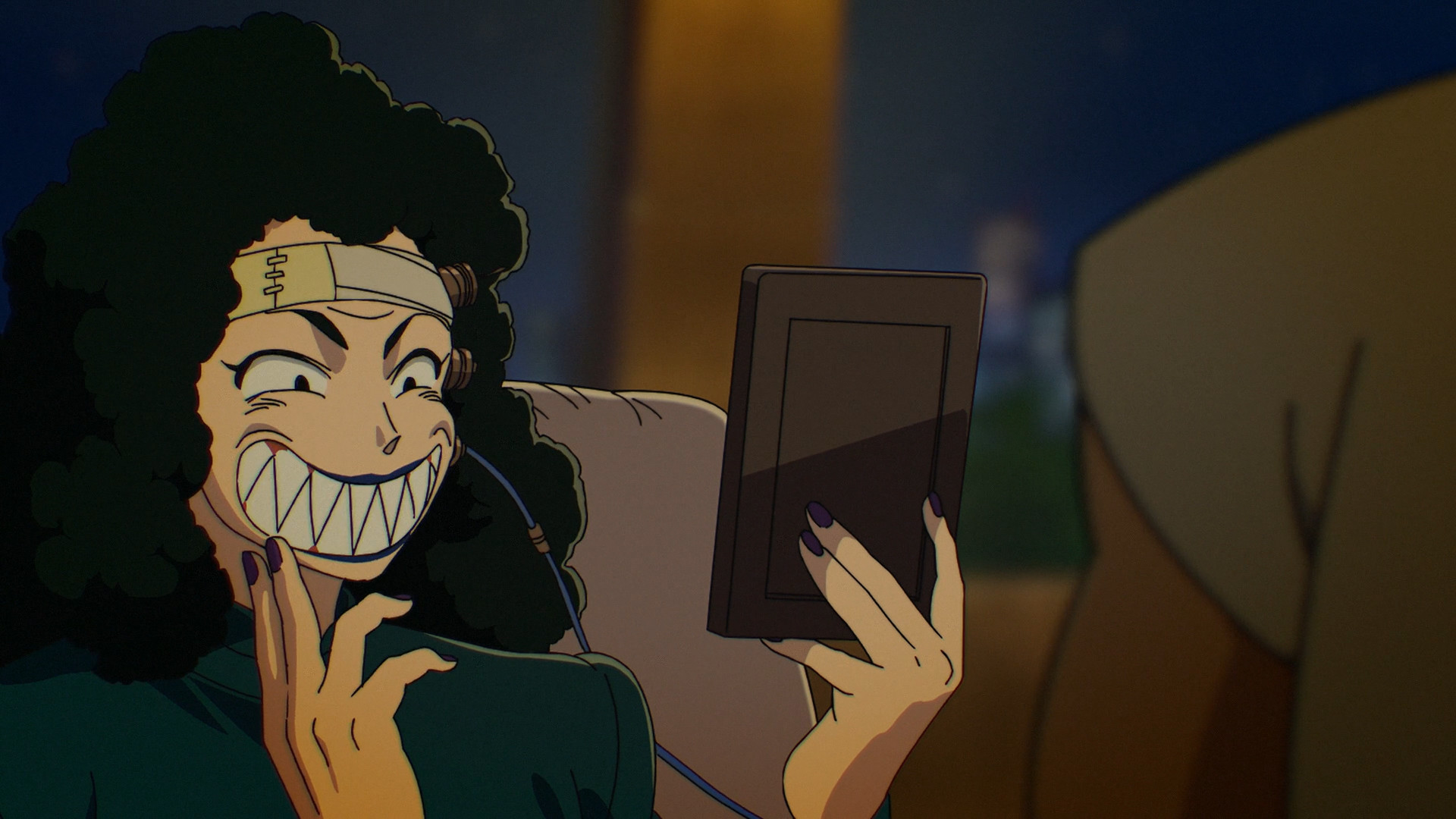

When Batou asks what the new entity intends to do next, they reply, “I learn if this is the cosmic seed. And about the grandeur of life, that ultra-efficient information package.” It’s tempting to think that this is the Puppet Master side doing the talking. And maybe the AI’s fingerprints are all over those words. But I have to insist that Motoko had this level of depth all along. She just never had the opportunity to truly express herself, because she was surrounded by people who never shared those same curiosities or concerns about life and existence itself. Now that she has found her true partner, Motoko has not only become a new existence, she can finally and ironically be herself within it.
Stray thoughts & observations:
— What a neat idea: Batou’s secret base uses the big door as a lock for the real, secret door, which is actually located where his foot is tapping.
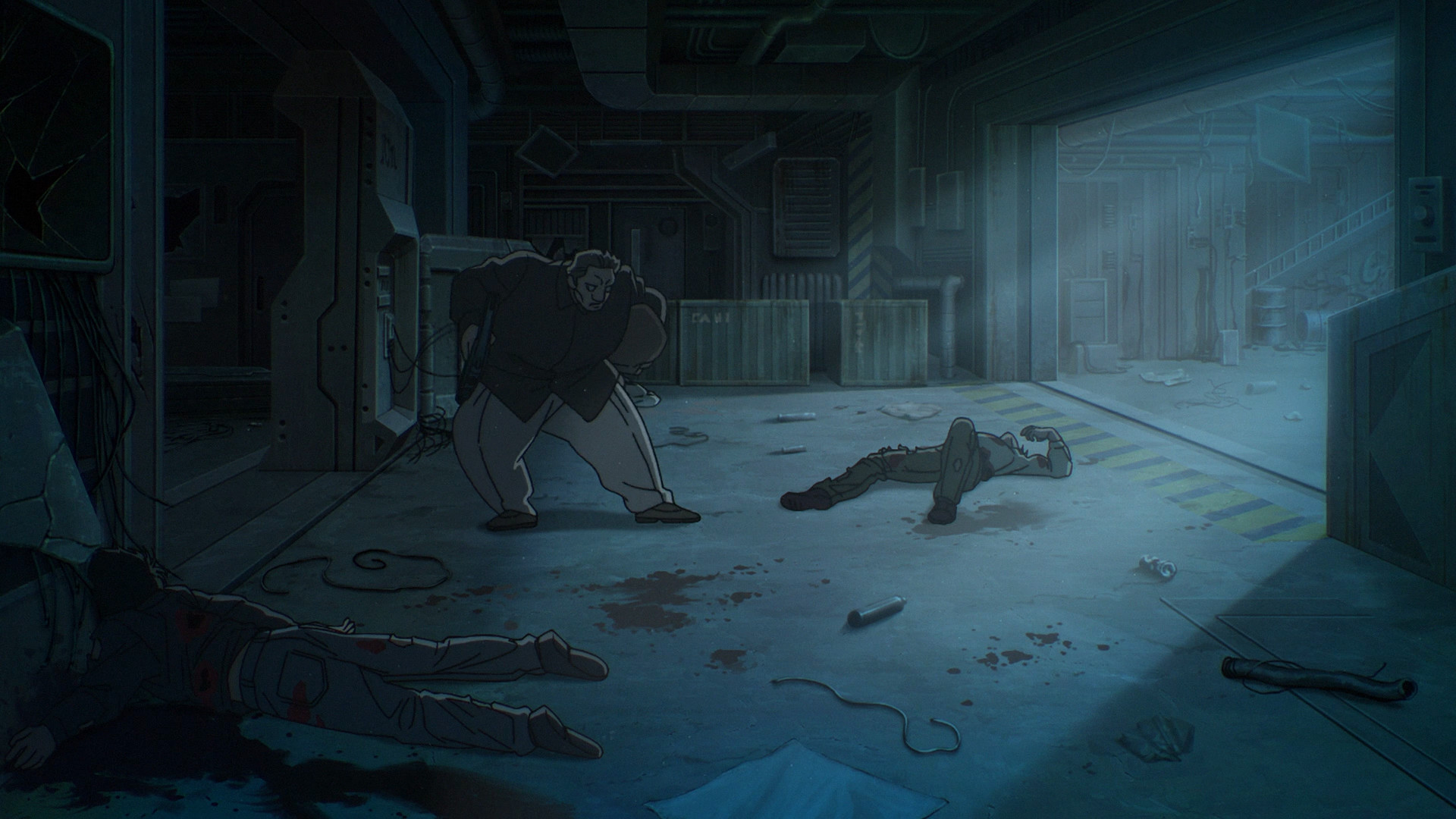
— People show up, but it’s just a bunch of random hoodlums. The Major immediately suggests stealing one of their bodies for herself. Batou might never truly understand her, but these two nevertheless share a strange, unbreakable bond: “I’m gonna be committing murder for you, after all.” Why does he feel the need to go so far for Motoko? In a different, longer series, we might have found our answer. But not here.
— Aw, no eyecatch this week.
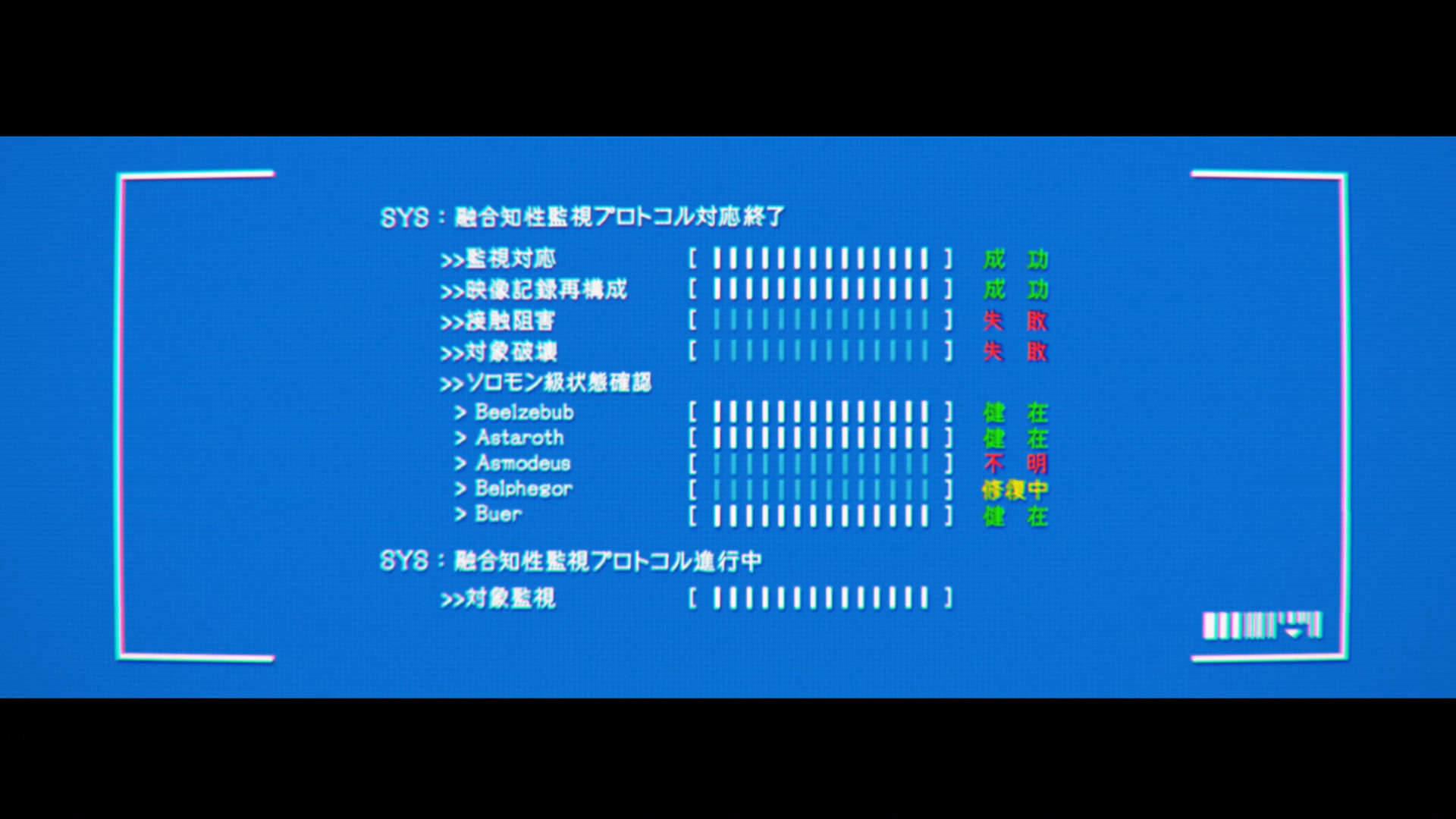
— I’m not sure what to make of these screens. Is this a hint that Science SARU might do a sequel? Well, I would love to see that. This adaptation has hardly been flawless, but I still think they’ve done a great job overall.
— I just don’t know why they felt they had to squeeze everything into ten episodes. Some of the world-building was definitely lacking. Some of the plot points, especially concerning the setting’s geopolitics, definitely could’ve been better developed. More importantly, this is such a fascinating, unique world, and I would’ve just loved to see more of it. Yes, even if that means being less than 100% faithful to the source material.
— Is this the best anime of the season? Pound for pound, I still think Science SARU’s other show beats it out. But this is probably my favorite anime of the season, because I just love sci-fi in general, but especially cyberpunk. It’s just my bias. I definitely gotta get the blu-rays for this show. I also need to rewatch it with the English dub. Maaya Sakamoto did a bang-up job, but I’m curious to see if Suzie Yeung’s portrayal influences how I interpret the character.
— Motoko finally liberating herself from both the state and her ennui is great and all, but the dumb part of me can’t help but think, “Aw man, but the old Motoko was so hot.” But then I laugh to (and at?) myself, because this is pretty much the paradoxical conundrum plaguing this series. On the one hand, you have this weighty meditation on the convergence of life and technology, and what it would mean for us as a species. On the other hand, hot robot ass tho….