
“I thought a god would be a little more impressive.”
Most of us are no doubt familiar with the following challenge:
1. Suffering exists.
2. If God is all powerful and all knowing, he isn’t all loving.
3. If God is all powerful and all loving, he isn’t all knowing.
4. If God is all knowing and all loving, he isn’t all powerful.
5. Therefore, God can’t be all powerful, all knowing and all loving at the same time.
Whether or not you find this argument convincing is irrelevant to this post. I brought it up to simply illustrate how debates on the nature of (a Christian) God usually go. We first assume that God is almighty, then we slowly retreat from this precipice until God can hardly be called a god anymore.
In Kamisama Dolls, the debate is markedly different. In fact, there is no debate; the anime’s characters (for now) accept the world as it is. For us viewers, however, the seed of doubt has been planted: “I thought a god would be a little more impressive.” We don’t start from the assumption that God is powerful. Instead, we start with the fact that God is empty — God is a shell, a vessel to be controlled and directed at whim. God has no sentience in Kamisama Dolls.

Instead, God’s actions are the realization of one’s will. In this episode, we observe Utao in training. She stands by an immense body of water and furrows her brow. She grits her teeth and focuses. As a result, her doll flies through the air at an amazing speed. It swoops and darts across the lake’s surface like a majestic bird. When her doll makes a mistake, Kuga quickly tells Utao to refocus and concentrate harder. Essentially, the doll’s will is her will.
For the moment, we know that two people can currently control dolls: Utao and Aki. Utao is a young child and Aki, we are told, is mentally unhinged. One can infer then that their minds are freer than ours in some respects. It has always been said that children act on impulse and are far more creative than adults. And although Aki is older than Utao, he, too, is free. Whereas Utao is unburdened by adulthood, Aki is unbound by the shackles of his village’s authority, i.e. morality.

We can contrast this with Kuga; we learn this week that he once had the ability to control a doll just like his sister. Unfortunately, tragedy struck one day and Kuga has since given up his power to control God. According to Kuga, an uncontrollable power should never be wielded, but deep down, it appears that he is most affected by guilt. Guilt implies responsibility — culpability; guilt implies that there is a moral code and Kuga had betrayed it. Instead of direct defiance against said moral code, Kuga opted to run away.
Nietzsche was oft-quoted as saying, “God is dead.” God wasn’t literally dead, but traditional morality, especially Christian morality, was soon becoming the thing of the past. Kuga, in a sense, is beholden to traditional morality. He’s afraid of his power — he’s afraid that it could hurt or kill someone. It was once said, however, that great men shouldn’t be bound by traditional morality or else he would never fulfill his destiny. Well, ask Raskolnikov how that turned out….
On the other hand, the same fears that limit Kuga are not limitations on either Utao or Aki. Utao might even share her brother’s worries, but she is definitely not motivated or hindered by any vague sense of right and wrong. This is most clearly demonstrated in this episode when the imminent deaths of two innocent people weren’t enough to get Utao to save them. She tried, but failed; what motivated her in the end was her brother’s love and approval. Again, she is controlled by her emotions, her desires and her impulses.
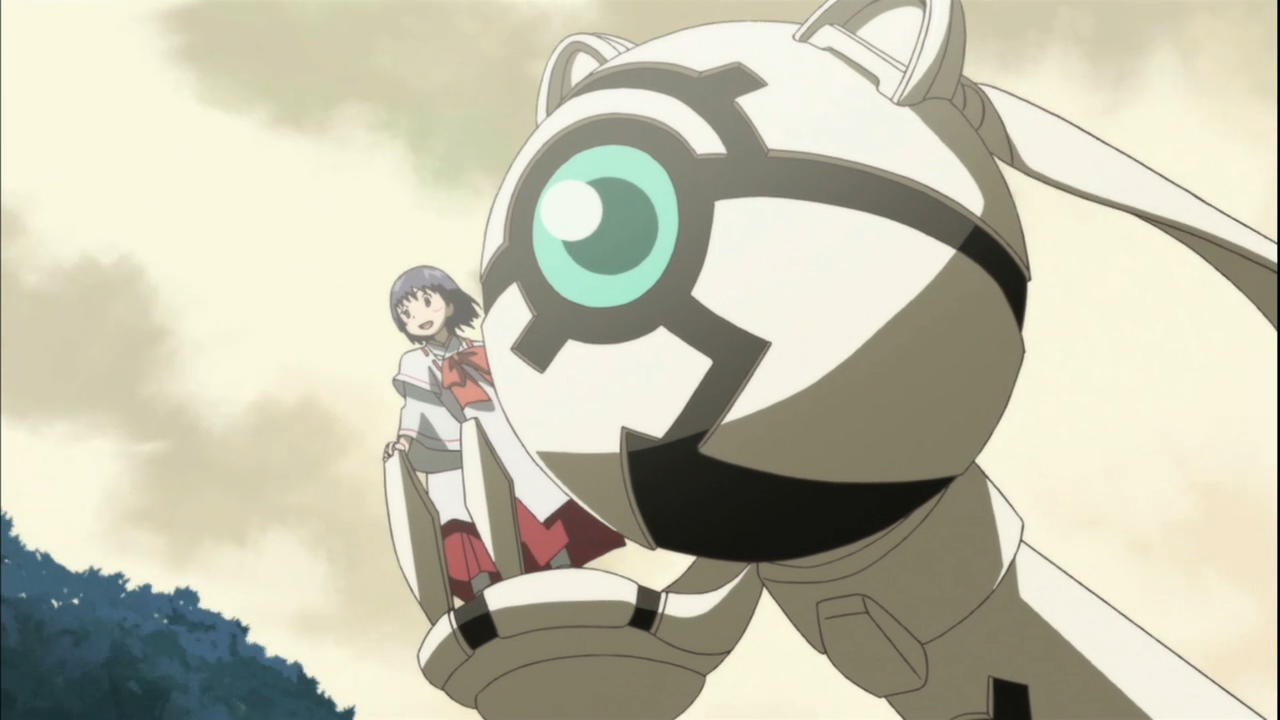
In exerting her will, Utao has managed to save three lives so far in the anime. In time, her mastery will allow her to do even more. Essentially, Utao will become God and all it takes is willpower.
As a quick aside, Hibino marvels at Utao’s doll after the rescue attempt proved successful; she finally believes that it is a god in spite of the fact that the doll was merely under Utao’s control. Later in the same episode, Kuga blames himself for being unable to control his power. So when good things happen, we praise the gods (the dolls), but when bad things happen, we blame ourselves. How peculiar yet so familiar all at the same time.
Stray Observations
• There’s about five minutes of worthwhile development in this episode compared to the last. All of a sudden, the anime took a more comic turn and you can usually tell when this happens. The soundtrack starts to play that generic hijinx-y song.
Aside from some additional backstory into the nature of the dolls and Kuga’s old village, the anime bogs itself down with fluff like the potential romance between Kuga and Hibino. Like most anime, their courtship will be maddeningly innocent and exceedingly drawn out to the point of exhaustion. I suppose I should take some solace in the fact that without Hibino, this episode would have been nothing but Utao and her grunting.
• This week also devoted time to a detective and Kuuka, the abrasive daughter of said detective.
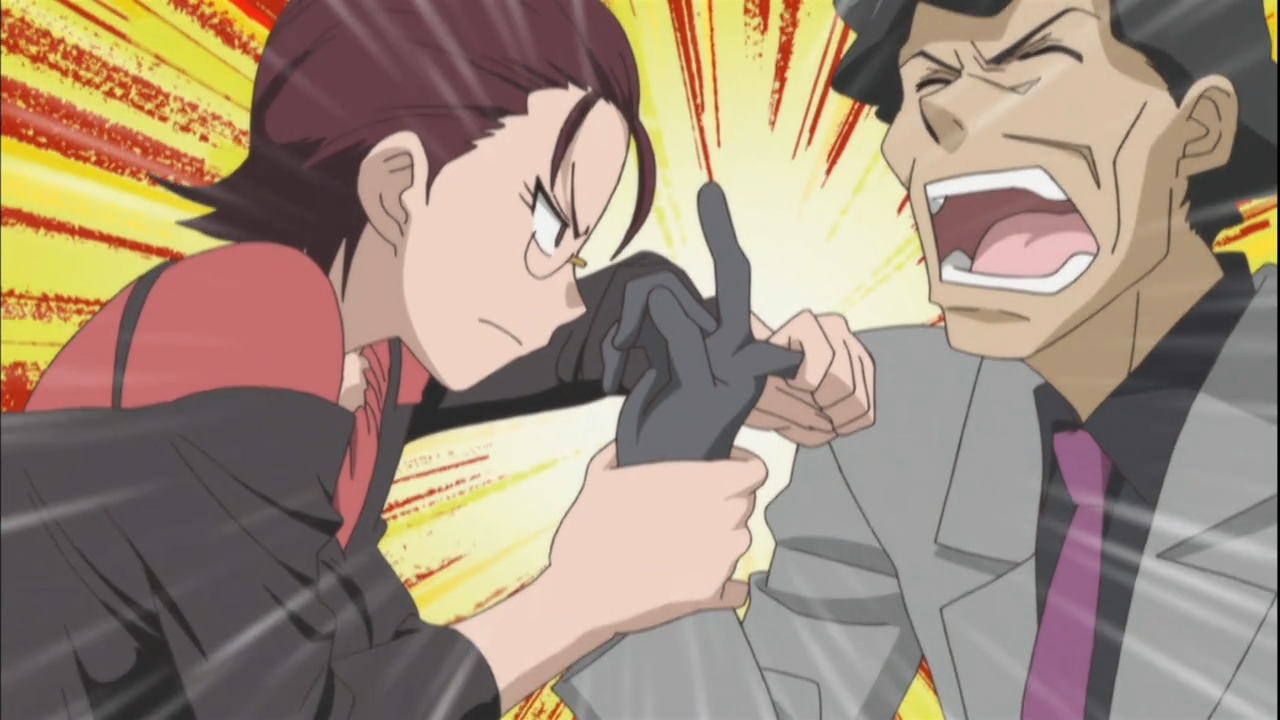
Neither character really added much to the story, however, other than some vague threat that the detective might snoop around and discover something.
• Utao’s clinginess to the brother is starting to hedge into creepy territory.

In the midst of a rescue attempt, she had to stop and pout for her bother’s approval.
• Hibino’s dad tells her that he knows nothing about Kuga’s past nor the recent going-ons of the village, but I doubt that very much.
• Through Kuga’s blurry flashbacks, the episode teases at the possibility of a darker story, but that feels like a far cry from this episode’s banality — yay, Utao is now a part-time waitress at Hibino’s father’s cafe!

Lots of potential in this anime so hopefully it doesn’t dissapoint
Unfortunately, a lull typically follows an anime’s opening episode and, in my opinion, the second episode of Kamisama Dolls is no different. I feel there are some interesting things to notice in this episode, but not enough to make up for the boring “comedy” scenes.
Wow, I find it amazing how you could glean so much meaning even from this ‘lull’… I am stumped.
Don’t get me wrong — the episode was boring. I just don’t understand calling something a god when it’s under human control, especially human will.
Comedy was too out of place for such a show, as was the token romance between HIbino and Kyouhei. Still, it wasn’t terrible as far as exposition goes. If it would’ve focused on an actual conflict for Utao to focus her doll on attempting to fix, rather than prying the door off a car, it would’ve been a bit better.
Everything’s forgiven when it works. Nobody would care that the comedy was out of place had it been funny. Exposition would be fine if we weren’t simply re-using the same tired anime conventions.
Whether or not you find this argument convincing is irrelevant to this post. I brought it up to simply illustrate how debates on the nature of (a Christian) God usually go. We first assume that God is almighty, then we slowly retreat from this precipice until God can hardly be called a god anymore.
What you said there makes sense in English, in a Judeo-Christian context. This is *not* a Judeo-Christian context, and “kami” != Almighty God, Creator of the Universe and All His Hosts. In this case, it’s pretty obvious that we’re supposed to be taking these things as small-k kami, probably some weird techno-variant on yorishiro and shintai. Additionally, the kami dwelling in the shintai seems to be the spirit of the seki herself. Utao should no more be worshipping Kukuri than one ought to stare lovingly into the mirror.
Nietzsche was oft-quoted as saying, “God is dead.” God wasn’t literally dead, but traditional morality, especially Christian morality, was soon becoming the thing of the past.
Let’s hear it for the passive voice, conservator of all innocence! No, Nietzsche and those who followed his line of argument were proposing the destruction, elimination, or negation of pietistic Christian morality. To put it the way you just did removes the moral agency complicit in their assault upon the verities.
In exerting her will, Utao has managed to save three lives so far in the anime. In time, her mastery will allow her to do even more. Essentially, Utao will become God and all it takes is willpower.
As I noted above, she isn’t becoming God, she’s already a kami, or at least, her spirit-in-the-object (shintai) is a kami.
And yeah, there seems to be some serious tonal dissonance going on here – the delinquent detective’s daughter belongs in a different show, perhaps the one where the cast decided that Utao ought to be working in the family cafe. ^_^
What difference does it make, Kami or kami? The point is that individuals are the ones powering these dolls and yet it is instantly assumed that there is an unseen religious spirit — unless we suddenly think Utao is a kami, which I don’t.
I think you’re splitting hairs.
But thanks for reading!
Perhaps he has not read “The Madman.” Whether or not Nietzsche was “proposing the destruction, elimination, or negation of pietistic Christian morality,” it wouldn’t be objectively put forth if he did not state Nietzsche’s quote and exemplified it the way he did. (And I agree with OP on this one.)
@OP: I have never seen the “Kami” versus “kami” spelling, but there are minor deities and more important deities in Japanese traditional religious beliefs: I believe this is what Mitch H. was trying to say. They were not all considered “all-powerful,” at any rate, ranging from “sprites” to the Sun Goddess.
Great review, anyway, sir.